
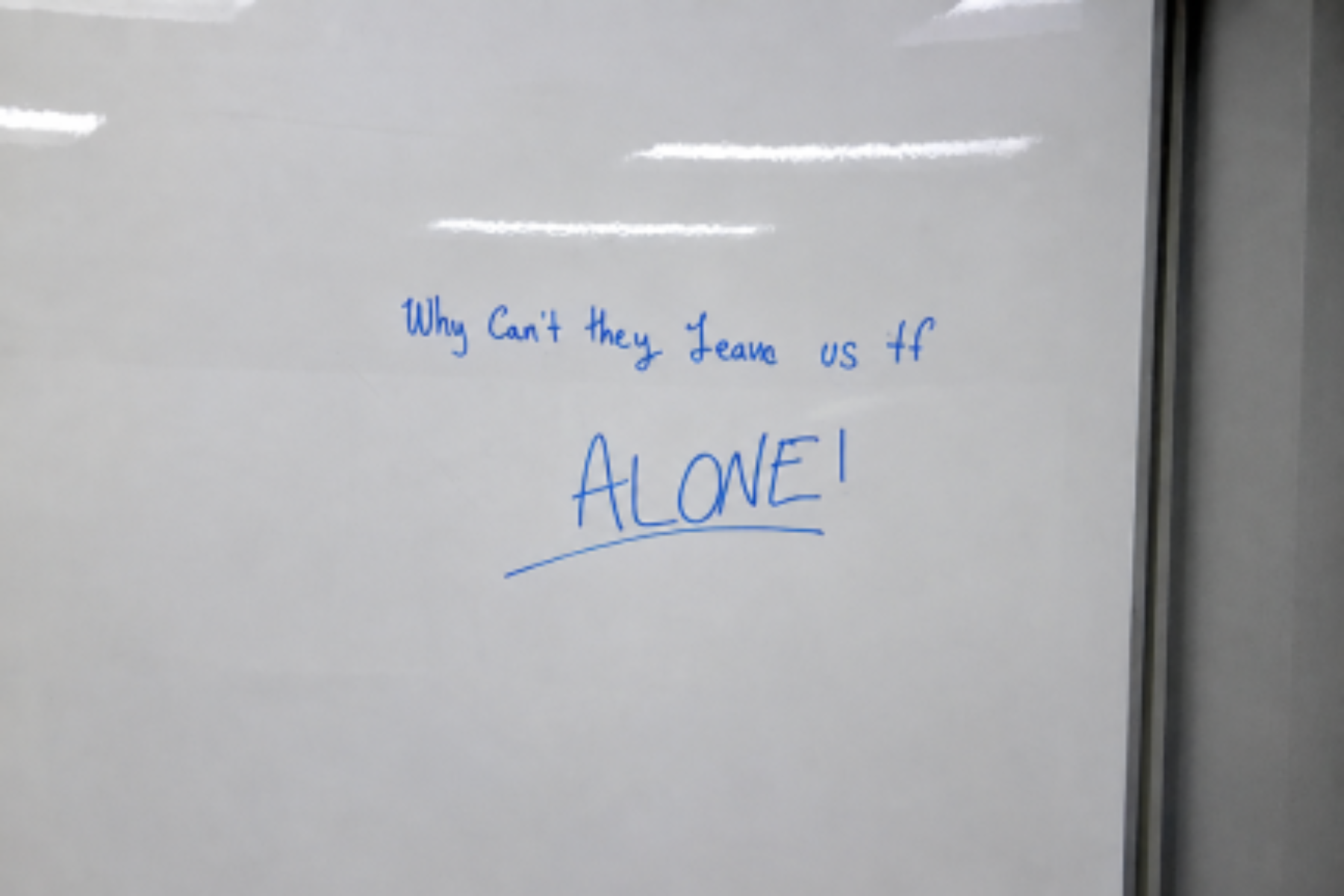
Photo By: Bianca Little
The “bathroom bill” restricting transgender individuals from entering the restrooms of their preferred gender in public buildings continues to affect JCCC students through these seven months of it being in effect.
The bill, which was passed on Feb. 26, 2026, requires Kansas residents to access restrooms, including in government buildings and schools, that align with their sex assigned at birth. Upon its passing, the bill also voided driver’s licenses that listed a preferred gender that did not align with biological sex. Failure to comply with the ruling can result in civil penalties and fines up to $1,000 .
Under Republican leadership, the ruling was passed in a single day through a “gut-and-go” maneuver, a strategy that quickly passes a bill without public notice or hearings. In an interview with a trans man and first year JCCC student, Alexander Skinner shared his thoughts about the bill’s suddenness.
“Based on our current [presidential] administration, it makes sense. The only thing that I guess was surprising was that it got passed so quickly and that it’s not getting enough pushback from other people in government,” said Alexander Skinner, a trans man and first-year student.
Skinner said using public restrooms has always been something to consider.
“Every time you’re going to the restroom, there’s a thought like, ‘which one do I go into?’” Skinner said. “[The bill] doesn’t actually change what I do. It just makes it scarier based on what I think. Because people are gonna react the same either way, it just now adds repercussions.”
About 1% of the U.S. population identifies as transgender, and Kansas is around 0.5%. Many believe that a heightened attention on putting restrictions on trans individuals detracts from a “for the people” mindset.
In a conversation with the Gender and Sexuality Alliance, members and advisor Amanda Glass gave their insights.
“It was passed deliberately in a way that undermines democracy. I don’t think you can really argue that that was for anybody but the minority of people who wanted to pass it and knew that they couldn’t pass it otherwise without being underhanded,” said member Penelope Zung.
“It is for the people that they see are people,” said member Patrick Seagraves. “I believe that it was probably passed in the way that it was so underhandedly because they knew it would not have passed had they been upfront with it.”
“Somebody who really wants to hurt women, they’re not going to stop because of a bathroom. They’re going to keep doing that. You’re just now also hurting trans people,” said member Verity Alexander.
Many want to see more attention on issues that are less highlighted.
“I don’t feel that there should be any need for legislation specifically targeting bodily functions when there are other things that are more pressing, like lack of healthcare, lack of SNAP benefits, lack of funding for WIC,” said member Abi Williams.
The bill has affected many members’ autonomy and attitudes toward the state.
“In my high school, I was told I was not allowed to use the restroom that I aligned with, and it led to medical problems because you have to be able to have these fundamental places to relieve yourself throughout the day,” said member Bugsy Feather.
Feather believes this bill disregards human needs.
“It’s frustrating, and it leads to resentment towards the system, resentment towards the state, wishing to be somewhere else or go somewhere else, and instead of having to fight constantly for my needs to be met, for fundamental basic needs to be met,” said Feather.
The need to avoid public restrooms to avoid inflammatory remarks and opposition from others is heavily felt.
“It is like an ever-present ‘don’t go to the bathroom in public that often. Just wait till you get home because you don’t know who’s in there.’ You don’t know if they’re chill, you don’t know if they are fine, you don’t know if they’ve had a bad day,” said Beatrice Luevano, president of the GSA. “All it takes is one bad day for anyone ever, and suddenly now I will be on the news, and that’s just a fact of life.”
Noted by the volume of anti-trans bills, Kansas has been becoming more and more unsafe for trans and gender nonconforming individuals. GSA serves to connect people to resources. The club provides scholarship opportunities and shares news and information, including gender-neutral bathroom areas on campus.
“I describe it as coming up for air in a system that is pushing you down,” said Feather. “To have a space like this is so important because of that.”
“Even if only one student is in the room, I hope for that one student that this can be a safe place or a safer place. We might be the only place where somebody can wear a skirt, or paint their nails, or can use a pronoun that actually allows them to breathe,” said advisor and professor Amanda Glass. “I cannot underscore enough the importance of the room being available for people to come in and feel safe.”
As the local general election approaches, change is possible by speaking out and voting.
“I think it falls a lot more on us as a public to protest and bring it up,” said Skinner. “The most important thing for like everyone in general, with how awfully we are getting politically, is that at all times, have hope. That may be getting someone elected who is like maybe a little bit better than someone who was awful.”
“If you want policies to change, you can. If you can register to vote, that is a way that you can make sure your voice is heard,” said Glass.
To learn more about GSA and how to get involved, visit its website.





Leave a Reply