
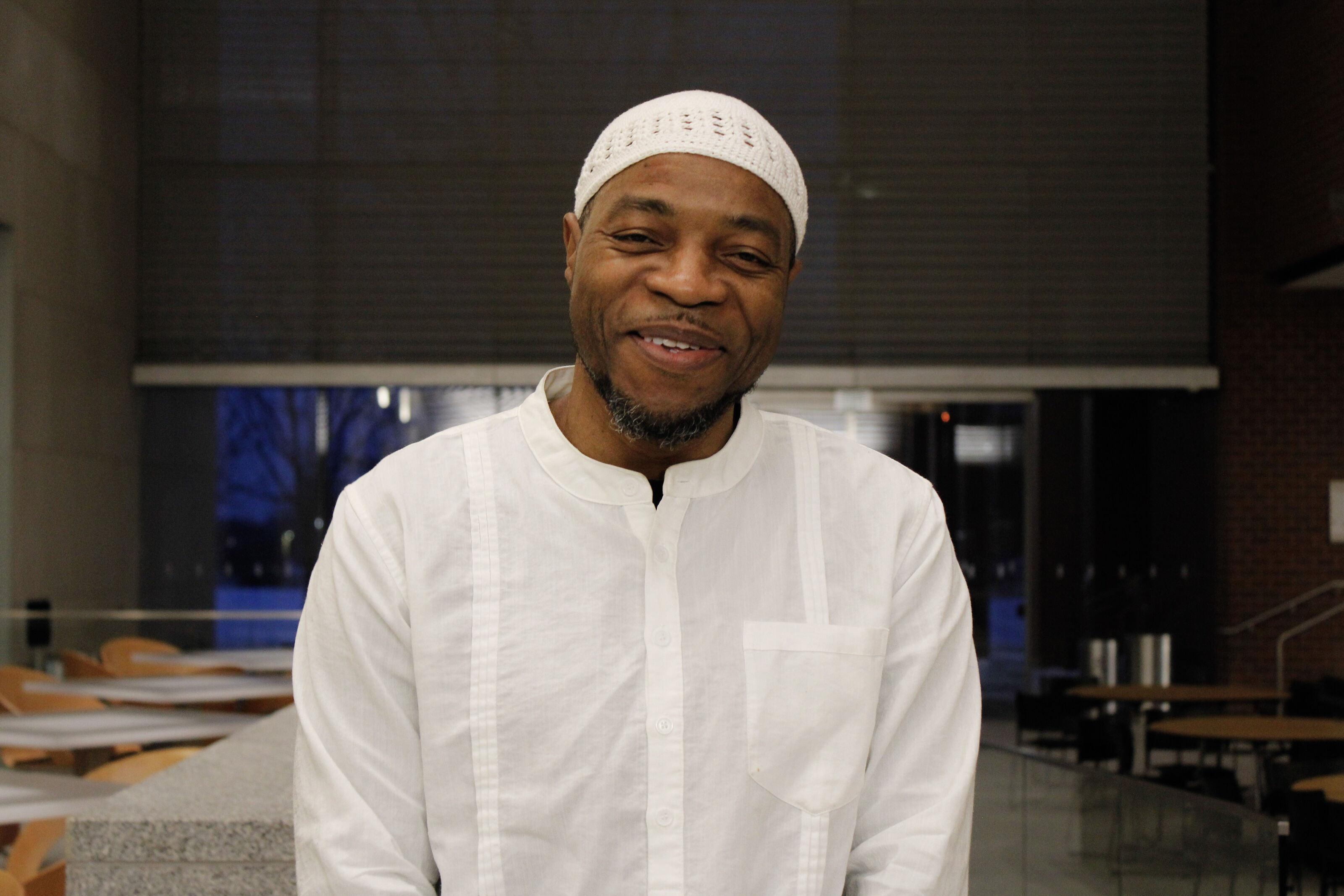
(Photo by: Miranda Sue Philpot)
Art and adversity usually go hand in hand. We often think we have to go through something traumatic for something to be beautiful or looked at as worthy, but one aspect that is often overlooked is hope. Artist Michael Brantley is very familiar with adversity–not only as a black man in America, but as someone who lost the ability to use his talent. Despite this, hope never left him. When asked about his work and what he was trying to convey through it, Brantley had this to say.
“I really didn’t know I was painting history, so people were kinda telling me that my work was teaching them about history,” Brantley said. “I was like, well, that was one of my favorite classes [in school]. But when I started learning history, I started learning about the stories we were taking out of true American history.”
Brantley initially painted pictures that showcased different aspects of the black community, mainly depicting music and art. He spent the first part of his career creating portraits that he would keep for himself. Later, he started framing for the American Jazz Museum, and his jazz pieces began to get picked up. In spite of Brantley’s rising success, unexpected hurdles stood in his path.
“I ended up getting sick with sarcoidosis and [couldn’t] paint for five years,” Brantley said. “I wasn’t even thinking about painting. ‘A Seat at the Table’ and ‘I Am,’ those are two ideas that came to me at that point and time. I was watching what was happening in the streets with all the protests and couldn’t go to the studio and paint.”
Fortunately, he started painting again in 2018. Around that time, Colin Kaepernick was protesting racial and systemic oppression. Brantley put him in a piece at a show with an art group he was with at the Leady. They did the show on what legacy black people left behind.
“At that point in time, it was a protest,” Brantley said. “I did a piece called ‘What is Freedom,’ and it started with Nina Simone. It had Kaepernick in it. It had all these different pieces in it, [and] they ended up taking it out of the show because it had Kaepernick in it.”
Some would call this a setback, but Brantley is no stranger to adversity. To him, this was just another opportunity.
“I took the piece to the studio and then colored [it],” Brantley said. “It turned into something else. But that exhibition in 2018, I did ‘I Am.’ ‘I Am’ is about protest, and that was the most specific… I was looking for an image that showed not just one struggle, but all the struggles that [were] happening.”
Another inspiration for these pieces was the 1968 sanitation worker strike in Memphis. Echol Cole and Robert Walker were two sanitation workers who were crushed by a trash compactor when trying to get out of a heavy rainstorm. On the same day, due to the rain, 22 black sanitation workers working in the sewers were sent home without pay, while their white supervisors stayed and were given pay.
“Well, the garbage trucks killed two sanitation workers, and they started striking, and everybody ignored them. And they were having this fight, and up against the union. That’s when Martin Luther King came down and risked his life for them.”
The iconic phrase “I Am A Man” came from the sign the strikers carried. Brantley explained what this phrase means to him.
“So when I found out that’s actually the reason why [Martin Luther King Jr] went to Tennessee, I said, ‘Well, this picture is more than that.’ Because it’s not saying, ‘Give me a job.’ It’s not saying, ‘Give me peace.’ It’s saying, ‘I’m a man.’ Because that’s what it was about,” Brantley said. “It’s not about a job. It was about being treated fairly, and for him to risk his life and go down there and speak on that–and knowing that that was gonna happen–I thought that piece was actually… it was necessary.”
“A Seat at the Table” is a piece that aims to exhibit the concept of hegemony.
“So hegemony is they do whatever they have to do to make the money,” Brantley said. “And that’s how we end up in this situation because the same people that we think we’re fighting against, [we are] actually fueling. Our 401(k)s are paying for the prison-industrial complex. See what I’m saying? …It’s weird. I don’t want to sound like Kanye West, but the bondage is ours. It’s willful consent. So that’s what I’m trying to say in the piece. I’m not really trying to talk to anyone. It’s just, no one’s saying it. And I’m putting it where I don’t control the conversation.”
This piece was meticulously detailed, even when it comes to the hairstyles that were typically banned in that era. The man in the front of the painting is inspired by none other than Brantley himself.
“The man represents [the] hip-hop generation,” Brantley said. “He represents me. I was the artist. I mean, I was the rapper who wanted to speak the truth. And I look at the artists who were speaking the truth and how they quiet down, and they got rich. So, he represents the artist who covers his mouth.”
But the piece is not solely about the past, like some might think; the piece is generational. Even with the types of paint Brantley used, oil and acrylic, is meant to show how taking two things that may not mix together perfectly can still be cohesive.
“With that piece, I was showing how they don’t like you to use black and art, and I directly use black, just ’cause I understand it,” Brantley said. “They say, ‘Why are you putting black in a piece?’ And what I realize is the reason why it doesn’t harmonize with other pieces–because you have to, if you wanna use all these colors and not use black, take the colors that you use and add a little black to it. Just a little pinch. It’s even with white; just add a little paint to it, and it’ll take all that away. So, in that piece, I have [an] acrylic, I have oil. [In] some places, you can’t put acrylic in oil. So I’m showing how I can take two different things and [use them] together.”
It’s hard for artists to be unable to create, especially when it’s out of their control. Brantley learned this when he was diagnosed with sarcoidosis.
“I got a hard lesson,” Brantley said. “The sickness I had, you couldn’t see it. So I’m just losing weight, and I’m hurting 24 hours a day, and no one can see it, no one can feel it.”
Despite this, Brantley kept his studio.
“Everybody told me to get rid of it. Couldn’t go to it,” Brantley said. “I made sure I maintained the studio. And when I got out [of] that, I wasn’t thinking about painting. I was thinking about getting back into the world.”
But Brantley didn’t give up. Across the hall from his studio was a class for people with learning disabilities. Disabled people are often overlooked and are a group many people don’t understand or treat with respect, even when it comes to those with disabilities that aren’t visible. But being around others who related to him helped him through that dark period in his life.
“Across the hall from me, they had–I forget the name of the organization–and they were helping people [with] learning disabilities, like, they were helping them through art,” Brantley said. “Those were the only people I saw. You kind of bond and help each other. So they kind of grabbed me and pulled me out of that. And it was something that was good, ’cause I was able to get comfortable back in my studio.”
As far as how his art has affected those here at JCCC, Sheila Njiru has some personal insight as an artist and a student.
“Through my time researching and learning about Michael Brantley, I found the most inspiration through his story as an artist. Brantley has overcome adversities that some may believe define you and your ability to pursue what you love; however, Michael Brantley continued to make art,” Njiru said. “Especially as a college student, I am constantly reminded that time is ticking and I need to rush to make sense of my future, with many struggles momentarily halting some of my dreams or goals I had set for myself. While my obstacles as a college student mirror or reflect the path of Brantley, he serves as an exceptional example of success after much endurance and drive to chase one’s dreams.”
Michael Brantley currently has an exhibit up in the Nerman Museum of Contemporary Art on JCCC’s campus, and it will be showcased until May 3 of this year. If there’s one thing you’ll get out of this exhibit, it’s that hope is more than just a feeling–it’s a mindset.



Leave a Reply