
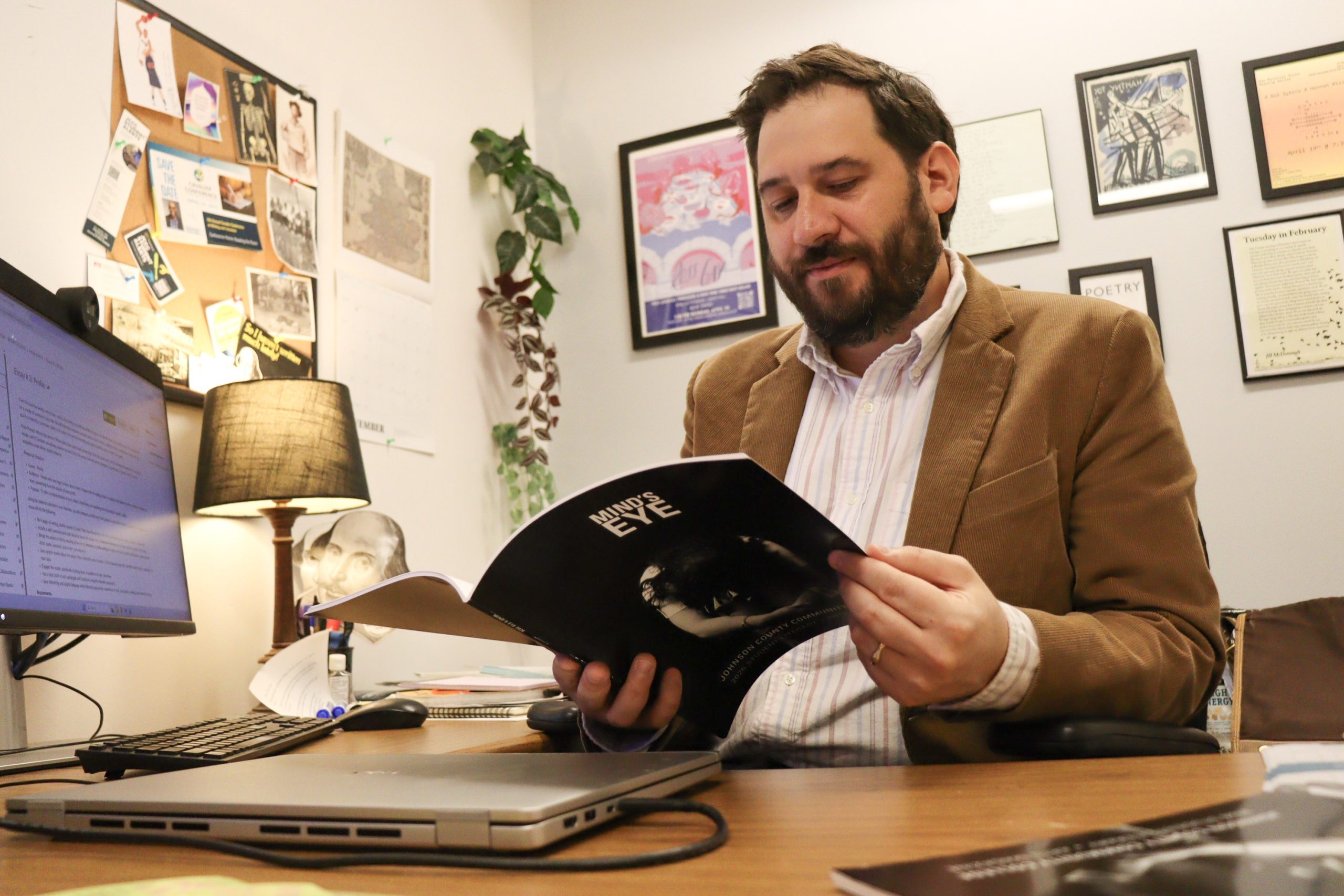
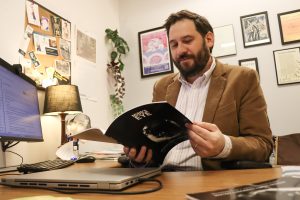
Professor Bob Sykora reads past renditions of the Mind’s Eye magazine on November 13 2026. Sykora is the head of the Mind’s Eye literary magazine, a student-run literary and arts magazine here at JCCC. Photo By: Caleb Jeong.
It usually starts in a notebook tucked away somewhere, full of poems, stories or sketches nobody else has seen. Eventually, though, a lot of writers and artists start to wonder what it would feel like to let someone else see it.
At Johnson County Community College, Mind’s Eye offers students an opportunity to take that work off the page and into print. The college’s annual literary and arts magazine pulls together creative pieces from students across disciplines, giving writers and artists a place to share what they’ve been working on and a first real taste of the publication process.
Bob Sykora, who teaches creative writing at JCCC and helps put the magazine together each year, keeps its purpose simple. For him, Mind’s Eye is a chance to prove there’s a lot more creativity on campus than people might realize.
“It’s just a way to kind of showcase that we have students working on cool stuff here,” Sykora said.
It’s also a way to help students take a step that can feel intimidating. Moving from writing privately to putting work out into the world doesn’t come with a guidebook, and the magazine gives students a place to start.
“There’s not always good instructions on how that happens,” Sykora said. “This is like a very early in your career, writing career, your art career, kind of example of what the publication process could look like.”
Beyond seeing their name in print, students get a taste of what working writers and artists go through. Contributors write a biography, think about how readers might interpret their work and then send it off without knowing whether it will be picked.
Mind’s Eye is open to just about any kind of creative work, from fiction and creative nonfiction to one-act plays and poetry, along with photography and visual art. Students working in other mediums, like sculpture, can submit photographs of their pieces. The limits are few and far between, though Sykora recalled one submission that just couldn’t work in print: a PowerPoint.
Any JCCC student can submit, no matter their program of study or how many classes they’re taking. Pieces written for class are welcome, and so are the projects students work on in their free time, as long as they’re recent. One student once sent in something from high school, and Sykora’s reaction was simple.
“You’ve done things since then, I promise,” Sykora said.
Longer fiction and creative nonfiction pieces max out at 5,000 words, though Sykora recommends aiming closer to 3,000. Students can submit up to three pieces of any kind.
For students more drawn to the other side of the process, there’s a place for them, too. Each year, Sykora puts together an editorial team that reads through the submissions and decides which pieces make it into the magazine. Anyone interested in joining can reach out to him directly.
Beyond giving students an outlet for their own work, Sykora hopes Mind’s Eye can bring together creative students who might otherwise never cross paths. As a commuter campus, JCCC is full of people with different interests and academic goals, but those communities don’t always get the chance to connect.
“Sometimes we just miss out on how many people are doing things,” Sykora said.
Creative students are spread all over campus, from the arts to entirely different fields of study. The magazine gives them one shared space to see what their peers have been making, no matter what they’re majoring in.
Because Mind’s Eye is published only in print, contributors also walk away with something they can actually hold on to. Past editions are kept in the college archives, so students can revisit their published work years down the road. Archive staff recently told Sykora about someone from the 1980s who called looking for a poem they’d published, and the archive still had it.
Last spring, the magazine also held its first launch event, where students read their published work aloud. Sykora hopes to bring it back so contributors can celebrate together in person again.
As he looks ahead to the upcoming issue, Sykora said he’s most excited about work that surprises him, both in what it’s about and how it’s done. He’s also hoping to hear from students outside his creative writing classes, like someone working toward a biology degree who has a creative project on the side.
“I’m always excited about things like that,” Sykora said.
For Sykora, Mind’s Eye is ultimately a reminder that creative work is happening all over the college and a place for students to share it.
How to submit
Students can email up to three pieces as attached documents to Sykora at [email protected]. Along with their work, students should include their name and student ID, their mailing address and a two- to three-sentence biography. The deadline to submit is Tuesday, Dec. 1.
Leave a Reply