
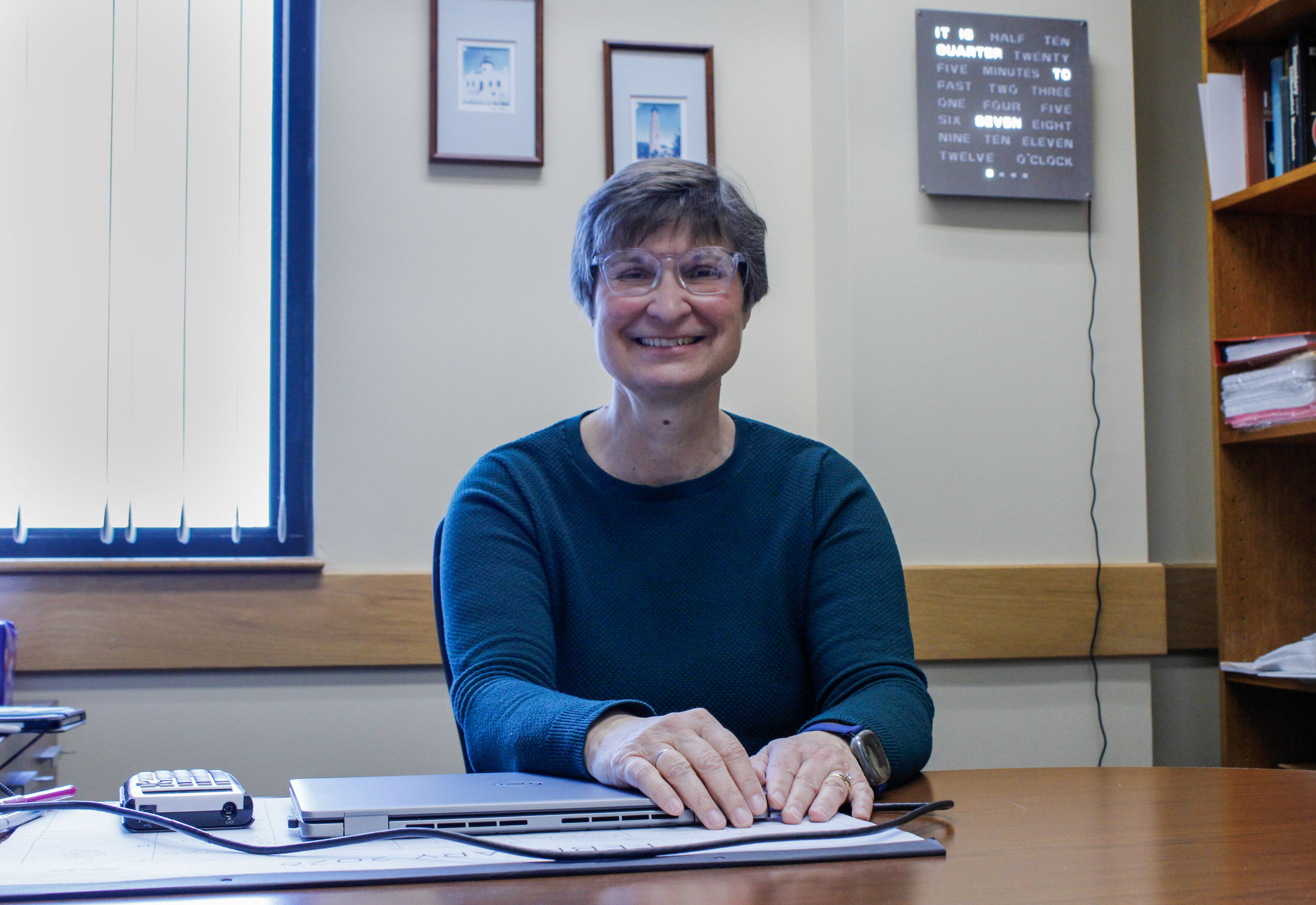
(Photo by: Miranda Sue Philpot)
Imagine you’re sitting in your fifth-grade math class learning about fractions, and all of a sudden, everything just clicks. This may not be the case for everyone, but for Professor Theresa McChesney, this was the reality.
“First of all, I love numbers, but that is when I said, ‘Oh, no, this is my love,’ because I liked a whole lot of other things before. I like science. I like health and nursing and all these other different things. But in fifth grade. I’m like, ‘This is really cool. This is it.’ And [it was] fractions that turned me on [to it],” McChesney said.
McChesney’s plans weren’t originally to be a teacher. All she knew was that she loved math.
“So when I graduated [high school], I went for math. I didn’t know I was going to be a teacher at all. But I went for math because all I knew was that I loved math, and when I finished my bachelor’s degree, I’m like, ‘I still love math. So let me go and get a graduate degree.’ So I went as far as my master’s,” McChesney said.
Before becoming a full-time professor at JCCC in 2004, McChesney spent five years working in business and taught part-time for 16 years.
“I worked as a technical consultant in a communications firm. And what I did there is I designed corporate networks. And so I used a ton of network design and probability, call pattern probabilities. And so, I like that part, too. and probabilities,” McChesney said. “But then I kind of missed doing more math, and so then I went into teaching, which I was qualified for.”
Chair and Associate Professor of Mathematics Rob Grondahl told The Messenger that working with McChesney is energizing and that she is always very helpful, encouraging and caring.
“She is always excited to do the work needed to make the department and the college better,” Grondahl said. “She comes to the table with great ideas, but also has an open mind and listens to others.”
He also explained that there are too many things McChesney has contributed, too many things to the math department to list.
“In the recent past, she has written our program review and represented us at Ed Affairs. Most recently, she helped develop our new Contemporary Math course.”
This new Contemporary Math course, called Math Pathways, is McChesney’s newfound passion.
“Every student, depending upon what their major is, is going to pick a different math class that is going to qualify for their degree. Because every educated student, everyone who is gonna get a college education, should have a math class because math class is part of an overall education,” McChesney said.
She explains that in this course, students should take a math class that’s going to be useful for their major. The college algebra pathway is good for those students who need it for their coursework, like those who are majoring in science, math, biology or engineering. Majors like social sciences, anthropology or psychology need math courses like statistics, called elementary statistics. For majors like English, journalism, and history, they don’t necessarily need math courses for their majors, but more for their lives.
“And so we call that contemporary math, and in contemporary math, we study things like logic, probability, and both of those topics help people make decisions. And so, those are good decision-making topics for their life. And then we have another topic called consumer finance. That’s important for your life too, because we talk about buying a car, buying a house, credit cards.”
McChesney loves what she does and wants to continue helping students realize that there is more to math than just finding a solution.
“I get students who come into my class, and they’re not STEM students, and some of them, maybe even more than half, most of them don’t have a good relationship with math,” McChesney said. “They don’t think they like math, they don’t think they like algebra. But we teach this course without algebra, so it’s a non-algebra course. But it’s all math, it’s true math. You just don’t solve for x. So what do I like about it? I like showing students that math is more than just solving for x.”









Leave a Reply