
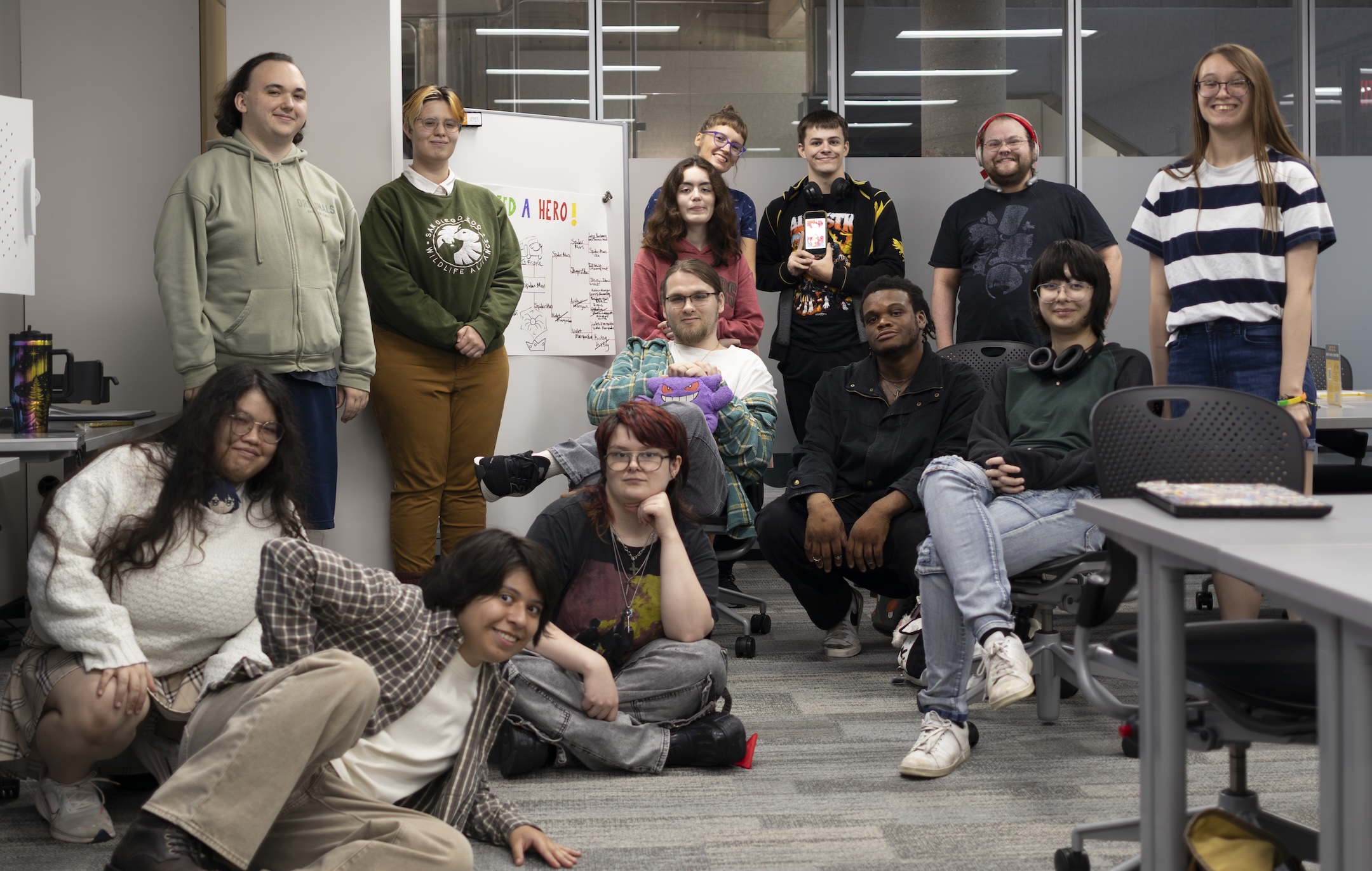
Creative Writing Club members gather for a group photo following their last Wednesday meeting in September. Photo By: Nathan Schweiger
For students who want to write without the pressure of grades or assignments, JCCC’s Creative Writing Club offers a space to create work and share ideas alongside other writers.
The club is open to anyone interested in writing, whether they have been working on a novel for years or are just starting out. Meetings give members time to work on their own projects and receive feedback from their peers. For those looking for a creative outlet outside the classroom, the club also provides a place to connect with others who share that interest.
Marianne Kunkel, the club’s faculty adviser, said in an email that attendance has grown from about six or seven students when the club began to more than 20 at recent meetings.
“It’s such a low-stakes opportunity for students to gather outside of a creative writing classroom and just talk about the types of writing they’re reading, thinking about and creating,” Kunkel wrote.
Meetings typically begin with a writing prompt before moving into a larger activity. Students can share their work and receive feedback, but sharing is not required.
Responding to questions by email, student officer Lysander McDonald said activities can range from additional writing prompts and collaborative stories to brackets centered on books and writing. Some activities encourage students to experiment with different styles, while others give members a chance to talk about their favorite books and writing ideas in a more casual setting.
“We always offer time to share and give feedback,” McDonald wrote.
The club also makes room for more playful activities. Members have taken part in brackets on literary villains and writing tropes and brought original characters to a show-and-tell. They have also played a written version of the telephone game and rewritten scenes in entirely different genres.
One activity involved rewriting a scene from “The Lord of the Rings” as a romance.
Patrick Seagraves, another student officer, came up with one of the club’s larger weekly activities last semester. He wrote a fake advertisement and removed key words from it for a fill-in-the-blank game, then blanked out the rest of the document so members had no idea what they were filling in.
“It ended up being a very enjoyable time,” Seagraves wrote.
The activities also give students a chance to interact with each other beyond their writing.
McDonald said some students attend because they are already writers or want to write more, while others may be looking for friends with similar interests. McDonald added that several students who joined this semester have kept coming back.
Kunkel said the club has become a supportive place for students who are drawn to building fictional worlds and developing characters or who simply enjoy playing with language, one that “operates much more like a community of like-minded creatives than a class.”
JCCC previously had a Creative Writing Club that eventually became defunct, according to Seagraves. He said he learned about an effort to revive it from Chris Patch, the WRC coordinator, who was collecting signatures on petition sheets.
For Seagraves, the benefits of the club extend beyond receiving feedback on his writing.
“Writing on my own tends to get me stuck in my own head all the time,” Seagraves wrote. “When I’m in the creative writing club space, I feel a sense of clarity that helps me really just get stuff out.”
Seagraves credits feedback from other members with helping him catch things he had not considered and find holes in his writing, and he has found the responses to be supportive whenever he shares his work.
“The club is definitely for people who just want to write for fun even if they have no aspirations of publishing or making money off their writing,” McDonald wrote.
Kunkel said she hopes students who think they do not like creative writing will keep looking for forms of writing that connect with them. Creative writing, in Kunkel’s view, offers both a way to encounter experiences different from one’s own and a way to recognize one’s own experiences in the work of others.
Without the structure of a traditional class, the club’s activities and discussions still give students opportunities to receive feedback on their work and connect with other writers.
Sometimes the biggest difference for Seagraves is simply being around other people who are creating.
“I feel accomplished because I was in a space with others who were working on their own things with me,” Seagraves wrote, “even if not directly collaborating.”
The Creative Writing Club meets from noon to 2 p.m. on Wednesdays in LIB 105A. Students can find upcoming meetings through JCCC’s event calendar.






Leave a Reply