Art-Related Careers

On Nov. 1, 2023, the Nerman Museum hosted a Young Artists Retreat, aimed at high school seniors, to allow them to learn more about careers in the arts. Below is the Art-Related Careers overview information shared in their programs. Download this list in PDF format.

Art-related Careers

Independent Artists:

  • Artist: uses diverse mediums to create works such as sculptures, paintings, murals, installations and photographs. Artists who are working full-time professionally often have a studio team.
  • Studio assistant or manager: works with artists to successfully plan and create works, logistical aspects of sending artworks to clients, administrative responsibilities.

Museum and Non-profit Arts Organization Roles:

  • Director: provides the leadership and vision for the institution, strategic planning, fundraising and overseeing both internal and external affairs. Some directors also work as/with curators.
  • Curator: responsible for putting together exhibitions, through researching and selecting works that speak to each other through some sort of common thread. In the institutional setting, this may involve working with exhibition designers, collection managers and the interpretation team among others. Many exhibitions take years to pull together.
  • Exhibition Designer: helps curators and artists bring their vision to life in the complex setting of museum and gallery installations.
  • Preparator: works with exhibition designers to build and install exhibitions and collections.
  • Learning & Engagement: focuses on using art as a medium for learning—not only about topics related to a classroom curriculum, but also to better understand the world.
  • Marketing & Communications: collaborates with artists, designers, educators and administrators to share information about art exhibitions, programs and events.
  • Interpretation: creates resources that help audiences understand and connect with the art, often in collaboration with curators, educators and independent writers.
  • Programs: works with artists, administrators and others to develop and implement programming that relates to art exhibitions.
  • Registration & Collections Management: ensures the safety and care of the art collection, managing loans of artworks, conservation efforts, storage and information about the collection.
  • Development: spearheads donor relations and fundraising for the institution which can include managing programs and travel associated with donor events and financial management.
  • Archives/Library: many institutions have a research library or archive that may be digitally available that serves as a resource for artists, curators, educators and students.
  • Visitor or Guest Services: works with front-of-house staff to ensure visitors feel welcome.

Gallerists and Independent Curators:

  • Gallerist or Curator: responsible for putting together exhibitions, through researching and selecting works that speak to each other through some sort of common thread.
  • Art Dealer: acts as an intermediary between buyers and sellers but may not have a gallery or curatorial role.
  • Auction Houses: major art auction houses are an important part of the art market, and there are various roles involved in valuation, appraisal and selling of artworks.

Higher Education:

  • Professor: teaches fine arts or studio arts at the college level. Most professors have a Ph.D. or terminal degree (MFA) in their subject area.

Independent Contractors:

  • Writer: bring the world to life through words—be it in poetry, essays, journals or other outlets and writing styles.
  • Installation and art handling: many art handlers work with museums, galleries or private collectors to move and install works safely, which may involve assisting with shipping artworks.
  • Photography: artists and institutions often work with professional photographers to get good images of their artwork.
  • Web design: artists and institutions often work with professional web designers to create engaging platforms for their content.
  • Conservator: highly specialized, conservators typically have in-depth knowledge about a particular type of media (textiles, painting, etc.) and have some scientific background also.

Commercial Arts: There are many opportunities to use art skills and experience in the commercial sector, whether it be for a particular company or as an independent contractor or businessperson. Below is a list of just a few of the many fields available. Most require specialized training and education.

  • Fashion design
  • Graphic design
  • Industrial design
  • Illustration
  • Animation
  • Architecture
  • Interior design
  • Printmaking
  • Set and costume design
  • Filmmaking

Nick Cave receives 2023 Race, Place & Diversity Award

Nick Cave, artist, received the Kansas City Friends of Alvin Ailey 2023 Race, Place & Diversity (RPD) Award on Nov. 4, 2023. RPD gives out this award to individuals and organizations that further diversity and equity in their communities.

The Nerman Museum has two of Cave’s Soundsuits in its permanent collection, one of which was last on view during the museum’s Adorned exhibition.

Nick Cave (Left), Soundsuit, 2005, Mixed media, (Right) Nick Cave, Soundsuit, 2011, Mixed media, Collection Nerman Museum of Contemporary Art, Gift of Marti and Tony Oppenheimer and the Oppenheimer Brothers Foundation


American Infamy – Roger Shimomura

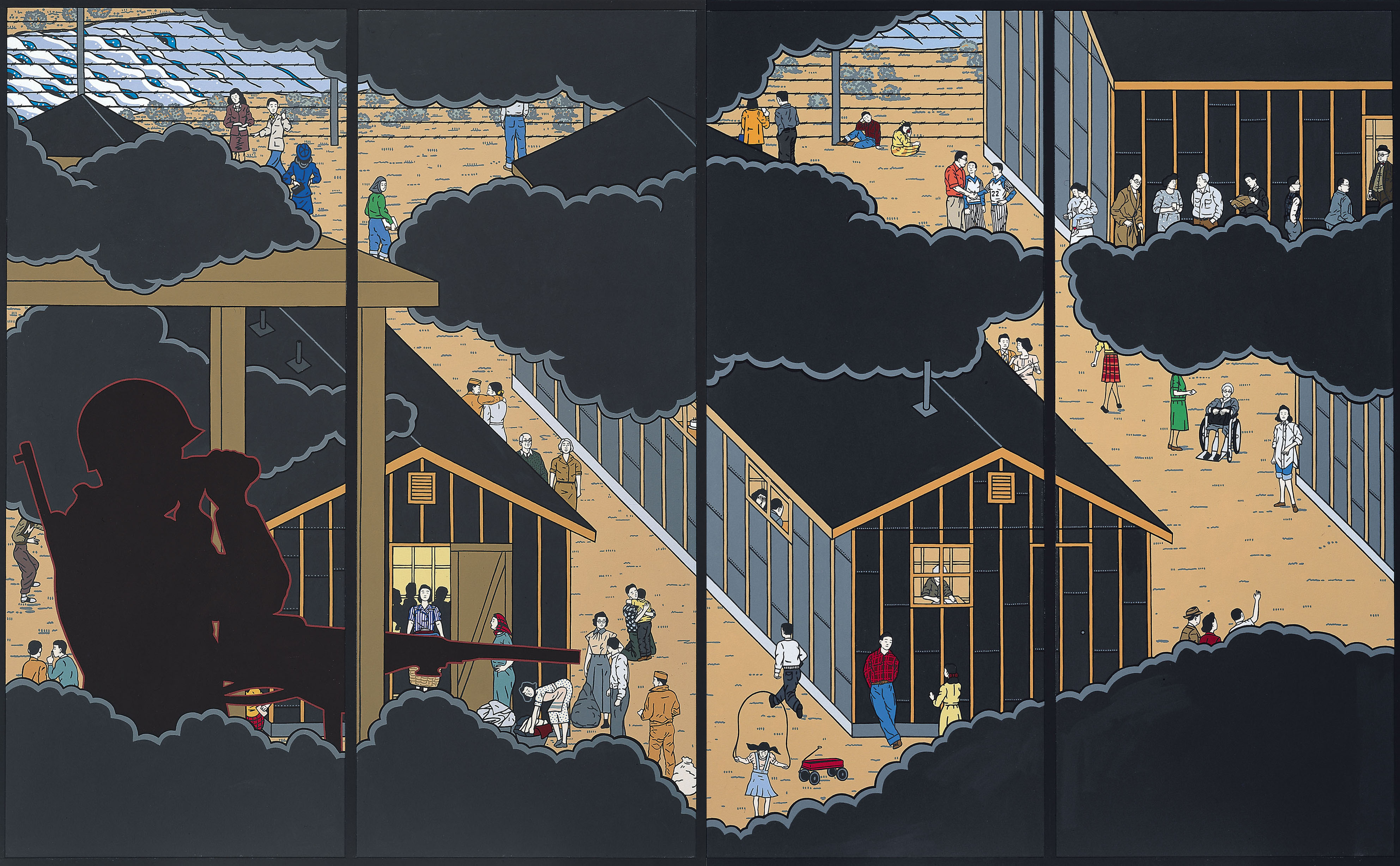
Roger Shimomura, American Infamy, 2006, Acrylic on canvas panels, 61.62 x 100.5″, Collection Nerman Museum of Contemporary Art, 2006.15, Acquired with funds provided by JCCC and Marti and Tony Oppenheimer and the Oppenheimer Brothers Foundation

During World War II, the United States government placed into incarceration camps some 110,000 Japanese Americans living along the West Coast. Among them was the Seattle-born Roger Shimomura, whose earliest childhood memories were formed in the Minidoka concentration camp in southern Idaho, where he was sent with his family. Since the late 1970s Shimomura has made hundreds of paintings and prints reflecting on his experience of incarceration, working in a flat, cool style influenced by both American pop art and Japanese ukiyo-e woodblock prints. American Infamy, from Shimomura’s Minidoka on My Mind series, presents a wide-angle view of the incarceration camp, spread across four vertical panels like a Japanese folding screen and viewed from a traditional Japanese bird’s-eye perspective, as if to emphasize the government’s conception of the incarcerees as essentially Japanese despite their American ways and citizenship. The composition offers numerous colorful glimpses of daily life in the camp, including women doing laundry, a girl jumping rope and people lined up outside the bathroom. These are overshadowed, however, by the ominous black silhouette of an armed guard wielding binoculars at the left, and by the dark clouds that obscure the composition’s base and several parts of the scene above, clearly signaling Shimomura’s critical view of this unjust incarceration.

Roger Shimomura earned his BA from the University of Washington in 1961 and his MFA from Syracuse University in 1969. Shimomura is also a respected printmaker, and JCCC owns several of his prints which are on view in the Carlsen Center’s Works on Paper focus area.

— David Cateforis, 2012
Galileo’s Garden Noon at the Nerman Presentation

The Nerman Museum, alongside Johnson County Community College’s Art History department , hosts the Noon At The Nerman series. Noon at the Nerman is a weekly interdisciplinary program examining works of art on view at the Nerman Museum of Contemporary Art or on campus. Students and staff gather at the museum or at other locations around the campus on select Wednesdays at noon, then go to a specific artwork to hear a JCCC  faculty or staff member speak briefly on that work of art.

Listen to Doug Patterson’s Noon at the Nerman Presentation about Dale Eldred’s Galileo’s Garden.

During the talk about, Dr. Patterson’s referenced Prof. Paul Tebbe’s work with the analemma. Since then, they have uncovered a video Prof. Tebbe’s public talk demonstrating the analemma and the overlay he and his students made for the sculpture.

Information on this post was adapted from JCCC’s Astronomy blog.

About Roger Shimomura

Roger Shimomura, American Infamy, 2006, Acrylic on canvas panels, 61.62 x 100.5″, Collection Nerman Museum of Contemporary Art, Acquired with funds provided by JCCC and Marti and Tony Oppenheimer and the Oppenheimer Brothers Foundation
Read more about American Infamy


  • American, b. 1939 in Seattle, Washington
  • Lives and works in Lawrence, Kansas
  • BA from the University of Washington in 1961; MFA degree from Syracuse University


BIOGRAPHY

Roger Shimomura, 2003, Housing Discrimination, acrylic on canvas

Shimomura was born in Seattle’s Central District. His first few years were spent interned with his family at the Puyallup State Fairgrounds while permanent camps were being built by the U.S. government. Soon he and his family moved to Camp Minidoka in southern Idaho. His father was told by administrators to seek employment outside the Western coast, and so the family settled briefly in South Chicago. After the war ended, the Shimomura family was permitted to return to Seattle, where Shimomura developed his interest in art.  He served in the U.S. Army two years as an artillery officer in Korea, then moved to New York where he worked as a graphic designer. He taught at the University of Kansas beginning in 1969, and he was designated a University Distinguished Professor in 1994, the first so honored in the history of the School of Fine Arts. His work is represented in the permanent collections of over 85 museums nationwide. A past winner of the Kansas Governor’s Arts Award, in 2008, he was designated the first Kansas Master Artist and was honored by the Asian American Arts Alliance, N.Y.C. as “Exceptional People in Fashion, Food & the Arts.” His personal papers and letters are being collected by the Archives of American Art, Smithsonian Institution in Washington, DC.

Roger Shimomura, 1978, Minidoka No. 3 (Diary), acrylic on canvas, Spencer Museum of Art, KU


Andrew McIlvaine: Resilience Story – Reach through walls (poem)

Reach through walls

Mira, I want to show you something.
Let me tell you why you wear that sheathing.
Why you’re so hard to reach.
Why you weigh so much,
And it feels so hard to leave.

I know that you hear me speak,
I know that you feel me breathe.
I know that same feeling,
That one, where you feel unseen.

Sometimes I want to run,
But my feet feel like concrete.

Sometimes my mind feels so weak
And weeks go by
Before I find a new routine.

I remember being thirteen
Thinking I was unclean.

Like no matter how much
I scrubbed my skin,
The stain of generational pain,
Generations longing
For anything but the same,
Just wouldn’t leave my brain.

Old fate on repeat,
Like passing trains.
Stuck in a loop
A circle of blame.P

I hope I’m healing.
I tell my myself,
As the tears form
And begin to rain.

I hope these sacrifices are worth the gain.
I reach out to the ancestors
To voice my shame
Knowing they may be able to help,
But they’re too far away.

So, I turn to the images
That flow through my veins.
The ones that may help me explain
Why this shadow,
This reflection
is one and the same.

Mira, open your eyes,
I hear you say.
I believe you can move through walls
Try to break the chain.

— Andrew Mcilvaine

Andrew Mcilvaine: Resilience Story – Terms and Definitions

Xicalcoliuqui (stepped fret/twisted gourd) – a symbol of movement between the visible life and invisible world where reality sits on the other side of the liminal realm. This can be interpreted as a threshold or portal, which unites the earth and the sky, humans, and the gods. It is a very spiritual symbol that can be seen attached to the façade of archeological sites and pottery in central and south America, extending itself from myth to the physical world. Since it is a symbol attached to the gods, it holds divinity power, and ceremonial/ritualistically it becomes very significant in conveying hereditary authority passed down from a dynastic lineage. This symbol also represents unity/balance through its geometric orientation, reflecting itself with a mirrored image. Some interpret it as a symbol of sacred direction, a road we must travel after death. A road called the milky way river of life. A path that must be traveled in-order to achieve another life, through rebirth.

Axis Mundi – is a line or stem through the earths center, which connects the surface to the underworld and the heavens above. This is the point around which the universe revolves. In Mexica culture as well as dating back to the maya, Toltec, and olmec, the horizon line was seen as the meeting place of the heavens and earth. A place where knowledge could be echanged from one place to another, hints the reason why complexes like Chichen itza, and Teotihuacan were created. It was to watch over or observe the boundary line, also why these spaces are associated with sacrifice.

Quiquiztli (conch shell) – associated with the feathered serpent and God of wind, Quetzalcoatl. This symbol can be connected to fertility, war, sacrifice. The conch shell offering was dedicated to Tlaloc, the god of rain, water, lightening and agriculture. The conch was also an instrument, a trumpet, whose sound was associated with the breath of life, as well as rhythms of the sea. Also, the conch becomes a symbol of perfect harmony/balance as it holds the golden ratio in it geometric shape.

Atl (water) – Is the day symbol that means water. It is associated with Xiuhtecuhtli, the god of fire, as well as Chalchiuhtlicue the water diety. Atl is also associated with life, creation, and battle, or holy war. Something that is both external and internal. It is part of the word At-ltlachinolli or burnt water/scorched earth. Water is often attached to the idea of cleansing. Water also symbolizes movement, and is an essential part of traditional ofrendas, alongside earth, fire, and wind, the cardinal directions of life. Lastly water was a way to connect with the spiritual world through reflection. In fact, Teotihuacan the ancient complex that sits just right outside present Mexico City has mirror ponds that were used to map the stars above.

Guadalupe (the mother) – Guadalupe comes into play in Mexico in 1531, through the miracle that Juan Diego witnesses in the hills right outside present-day Mexico City. She approached him to ask the bishop to build a shrine of her there, so that the indigenous peoples would be baptized and converted to Catholicism. She promised that she would bless anyone with good fortune that called to her. She is often seen as the second mother of Mexico and the Mestizo race outside of La Malinche, the indigenous partner of Hernan Cortez, or Spanish conquistador who conquered the Mexica of Tenochtitlan. Guadalupe is associated with the rose.

Chain-link Fence – spiritually, the chain-link fence is associated with a barrier between two states of consciousness. Chains can mean weight, confinement, limitation, and isolation, or imprisonment. Whereas a link is a symbol of connection or a relationship to another person, or place. Dreaming of chain link fences can refer to feelings of guilt or anger and can signify a message from the spiritual realm that there’s a barrier that needs to be overcome or journey that awaits. Chain link fences are also woven structures, pieces of metal that are intertwined and connected. In fact, Charles Barnard who invented the chain link fence in 1844 was a cloth manufacturer and based the invention on the same machines that fabricated cloths. Chain-link fences were also the first type of fences that were used to separate the U.S. from Mexico were made up of roughly 700 miles of chain-link fence and barbed wire.

Paño (fabric) – Paños are traditional Mexican and Mexican American prison works of art typically drawn with ballpoint pen on fabric. These images often infuse symbols that are connected to both indigenous and non-indigenous life. Usually, these works have a religious undertone to them, and discuss ideas of falling from grace, and redemption. They also include Chicano imagery like lowriders, chains, and popular culture symbols like Nike, mickey mouse, etc. These types of artworks can be traced back to the 1920’s and 30’s, when mass imprisonments of Mexicans started to occur due to Anglo-Americans thinking that there was an invasion or attempt to strip white men jobs. This was of course just a continuation of the propaganda that was pushed by the American government that goes as far back as 1846-48. These types of works were originally created to communicate to loved ones the location and whereabouts they were being held, due to rapidness of most immigrants and non-immigrants being thrown into jail. Usually, these messages were written or drawn on clothing and bedding, and smuggled, or mailed out of the prison. They’re a symbol of love and longing.

Milagros (miracles) – Milagros are essentially miracles or charms that can be purchased. They are often used as gifts for protection. They are connected to good health and or good fortune. They can be used for ritualistic and divine purposes through devotion. Each miracle symbolizes a specific hope, or prayer. These votive folk figurines are made of silver or tin, and can be seen attached to ofrendas, altars, or shrines. Traditionally they were purchased through the church, but now they can be found in stores and sold by street vendors. Although they are commonly found in Mexico and Southern United States, they come from Spain and entered the Americas through the Conquest of Mexico. Because they are seen to hold mystical or magical powers, they are sometimes used by brujas/shamans. My great grandmother and grandma would buy these and give them to people in the hospital, whether it was for a birth, broken bone, or sickness.

Spider – spiders are connected to creation myths. Spiders are weavers, the makers of destiny, so they can be attached to wisdom, knowledge, and education. The great goddess of Teotihuacan represented a spider woman. Many interpretations of the spider can be associated with the spirit world or underworld. Archaeologist Alfonso Caso interprets this goddess to Tlaloc, the Mesoamerican god of rain, a motherly figure who brings fertility to the land.

Wheatley Courts Projects (San Antonio, Texas) – The place my parents were raised, and the place I was born and raised in for the first part of my life. The projects were leveled in 2014-2016 and turned into the East Meadows. A lot of the work that I make reflects this space, and the sacrifices that were made here in-order for me to take the path I ended up making. My mom lived off 1,400 dollars a year in this space. She, my brother, and I left due to several tragedies that occurred. The first being her best friend was shot in the head outside of our apartment. Due to the high murder rate in the projects, cops did not enter the Wheatley courts at night. His body was left outside from 3am-12pm the next day. In addition to this my dad got caught up in street life and ended up going to prison. He was originally facing 25 to life, and his crimes included attempted murder, capital murder, procession of drugs, grand theft auto, etc. Lastly, my mother’s roommate and her boyfriend robbed our apartment. Everything including furniture and groceries out of the fridge were taken. She was left with nothing, and no one was able to help her. This led to the difficult decision to leave San Antonio, and the life she only knew and was comfortable with. Subsequently she used the last of her money on three greyhound bus ticket that landed us in Missouri. San Antonio is the reason why my work lately has strictly been made up of white, black, and silver. A reflection of the spur’s basketball team, and the colors of SA, as well as paying homage to cattle and mestizo culture, which makes of much of the population. San Antonio outside of Laredo, and El Paso has the largest Mexican American population in the country. San Antonio is often seen as the Mexican American Capital of the world.

Ayoyotes (bells) – are a percussion instrument used by the Mexica. It consists of hard shells from the ayoyote or chachayotl tree. These bells were strapped or tied to the skin or cloths, either around the ankles or wrists. In ceremonial dance by concheros these bells were used to sound like rain. Concheros are performers who use dance to connect to their indigenous roots. Although these ceremonial dances can be connected to priesthood and ritualistic practices that are ancient in conception, they became popular in northern Mexico and Southern United States through the Chicano movement in the 40’s and 50’s.

Fence Stretchers – is a devise used in farming to stretch and pull wire taut. This tool is used to attach or connect separate parts together. Often it is used to fix or repair a broken fence.

Reflections (mirrors) – mirrors are regarded as sacred object which hold magical powers. They also symbolize water, as they reflect the world and self. They are said to connect the spiritual world with the real world. Also, mirrors are associated with sight and truth, self-reflection, and the soul. In Mexico mirrors were used to reveal one’s destiny through divination.

Stained Glass – This material is connected to spiritualism. How light moves through and reflects off it was seen a divine encounter with God. Thus, the reason why in the medieval period, stained glass was so heavily incorporated into religious spaces. Therefore, stained glass symbolizes purity, heaven/spirit world, and transformation.