December Events, Important Dates, and Openings

UPCOMING EVENTS

Left: Linda Lighton, Nude Descending a Staircase, 2007, glazed earthenware with china paint and luster, 18 x 11 ½ x 5 ½ in. Collection Shook, Hardy, & Bacon L.L.P. Right: Linda Lighton, Tinkerbelle, 2007, glazed earthenware with china paint and luster, 14 ½ x 13 x 12 in. Courtesy the Artist

Linda Lighton: Love & War, A Fifty-Year Survey, 1975-2025 brings with it two opportunities!

  • Education Preview Day • Linda Lighton: Love & War
    Thursday, December 11 • 4-6 PM • Free – Space is limited; RSVP required

We’ll also discuss updates to what’s on view, both in our permanent collection and temporary exhibition spaces, Nerman Museum resources available to educators, and other types of educational opportunities that can be created for your students right here at the Nerman Museum! This preview is one hour long, and educators will be able to select their timeslot – either 4-5 PM or 5-6 PM – upon registration.

  • Linda Lighton Artist Talk and Opening Reception
    Friday, December 12 • Artist talk: 6-7 PM • Reception: 7-9 PM
    FREE and Open to the Public • Artist talk livestream available

Join us for an artist talk with Linda Lighton at our Hudson Auditorium, celebrating the opening of the Linda Lighton: Love & War, A Fifty-Year Survey, 1975-2025. A reception in the Museum’s atrium will follow the talk. The artist talk will be available via livestream. RSVP to receive the livestream link.

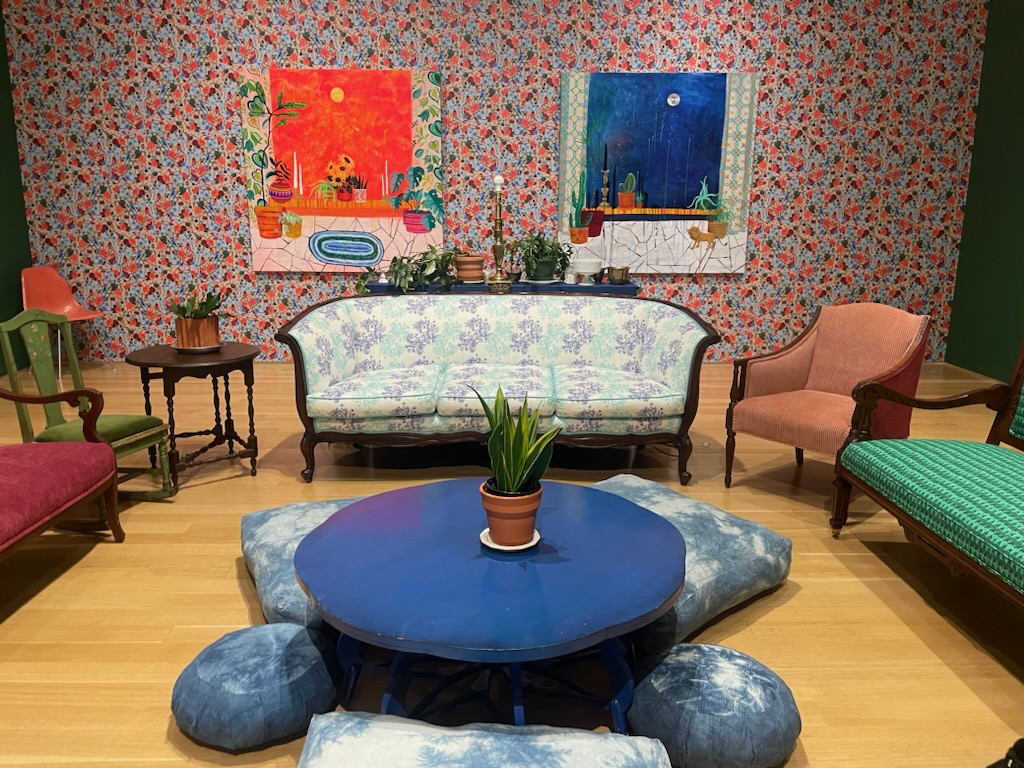
A living room setting with different patterned couches, a blue coffee table, and a flower printed wallpaper.

Amy Kligman: The Salon for Possible Futures

The Salon‘s calendar of events continues with a Collective Imagining Circle: 2026 on Saturday, December 13 from 1-2:30 PM. This event is free, but space is limited and RSVP  is required.

UPCOMING EXHIBITIONS

Angeline Rivas, Charm and Strange (detail), 2024, acrylic, gouache, and graphite on panel, 60 x 48 in. Collection Nerman Museum of Contemporary Art, Johnson County Community College, Overland Park, KS, Acquired with funds provided by the Barton P. and Mary D. Cohen Art Acquisition Endowment at the JCCC Foundation. Photo: Chris Sharp Gallery

Angeline Rivas: I Had a Dark Night of the Soul and All I Got Was This Lousy T-Shirt
On view December 13, 2025 through May 3, 2026
Kansas Focus Gallery, First Floor

The Nerman Museum of Contemporary Art is proud to host Angeline Rivas’s first institutional solo exhibition. Painted with airbrush on wood panel and canvas, the works of Angeline Rivas are vast, yet compact crucibles of a unique form of western Americana. Unlike typical airbrush paintings, Rivas’s works have a way of disclosing, as opposed to effacing, facture via imperfections, pieces of tape, and small moments of graffiti, making it such that the work has carved out a singular space for itself both on a formal and a conceptual level. Rivas (b. 1981) was born and raised in Kansas City, MO and is now based in Los Angeles, CA. Rivas earned her MFA in 2022 from the ArtCenter College of Design, Pasadena, CA and her BFA in 2005 from Otis College of Art and Design, Los Angeles, CA.

Michael Brantley, The First Lady of Song, c. 2012, oil on canvas, 50 x 52 x 2 in. Courtesy the Artist

Visionary: The Work of Michael Brantley
On view December 13, 2025 through May 3, 2026
McCaffree Gallery, Second Floor

Guest curated by artist Harold Smith, Visionary, Brantley’s first institutional solo exhibition, will feature the elegant and sophisticated work of painter Michael Brantley, a master painter whose stunning work and practice compellingly encapsulates the love, fears, hopes, and dreams within the Black experience. Michael Brantley (b. 1970) is a multi-disciplinary figurative artist living and working in Kansas City, Missouri. Using oil paint as his preferred medium, his work reflects and celebrates the lifestyle, heritage, and culture of American Africans. Brantley’s art inspires, informs, and provokes dialogue. His large-scale monochromatic paintings in the jazz aesthetic have been spotlighted by the NFL and exhibited at the American Jazz Museum and at the Nelson-Atkins Museum of Art.

UPCOMING CLOSURES

Special closures: Café Tempo will be closed Dec. 10 for a special event and Dec. 13, 2025-Jan. 19, 2026 for JCCC’s Winter Break. The Nerman Museum will be closed Dec. 24, 2025-Jan. 5, 2026 for JCCC’s Winter Break.

Visionary: The Work of Michael Brantley

Visionary: The Work of Michael Brantley

December 13, 2025 through May 3, 2026

Exhibition Catalogue by Harold Smith (PDF)

On the art of Michael Brantley —  by guest curator Harold Smith, artist, curator, educator, and writer

“Where there is no vision, there is no hope.” – George Washington Carver

My first visit with Michael A. Brantley was in the cavernous basement of the former Pressman Studios in Kansas City, Kansas.  From 1927 to the mid-2000s, this basement housed the printing presses for the once-daily but now online-only Kansas City Kansan newspaper. When the Kansan ceased physical publication, the basement was converted to artist studios. At one point, it housed multiple working artists, each with their own space. Now all the artists were are long gone, except Michael Brantley.

As the space is vast (the Kansan once had a circulation of 34,000), the temptation of many artists would have been to just spread out supplies and projects, since there is so much room to work with and no one else to consider. However, one look, and the intentionality of Brantley, its sole inhabitant, is evident. The entire space is neatly organized, with works in progress strategically placed so that Brantley could focus on each one without visual distraction from the others.

Michael’s office is a compact, somewhat dimly lit yet cozy and inviting space that made me think of the smoky backroom of a speakeasy where the aroma of bourbon is in the air and clouds of cigar smoke hover over clandestine poker games. It was here where Brantley first opened up and peeled back some of the layers of his complex and winding journey to this moment.

We talked for about an hour about his backstory, his education, his influences, and what the work of Michael Brantley is truly about. I left that first meeting with a clear understanding of his work, born of struggle and triumph, synthesizing tradition, realism, and the Black experience.

Brantley’s masterful oil paintings stand as a bridge linking the past and the present, ascending from deep roots in Western art traditionalism and spreading its branches wide to incorporate the lived realities of today’s Black Americans. His duotone photorealistic style synthesizes the intensity of jazz, the struggles and dignity of living while Black, and the complex social dynamics of a community still negotiating what it means to be Black in America. His velvety paintings explode from the collision of classical technique and the contemporary Black experience.

A native of Kansas City who spent time in Detroit, Brantley is best known for his lush renditions of Black jazz musicians. His work has been featured by the NFL, and he has exhibited at the American Jazz Museum, the Nelson-Atkins Museum, The Zhou Brothers Art Center, and now the Nerman Museum of Contemporary Art.

Brantley’s career trajectory has been somewhat delayed but not denied by profound personal adversity. In 2015, coming off a breakthrough exhibition at the American Jazz Museum, Brantley was diagnosed with sarcoidosis, a chronic inflammatory disease. Navigating the precarious waters of the Affordable Care Act to secure treatment was a challenge that soon followed. Yet, ten years later, Brantley paints daily with the same dedication and purpose, a testament to his personal courage and creative endurance.

Brantley is a longtime member of the African American Artists Collective in Kansas City, a respected organization empowering Black voices in the Midwest art scene. It was through this membership that Brantley’s work was exhibited at the Nelson-Atkins Museum of Art as part of the Testimony: African American Artists Collective exhibition in 2021. An artist with deep roots in Kansas City’s Black community, Brantley grounds his artistic practice in his commitment to his community, ethnic heritage, cultural history, and Black artistic tradition.

The African American Artists Collective in 2021, Photo: Jim Barcus, Courtesy of KC Studio Magazine

One of the most impressive aspects of Brantley’s work is that, despite being primarily self-taught, his work reflects a striking adherence to traditional realism. This alone is a testament to the veracity of his artistic practice. A skill set such as Brantley’s is only developed through years of focus, practice, and dedication to perfection. Anatomical precision, exemplary composition, virtuosic use of light, and sophisticated shading speak to an artist who has practiced long and hard at his craft, holding himself to the highest of painterly standards. Brantley’s Caravaggesque ability to utilize light and darkness to dramatize, isolate, and elevate his subjects distinguishes his work from much of today’s contemporary painting while his somewhat understated visual ambiance brings to mind the sense of timelessness observed in the works of Rembrandt, Vermeer, and Goya.

A serious craftsman with unwavering painterly conviction, Brantley wields the tools of tradition with precision and intention for the purpose of elevating Black subjects that were minimized and marginalized within those same traditions. Like Michelangelo using mallets and chisels to liberate forms from marble, Brantley uses the tools of Western art traditionalism to liberate and uplift the Black subject from the social-historical constraints inherent in the canon of Western art.

It is no surprise, therefore, that Brantley cites Henry Ossawa Tanner as an influence. Born free in 1859, the son of a future African Methodist Episcopal Church bishop, Tanner expatriated to France in 1891 and became the first Black American painter to gain international acclaim. Possibly the first known painting by a Black American to realistically depict other Black Americans, Tanner’s Banjo Lesson (1893) utilized realism to present the Black lived experience in a way that challenged the commonly held stereotypes of the time. Brantley, likewise, uses realism to confront and challenge the stereotypes of our time as seen in Figures of Speech (2024).

Michael A. Brantley, Figures of Speech, 2024, oil on canvas, Image courtesy the Artist

Henry Ossawa Tanner, The Banjo Lesson, 1893, Hampton University Museum, Gift to museum by Robert C. Ogden

Brantley’s usage of traditional painting techniques to express contemporary Blackness effectively captures the emotionally charged history of Black artistic resistance in a bottle. By using techniques of the Old Masters to immortalize Black musicians and activists, Brantley’s work becomes the physical embodiment of Charles White’s 1940 declaration that “paint is the only weapon I have with which to fight what I resent.”

While Caravaggio used chiaroscuro to dramatize Christian martyrs, Brantley uses it to dramatize the juxtaposition of the Black lived experience against the backdrop of the Black American experience. In that sense, like Caravaggio, Brantley uses realism and tenebrism to transform the martyred, both literally and symbolically, into heroic figures.

This transformation is evident in I Am A Man (2018), where Brantley uses chiaroscuro to triumphantly crown the subject with the phrase “I Am A Man.” Rooted in the 1968 Memphis sanitation workers strike, this phrase is now synonymous with the demand for civil rights, dignity, and equal treatment. Powerfully simple, it speaks to Black self-affirmation rising like a phoenix from the smoldering ashes of cultural subjugation.

Taken during a Civil Rights protest, Richard L. Copley’s famed 1968 photograph contextualizes “I Am A Man” as an external declaration, publicly asserting one’s inherent human dignity and demand for respect as such. Twenty years later, Glenn Ligon’s 1988 rendition isolates the phrase, allowing the viewer to interpret it based on their own internal experiences.

Thirty years later, Brantley’s presentation of “I Am A Man” as a chorus of affirmative declarations exuding like afro picks from the hair of an aged Black man grasping chains resonates like a choral response to “I am an invisible man,” the opening sentence from Ralph Ellison’s seminal novel Invisible Man. His portrayal of the phrase contextualizes it as an internal declaration, one that exists in and of itself, regardless of public response.

Richard L. Copley, I am a man, 1968, Photographic print

Glenn Ligon, Untitled (I Am a Man), 1988, Oil and enamel on canvas 40 x 25 inches (101.6 x 63.5 cm), National Gallery of Art

Michael A. Brantley, I AM A MAN, 2018, oil on canvas, Image courtesy the Artist

While Brantley wields traditionalism with the exactness of a surgeon’s scalpel, removing the cancers of stereotype and caricature from the canon of Western imagery, his aesthetic ideology stems from the self-determination of Alain Locke and the New Negro philosophy which fueled the Harlem Renaissance. Brantley’s work faithfully picks up the mantle from Locke’s 1925 declaration that, “art must discover and reveal the beauty which prejudice and caricature have overlaid.” In A Seat at the Table and I Am A Man, Brantley utilizes allegory to position Black subjects as heroic figures, analogous to Harlem Renaissance painter Aaron Douglas in The Creation (1927), Judgment Day (1927), and The Negro in an African Setting (1934). When one considers the synthesis of traditionalism and New Negro/Harlem Renaissance aesthetic ideology, it is inevitable that A Seat at the Table and I Am A Man lie firmly within the canon of Black American Social Realism, echoing tenets found in the work of Augusta Savage, Jacob Lawrence, Hale Woodruff, and others.

In A Seat at the Table, Brantley portrays his subjects with natural hairstyles while dressed as domestic servants, visually manifesting Locke’s assertion that art reveals “the beauty which prejudice and caricature have overlaid.” The primary subject’s mouth is taped shut, symbolically silencing his physical voice. Yet, the voice of his humanity is heard through his natural hairstyle. These notions of heroism in the midst of oppression echo those found in the works by Aaron Douglas such as Harriet Tubman (1931).

Michael A. Brantley, A Seat at the Table, 2021, oil on canvas, Collection of John and Sharon Hoffman, Image courtesy the Artist

Aaron Douglas (1899-1979), Harriet Tubman, 1931, oil on canvas, © Heirs of Aaron Douglas / Licensed by VAGA at Artists Rights Society (ARS), NY

Brantley’s work is imbued with intricate detail reflective of the photorealism found in the paintings of contemporary Black painters such as Amy Sherald, Kehinde Wiley, and the late Barkley Hendricks. However, Brantley’s emotionally charged references to social injustice differentiates his work from theirs and places it in a category of its own. Hendricks’s North Philly Niggah (William Corbett) (1975) and Brantley’s The First Lady of Song (2012), a rendition of jazz icon Ella Fitzgerald, both utilize a sense of photorealistic detail in portraying their subjects, yet Brantley’s heightened sense of emotion, from the pained facial expression to the singular drop of sweat streaking down the subject’s face, evokes a different, possibly more intimate and visceral response.

Barkley L. Hendricks, North Philly Niggah (William Corbett), 1975, oil and acrylic on canvas, 182.9 x 121.9 cm (detail). Photo © Sotheby’s

Michael A. Brantley, The First Lady of Song, 2012, oil on canvas, Image courtesy the Artist

By painting jazz icons in works such as The First Lady of Song, The Cornet (2025), and Yardbird (2025), Brantley speaks to their centrality, and that of the arts in general, to Black cultural and social identity. By making the humanity of these musicians the focus of the image, Brantley positions the Black jazz musicians as living embodiments of the Black contemporary struggle. He does not emphasize their humanity to the detriment of their artistry but rather affirms that Black artistry and Black humanity are inseparable. In Brantley’s work, Black humanity and Black artistry are analogous to light and heat; they may be separate qualities, but you cannot have one without the other.

Michael A. Brantley, Yardbird, 2025, oil on canvas, Image courtesy the Artist

In The Soloist (Trumpette) (2024), a painting of a seemingly exhausted or reflective woman trumpet player, Brantley departs from his normal duotone palette, utilizing soft crimsons and browns. This grounded position of the subject speaks to the connection between vulnerability and the power of the vulnerable, an uneasy relationship shared by the dispossessed. An emotional weightiness exudes from the image, as in most of Brantley’s work. The departure from a duotone palette shifts the emotional weight from the subject to the entire image itself.

Michael A. Brantley, The Soloist (Trumpette), 2024, oil on canvas, Image courtesy the Artist

Michael A. Brantley’s work synthesizes Western painting traditionalism and the contemporary Black experience. Ideologically speaking, he is firmly planted in the ideas guiding the Harlem Renaissance, Social Realism, and the Black Arts Movement. By portraying both the famous and the unknown, the easily recognizable and the nameless, Brantley affirms the shared experience of Black Americans.

Brantley’s paintings remind us that artistic tradition is not written in stone. It is changeable and continually evolving. In his work, prior traditions become tools for creating new expressions that not only articulate the Black experience but speak to the shared human experience itself.

The work of Michael A. Brantley is both for this time and also timeless. His work honors the past, paying homage to both cultural and artistic traditions, while speaking to power in the present.

References

Locke, Alain. The New Negro. New York: Albert and Charles Boni, 1925.

White, Charles. Interview in Art Digest, 1940 in The Journal of Pan African Studies, vol.3, no.4, December 2009, https://www.jpanafrican.org/docs/vol3no4/3.4CharlesWhitebyPaul.pdf

Ellison, Ralph. Invisible Man. London: Penguin Books, 2014.

Michael A. Brantley, Love Still Remains, Oil on canvas with acrylic flakes mounted on wood, 2025

Michael A. Brantley, Say Whaat? (The Tea), 2025, acrylic and oil on canvas, Image courtesy the Artist

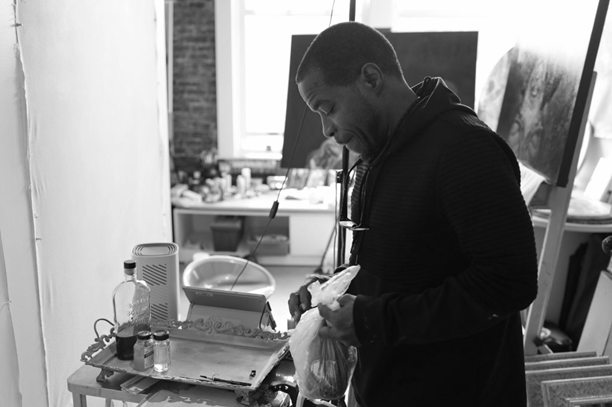
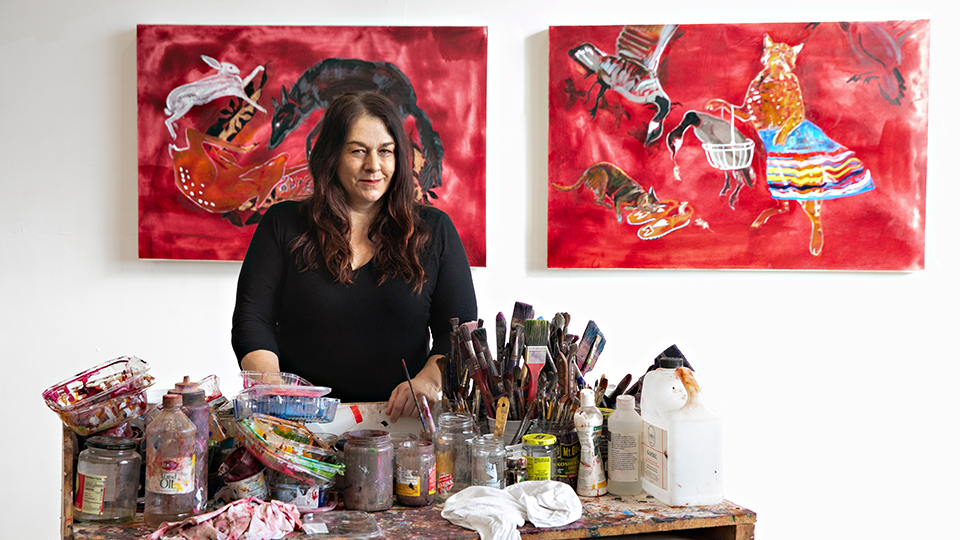
Michael Brantley in his studio

November Events and Important Dates

Living room setting with various people within it

The Nerman Museum continues its The Salon for Possible Futures programming in November with a Nov. 20 Storytelling Night from 6-8 PM with poet Glenn North.

THANKSGIVING BREAK:

The Nerman Museum will be closed Wednesday, Nov. 26, through Sunday, Nov. 30 for JCCC’s Thanksgiving break. Café Tempo will be closed for that same time frame, as well as Tuesday, Nov. 25.

Save the dates! Oct. 25 and 26 is a full weekend + Other October Events!

Save the date!

October is going to be another month full of activities here at the Nerman Museum, including an extra special weekend with big events on Oct. 25 and 26.

You can learn more about all events, and RSVP for the events that require registration, on our calendar page.

Four silhouettes look around a blue landscape with lanterns in their hands as they search for something

Diedrick Brackens, shadows spell my name, 2024, cotton and acrylic yarn, 102 x 134 in. Collection Nerman Museum of Contemporary Art, Johnson County Community College, Overland Park, KS, Gift of Sue and Lewis Nerman, Leawood, KS.

Our major events this month include the Jerome Nerman Lecture Series, featuring Diedrick Brackens, on Saturday, Oct. 25, from 4-5 PM, at the Museum’s Hudson Auditorium, with a reception to follow.

Brackens will discuss his large-scale weavings that incorporate myth and storytelling to highlight Black and Queer histories and bodies. Brackens is best known for his tapestries that explore allegory and narrative through autobiography, along with broader themes in American history.

Brackens employs techniques from West African weaving, European tapestry-making, and quilting from the American South to create both abstract and figurative artworks. Often depicting moments of male tenderness, Brackens draws inspiration from African and African American literature, poetry and folklore.

Man and woman holding a boom box between them, standing in front of a large pink panther painting.

Jeremy Scott and Katherine Bernhardt. Photo: Wil Driscoll

On Sunday, Oct. 26, 2-5 PM, we’ll celebrate the end of A Match Made in Heaven: Katherine Bernhardt x Jeremy Scott with a Closing Countdown alongside the artists.

Teenagers looking at prints and using a printing press

Young Artists Retreat 2024. Photo: Susan McSpadden, JCCC Photographer
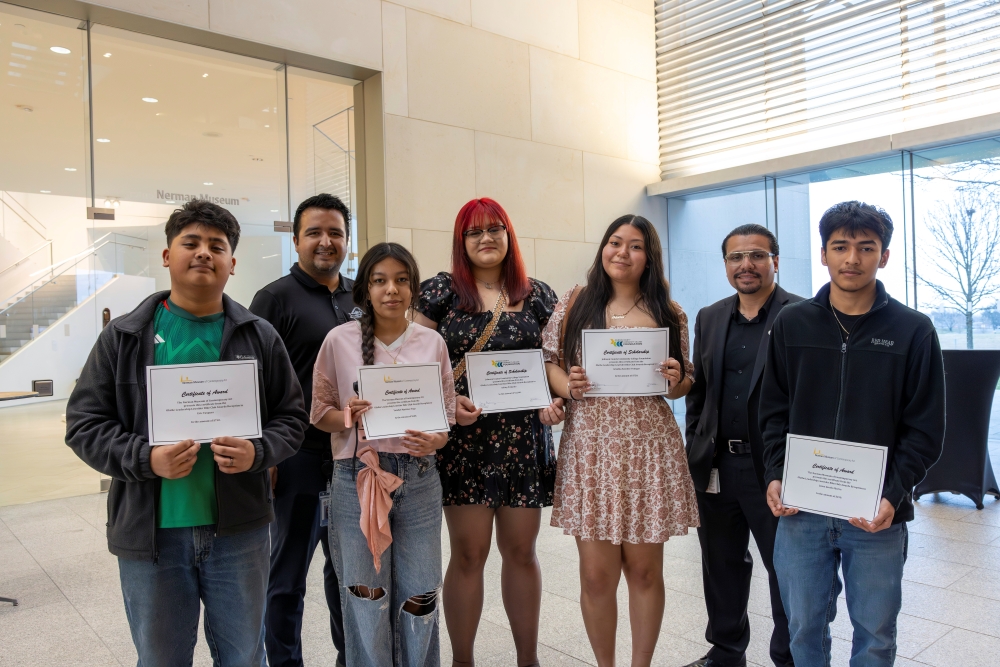
Earlier that same week, on Friday, Oct. 24, 8 AM-2 PM, we’ll also be hosting the 2025 Young Artists Retreat. While nominations for the in-person portion of the event is already closed, teachers and students can still register for the livestream option through October 22.

Living room setting with various people within it

The Salon for Possible Futures

Our Salon events continue, with:

  • Thursday, Oct. 2, 5:30-7 PM – Make Your Own (MYO) Pocket Charms with Amy Kligman
  • Friday, Oct. 17, 7-10 PM – Utopia/Dystopia Movie Night with Caitlin Horsmon
  • Saturday, Oct. 25, 2-3 PM – Book Swap & Share: Scare Stories
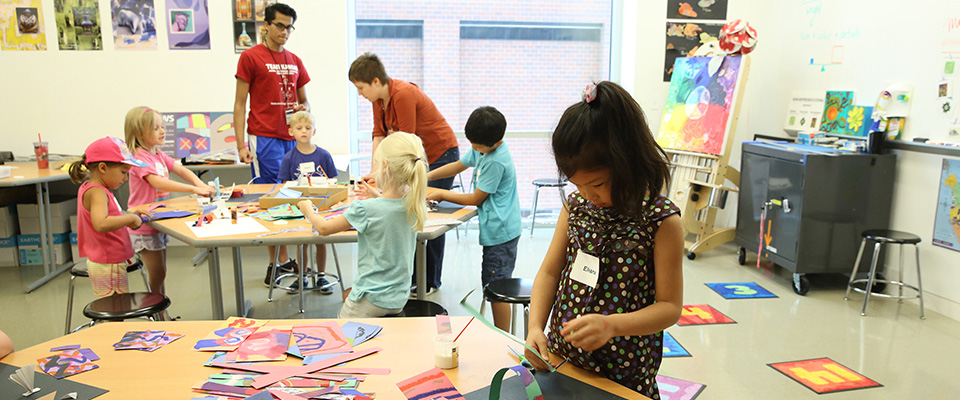
Young children participating in art activities

Students creating art projects in a Nerman Museum Youth Art Class

Lastly, our Youth Art Classes are back for the fall semester, with an all-new line up of topics and art projects. We’ll be kicking off the season with the following classes:

  • Thursday, Oct. 9, 4-7 PM – Street Fashion – Gr. 6-9
  • Saturday, Oct. 11, 2-4 PM – Accessories 3 Ways! – Gr. 3-5
  • Saturday, Oct. 18, 2-4 PM – Artful Fashion Design – Gr. K-2

September 2025 Events at the Nerman Museum

Another eventful month coming up at the Nerman Museum!

You can learn more about all events, and RSVP for the events that require registration, on our calendar page.

Living room setting with various people within it

Visitors enjoying their time in The Salon for Possible Futures

Our The Salon for Possible Futures events continue, with the September programming being as follows (please note, all Salon events are free, but due to limited capacity, RSVP is requested):

  • Saturday, Sep. 6, 1-3 PM: All Ages Drawing Party, hosted by the Kligman family
  • Saturday, Sep. 13, 1-3 PM: Letterlocking Workshop with Laura Pensar
  • Thursday, Sep. 25 – 5:30-7:30 PM: Mending Workshop with Hadley Clark
Linda Lighton: Love & War, A Fifty-Year Survey, 1975-2025 - Book Launch: Sep. 17, 2025, 5-8 PM - Free and  open to the public. Exhibition: Dec. 13, 2025-May 3, 2026

Left: Linda Lighton, Nude Descending a Staircase, 2007, glazed earthenware with china paint and luster, 18 x 11 ½ x 5 ½ in. Collection Shook, Hardy, & Bacon L.L.P. Right: Linda Lighton, Tinkerbelle, 2007, glazed earthenware with china paint and luster, 14 ½ x 13 x 12 in. Courtesy the Artist

In anticipation of one of our Fall/Winter exhibitions, Linda Lighton: Love & War, A Fifty-Year Survey, 1975-2025, the Nerman Museum is excited to announce the publication of its accompanying publication, a 208-page book of the same name, published and internationally distributed by Hirmer. Attendees will be able to purchase their own copy of the book, priced at $50. This richly illustrated monograph gives a comprehensive overview of Lighton’s pioneering body of work, which pushes the boundaries of ceramic sculpture. We’ll be celebration this book on Sep. 17, from 5-8 PM, with a book signing event with the artist.

Young children participating in art activities

Students creating art projects in a Nerman Museum Youth Art Class

Lastly, our Youth Art Classes are back for the fall semester, with an all-new line up of topics and art projects. We’ll be kicking off the season with the following classes:

  • Sep. 20, 2-4 PM: Pop Art Clay Accessories – Grades K-2
  • Sep. 27, 2-4 PM – Sew into Art – Grades 3-5

August 2025 Events at the Nerman Museum

Another month full of interesting activities here at the Nerman Museum!

composite image of 3 bands

The Elders, Beth Watts Nelson & Kelly Hunt, and Back Alley Brass Band

Light Up the Lawn, a collaboration between the Midwest Trust Center, bringing free concerts to the Nerman Museum lawn is back again! Join us on the following Fridays, starting at 8:30 PM to enjoy the bands below:

  • Aug. 15 – The Elders
  • Aug. 22 – Beth Watts Nelson & Kelly Hunt
  • Aug. 29 – Back Alley Brass Band

The Salon for Possible Futures is also hosting a couple more events (these events are also free, but due to limited space, RSVP is required):

  • Saturday, Aug. 16, 1-3 PM – Mending Workshop with Hadley Clark
  • Thursday, Aug. 28, 6-8 PM – Storytelling Night: Bad Ideas, hosted by Glenn North

Learn more and RSVP at our calendar.

Welcoming our youngest visitors to the museum

It’s summertime and we’re seeing a lot of families visiting the museum. The littlest visitors have been really enjoying the exhibitions, especially The Salon for Possible Futures!

We welcome visitors of all ages, and for our preschool visitors, here are some things we provide to enrich their visits:

Games! The Salon has games already in it, and the one pictured here is a game that was made custom for the exhibition by Sally Paul. The large wooden blocks with simple shapes on each side are perfect for open-ended play.

Tip: keep in mind that kids 3 and under often are still in the parallel play stage of development and not yet ready to play interactively, which means they’ll each want their own blocks and won’t want to build something together. With this group, I had one child who was in parallel play mode and other children who played interactively. It works fine as long as you remind everyone that we need to share the blocks, even if we don’t want to build something together.

We have touchable objects that relate to specific works (note how the children are seated in the galleries) such as dog tags, jingle beads, beaded canvas and examples of different paint textures. Kids LOVE having these opportunities to touch materials.

Storybooks are a great way to get kids engaged and focused on the art! Stopping at several works and having everyone seated on the floor listening to a storybook can help the group calm down in an exciting environment (being at the museum is exciting!)

Mouse Paint is fun for kids 3-5years old to talk about colors and color mixing. We also have color-mixing tubes which the kids love shaking up to see what colors are created. It’s important that everyone gets a turn.

Note how the reader in this video is supplementing the text by asking questions and encouraging interaction. It helps to practice reading the book several times, and to remember that the kids all want to see the pictures, so taking time to show every illustration to everyone is essential!

We can also be color investigators, using colored lenses to see how artworks look different through different colors and overlapping them.

And at the end of the tour, when everyone has had plenty of time to look and play, we can spend some time making art! We have finger crayons and crayons that can be used with a palm grip, and coloring pages and stickers featuring works by Dyani White Hawk and others.

Finally we have some goodies visitors can take home at the end, including postcards and bookmarks featuring artworks from the exhibitions, as well as zines and some of the other fun things in the cabinet drawers of The Salon.

Art Vision – tours for students in healthcare fields

2025 Art Vision Tour info

We are delighted to continue working with our colleagues in healthcare fields to host students in the JCCC Nursing, Respiratory Care and Neurodiagnostic Tech programs here at the museum as part of their coursework. For these “Art Vision” tours we ask students to do a series of in-depth looking exercises to hone their observation and assessment skills.

Students start by doing a full 15-minute formal analysis of an artwork, followed by a comparison of two works and then some sketching. Most visitors don’t spend 15 seconds looking at each work, so this is a challenging and rewarding exercise! As educators facilitating the activities, it is crucial that we spend time with the artwork ourselves, looking and then looking more.

For the formal analysis portion we select works that have figuration and other recognizable imagery. It’s important to start with a representational work (rather than a totally abstract, non-representational work) for this first activity so that folks that have some accessible entry-points into the discussion – it’s easier for many folks to observe that there’s a group of girls in a painting than it is to launch right into a discussion about color and line, for example.

Multiple women surrounding and operating on a person on a table in the middle of a field.

Dana Schutz (b. 1976), Surgery, 2004, Oil on canvas

From there we can move on to abstract works for the comparison portion, if desired. These two works are an example of a set we compare:

Blocky segments of pink, green, blue, and white form a traditional weaving styled pattern.

Jordan Ann Craig (b. 1992), We Don’t Have to Talk About It, 2020, Acrylic on canvas

Wavy lines in different colors move along in multiple directions.

Karin Davie (b. 1965), Lover, 1998, Oil on canvas


Karin Davie, Artist: Aldrich Contemporary Art Museum Interview

Karin Davie’s website

Jordan Ann Craig’s website

And for the sketching we always select a sculpture, as it is more interesting to compare folks’ sketches from different perspectives and observe how the work appears from different points of view/angles. BUT we try to select a sculpture that is not TOO difficult to sketch (not too many complex shapes or textures). For the students visiting this summer we couldn’t resist having them sketch one of Jeremy Scott’s designs.


July 2025 Events at the Nerman Museum

Colorful pop art collage

There is a lot going on in July here at the Nerman Museum!

We still have some spots available in the last few summer camps we’re hosting this month.

  • July 8-11 – Game Design Week for ages 5-7 and 8-11
  • July 15-18 – Pop Art Week for ages 8-11
  • July 22-25 – Textiles Week for ages 5-7 and 8-11
  • July 29-Aug. 1 – 3-D Art Week for ages 5-7 and 8-11


Living room setting with various people within it

Amy Kligman’s Salon will also be hosting more events this month!