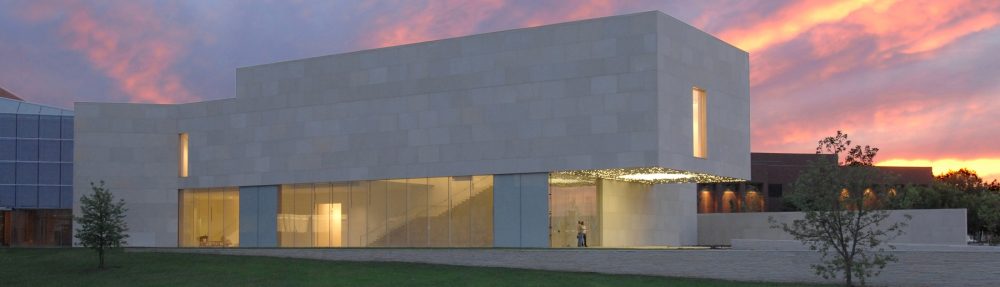
We are delighted to continue working with our colleagues in healthcare fields to host students in the JCCC Nursing, Respiratory Care and Neurodiagnostic Tech programs here at the museum as part of their coursework. For these “Art Vision” tours we ask students to do a series of in-depth looking exercises to hone their observation and assessment skills.
Students start by doing a full 15-minute formal analysis of an artwork, followed by a comparison of two works and then some sketching. Most visitors don’t spend 15 seconds looking at each work, so this is a challenging and rewarding exercise! As educators facilitating the activities, it is crucial that we spend time with the artwork ourselves, looking and then looking more.
For the formal analysis portion we select works that have figuration and other recognizable imagery. It’s important to start with a representational work (rather than a totally abstract, non-representational work) for this first activity so that folks that have some accessible entry-points into the discussion – it’s easier for many folks to observe that there’s a group of girls in a painting than it is to launch right into a discussion about color and line, for example.
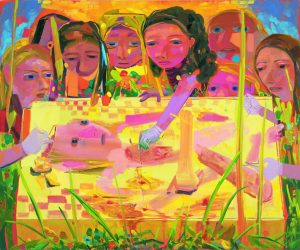
Dana Schutz (b. 1976), Surgery, 2004, Oil on canvas
From there we can move on to abstract works for the comparison portion, if desired. These two works are an example of a set we compare:

Jordan Ann Craig (b. 1992), We Don’t Have to Talk About It, 2020, Acrylic on canvas

Karin Davie (b. 1965), Lover, 1998, Oil on canvas
Karin Davie, Artist: Aldrich Contemporary Art Museum Interview
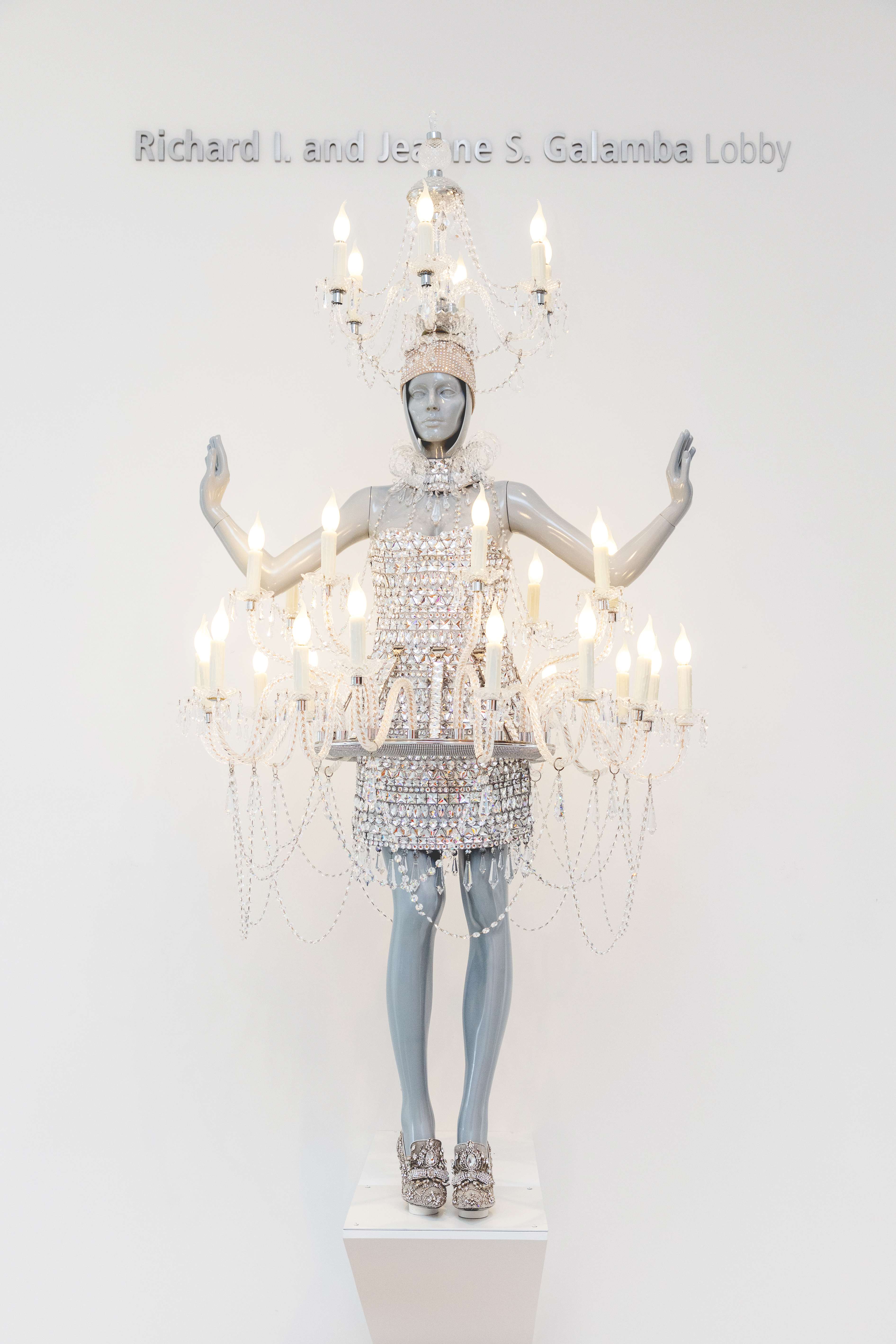
And for the sketching we always select a sculpture, as it is more interesting to compare folks’ sketches from different perspectives and observe how the work appears from different points of view/angles. BUT we try to select a sculpture that is not TOO difficult to sketch (not too many complex shapes or textures). For the students visiting this summer we couldn’t resist having them sketch one of Jeremy Scott’s designs.