
Design By: Athena Gonzalez
You open TikTok for what’s supposed to be a five-minute break from homework. One video leads to another, then another, and the comments become a distraction of their own, complete with a stranger inexplicably arguing about something you don’t care about. You tell yourself you’ll stop after this one. Then the next video starts playing before you’ve even decided.
Before you know it, 45 minutes have disappeared with nothing to show for them. You didn’t enjoy most of it, and you couldn’t name half of what you watched.
Your assignment is still sitting there untouched.
Unfortunately, so is your screen time report.
For some students at JCCC, the problem with social media isn’t just what appears on their screens but how difficult it can be to look away.
Anthony Giron is one of them. He recently noticed himself getting caught up in doomscrolling, losing time to videos and comments that pulled him away from schoolwork. What bothered him was what that time was replacing.
“I definitely didn’t like feeling like it was taking me away from things I enjoyed,” Giron wrote in an email.
Giron has taken breaks from social media before, but giving it up for good was never the plan when so much of his communication with friends and family happens there. Instead, he started setting screen-time limits for himself. The goal wasn’t to cut social media out of his life, just to put it back in its place.
“I just get on here and there now,” Giron wrote, “not spending hours like I was before on it.”
Erin O’Connor, another student, knows the late-night version of the scroll all too well. Some nights, she’ll search YouTube endlessly for the perfect video to fall asleep to, even though she keeps the volume so low it’s barely audible once she drifts off. According to O’Connor, she can stay stuck for hours, long after she first lies down.
The toll goes beyond lost sleep. Doomscrolling can exacerbate her anxiety and depression symptoms, along with her OCD tendencies, O’Connor shared.
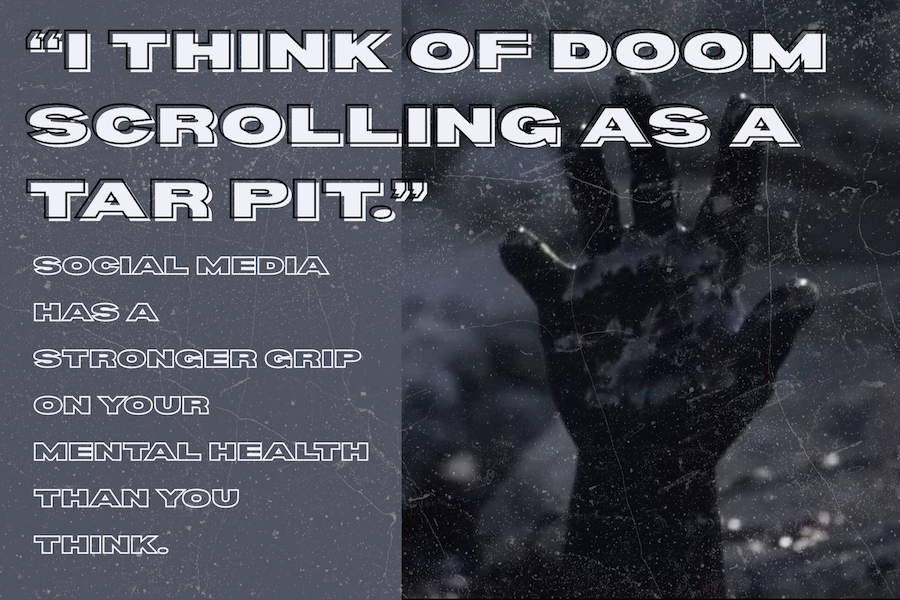
“I think of doom scrolling as a tar pit,” O’Connor wrote in an email.
The image goes deeper than it sounds. Tar pits aren’t actually hot, O’Connor pointed out. They’re about the same temperature as the air around them, so by the time you realize you’re stuck, breaking free can feel nearly impossible.
Then there’s the comparison trap. O’Connor doesn’t usually measure her life against other people’s posts, and she tries to remember that what people share online is only a fraction of their lives, and a highly curated one at that. Still, the more time she spends on social media, the more likely she is to start comparing herself to others.
Social media mostly shows the highlight reel, making it tempting to hold an ordinary Tuesday up against someone else’s best day.
Giron doesn’t feel that pressure to perform. He wants people to see the same person online that they see in person.
“My goal is not to make a fool of myself online and then be seen in person and act totally different because that to me is just weird,” Giron wrote.
For O’Connor, the pull has been harder to resist. For a long time, she prided herself on knowing a little about everything, and she idolized online creators who presented themselves as experts in their corners of the internet.
“I fell for it almost every time, hook, line and sinker,” O’Connor added. “Nowadays, I’m a bit more skeptical of what sort of content I consume.”
Still, she understands why so many people keep scrolling anyway.
“I have a great deal of empathy for those who simply want to turn off their brains and scroll,” O’Connor wrote.
Part of the problem, in O’Connor’s view, is that most platforms are “pulling out all the stops to keep you online as long as possible.” For students already balancing classes and work, losing an hour online becomes one more source of stress in an already full schedule.
Both Giron and O’Connor have found that setting boundaries helps, though they approach it differently.
Giron’s approach comes down to timing. He recommends waiting until assignments are finished or until the weekend before getting on social media, so going online becomes a deliberate choice rather than a reflex.
“Not getting on it just because, and then wasting hours, and then you’re behind on work,” Giron wrote.
O’Connor’s approach is about distance. She limits or entirely disables notifications and keeps her phone on the other side of the room. Requiring a long, complicated password every time an app opens can also make it easier to resist the urge to check social media, according to O’Connor.
As someone with ADHD, O’Connor wrote that she is “more susceptible to some of the features that make social media addicting,” and that her approach is not a one-size-fits-all solution. For her, success has come from remaining uncompromising about how and when social media reaches her.
None of this means deleting every app. For many students, social media is still how they keep up with friends and stay close to family, and it remains a window into the world around them.
Both Giron and O’Connor still use it. They’ve just changed the terms.
The real challenge is catching the moment a quick scroll stops being a break and quietly starts eating into everything else, whether that’s sleep, schoolwork or the things that used to fill that time.










Leave a Reply