
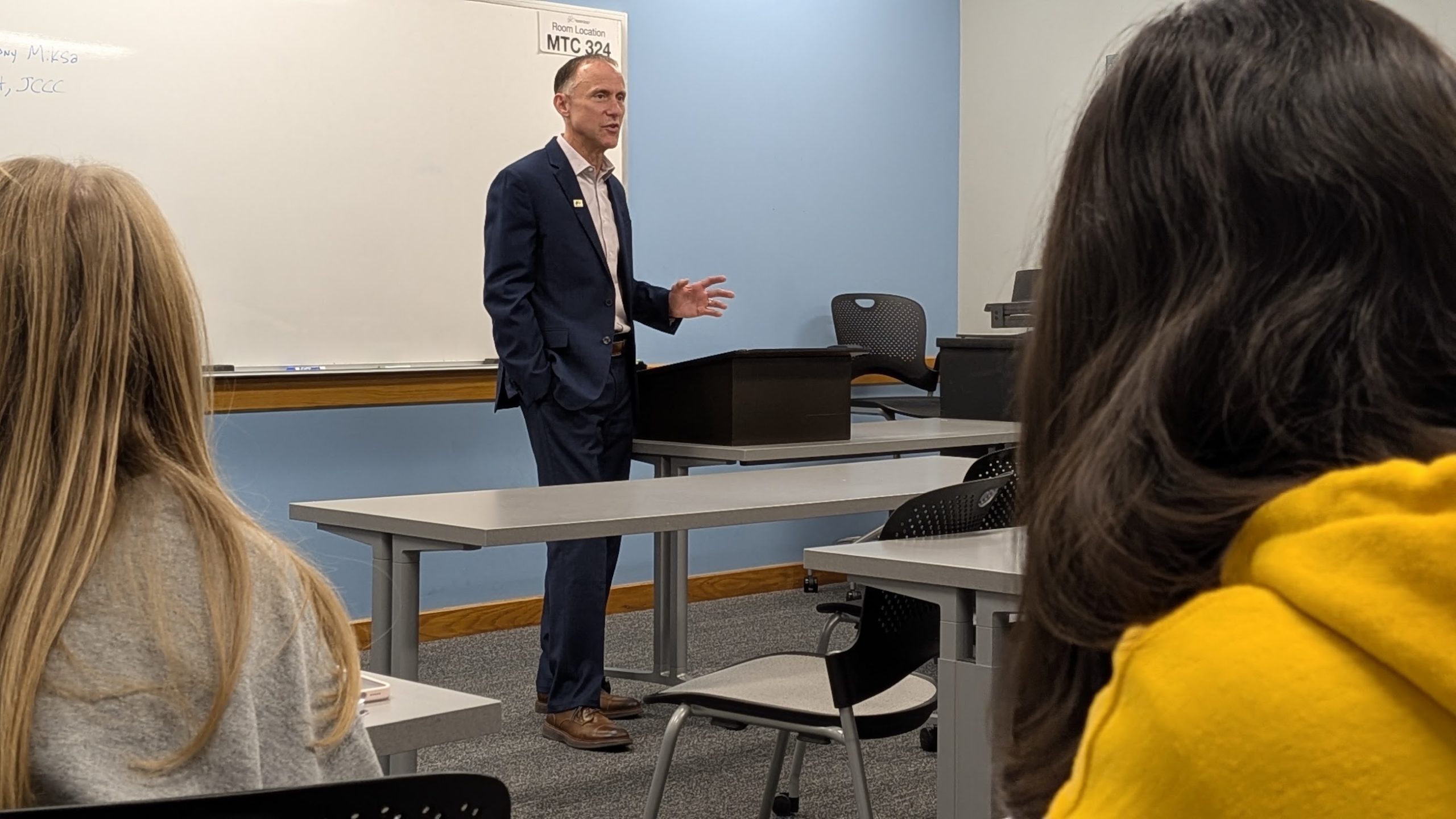
For the second straight semester, JCCC President Tony Miksa provided a real-world press conference experience for students in the News Writing and Reporting class.
Transit issues for commuters coming from both the metro area and Lawrence are sparking student concerns, but JCCC President Dr. Tony Miksa said in a press conference earlier this month that the college cannot take an active role in solving the problem.
“Our focus is education,” Miksa said, “and we certainly want to support students in transportation, but we don’t want to be a transportation company. Once you become a transportation company, you take on the risk and the liability of that, and that’s not really where we’re at, that’s not what we do.”
Miksa made the comment as a guest speaker at JOUR 122, News Writing and Reporting, which collaborates with the president to create a live in-class press conference experience. This press conference tackled issues ranging across the growing transportation issue, the soon-to-be-built health care building, as well as the September arrest of a campus police officer and new state law about undocumented students’ eligibility for in-state tuition.
He addressed transportation after a student asked a question about buses in the Kansas City Area Transportation Authority and the Lawrence-bound K-10 Connector beginning to charge for rides on June 1. The price for KC metro buses is $2 per ride, while the K-10 Connector costs $4 for a single ride and $125 for a monthly pass.
“Transportation, public transportation, is very expensive, and everybody’s trying to figure out how to afford that,” Miksa said, adding that the Student Basic Needs Center can help defray costs for riding the bus system. “Our goal is to make sure that no student can’t come to college because they don’t have transportation in the Kansas area.”
Student journalists confirmed with the Student Basic Needs Center that it provides bus passes for the Kansas City Area Transportation Authority buses, which cover the metro area. The bus passes do not cover the K-10 rides.
Miksa kicked off the press conference by explaining his 40-40-40 by 30 plan, which includes increasing the graduation rate to 40%, recruiting 40,000 students, including 20,000 credit-seeking and 20,000 noncredit-seeking students, and raising $40 million by 2030.
He also addressed many other changes happening at JCCC, including expanding and adding buildings for programs to grow. He said a new health care building is in the planning stages.
“It’s our hope in the spring of 2027 that we’re gonna start working,” Miksa said. “They’ll do a little groundbreaking ceremony. We’ll get going there. And then by the end of 2028, the building will be done, and we’ll be moving in, and we’ll be starting our new programs in January of 2029.”
Other building projects include an outdoor amphitheater and an observatory. These projects are included in Phase 1, Group 1 of the Facilities Master Plan, approved by JCCC’s Board of Trustees in 2025, that aims to expand on JCCC’s mission and vision to support students with state-of-the-art facilities.
Later, Miksa discussed improving athletic support spaces, including creating an outdoor area for athletes to recover during a game without having to head to the gym.
“They have to go all the way inside if something happens,” Miksa said, “if they get an injury, or at halftime. We’re going to build these locker rooms outside. Four locker rooms: baseball, softball, men’s and women’s soccer.”
After talking with the coaches, they decided to also build a training room outside so if players get hurt, they don’t have to go inside.
Miksa also spoke about the recent charge of sexual assault against a JCCC police officer and about the onboarding process of the campus officers.
“There’s background checks, and then they also have to be registered,” Miksa said.
There is currently no plan in place to make the background checks more regular.
“I don’t know if we would do yearly background checks on employees,” Miksa said. “Certainly any employee that is involved in something, they have to report it to their supervisor.”
During the press conference, Miksa answered questions about the Sept. 9 ruling that ended a bill permitting in-state tuition rates for qualified undocumented immigrants in the state of Kansas and how it could affect enrollment.
“Anytime that there are some types of restrictions put on students that can come to school here, it can obviously impact us,” Miksa said. “If there’s a way when we look at the law and that we can still serve as many students as possible, we’re going to try to figure out how to do that as well.”



Leave a Reply