
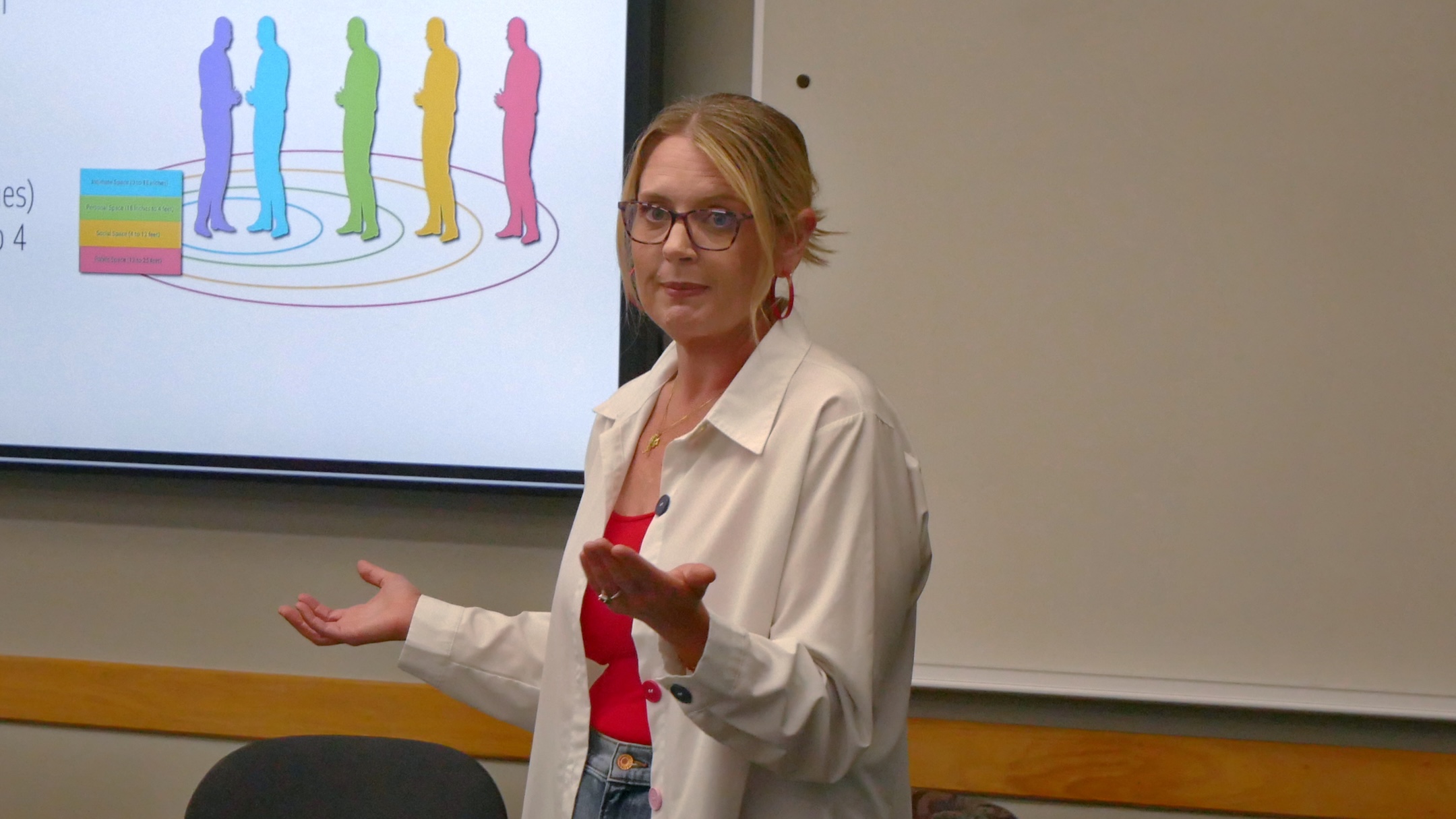
“She makes all of us better,” Terri Easley-Giraldo, chair of Communication Studies, recently wrote about Professor Ashley Rader. Photos By: Jordan Soltz
When friends come to Gianna Umentum complaining about homework, her first instinct used to be fixing the problem. She’d offer advice or even make them a to-do list.
Now, she just asks if they’d like to study together.
Umentum credits the change to Professor Ashley Rader’s interpersonal communication class at Johnson County Community College.
“Often, rather than advice, people just need someone to converse with,” Umentum wrote in an email.
The class changed how she sees herself, too. Umentum always considered herself more of a listener than a talker until she realized she spent most conversations planning her reply instead of understanding what someone was telling her.
Those everyday shifts are exactly what Rader hopes students take with them. To her, communication isn’t just a course requirement. It’s something students carry with them long after the semester ends, into their relationships and their careers.
But the classroom wasn’t where Rader expected to end up.
From reporter to professor
Rader spent nearly eight years as a professional journalist after finishing her undergraduate degree in 2001, writing and taking photos in community journalism. The job came with its share of strange assignments, including a gas station robbery where the thieves made off with all the chocolate milk.
“Which was just funny, right?” Rader said.
She loved the work, but over time, something started to feel off.
“I felt like I was kind of sitting on the sidelines of life a little bit,” Rader said. “Like, I was talking about what other people were doing that was awesome, not doing something as much awesome, I guess.”
After earning her master’s degree in 2008, she tried teaching as an adjunct. What started as an experiment turned into a calling. Rader realized she might not be the best writer who ever lived, but she was a strong interviewer who loved being around people, and interpersonal communication and public speaking felt like a natural fit.
Eighteen years later, she still can’t picture being anywhere else.
“I’d rather be in the classroom than anywhere else,” Rader said.
Learning the system the hard way
Part of what connects Rader to her students is her own path through college. As a first-generation college student, she knew she was supposed to go but had little guidance on how to navigate it once she got there. She sees that same uncertainty in many of her students today.
Her path also didn’t follow a straight line. Rader finished her doctorate two years ago, at 44.
And for students worried about their GPA, she offers a little perspective. Rader earned only two Bs in college.
The irony?
Both were in interpersonal communication and public speaking, the very subjects she now teaches.
“I wasn’t necessarily ready, and I was still learning how to do college work,” Rader said. “Bs are okay. They’re really okay.”
No one leaves a stranger
In her classroom, nobody stays anonymous for long. Rader makes it a priority to learn every student’s name and something about them within the first week and a half, and no class goes by without everyone being recognized.
“You’re not going to get out of my class without making friends,” Rader said.
Students notice. Umentum describes Rader as professional, humorous and laid-back, someone who makes students feel heard and valued. Instead of lecturing while students quietly take notes, Rader fills class time with activities and discussions that get everyone involved.
Katelyn Fisk, another of Rader’s students, appreciates that class often starts with Rader asking students about their lives and actually listening to the answers. That lesson about listening stuck with her. Fisk wrote that paying attention to body language and showing someone you’re engaged has changed how she approaches every conversation.
“When the other person can tell you are listening and actually want to be in the conversation,” Fisk wrote in an email, “it makes whatever you’re talking about much deeper and more meaningful.”
A colleague people count on
Rader’s impact reaches beyond her own classroom. Terri Easley-Giraldo, chair of Communication Studies, wrote that Rader is constantly looking for ways to improve her courses and has helped strengthen the department’s curriculum through years of change. She also serves on college committees, supports faculty development and mentors newer instructors as they find their footing.
“She makes all of us better,” Easley-Giraldo wrote in an email.
What her students teach her
The learning goes both ways. Rader said her students have taught her humility, along with a steady supply of new slang, which she enjoys dropping into sentences to tease her 15-year-old daughter.
Ask what she’d be doing if she weren’t teaching, and her answer is the opposite of her job: growing exotic plants and reading books.
“I’d be like a professional introvert,” Rader said.
The lesson that sticks
What Rader finds most rewarding isn’t a strong test score. It’s watching students grow as people, learning to express themselves and thinking about the relationships and lives they want.
She knows she may never see the full impact. Her hope is that years from now, a former student facing a hard time or a big decision will remember something from her class.
“Maybe one little thing I said, or one thing we learned, changed their decision-making,” Rader said.



Leave a Reply