
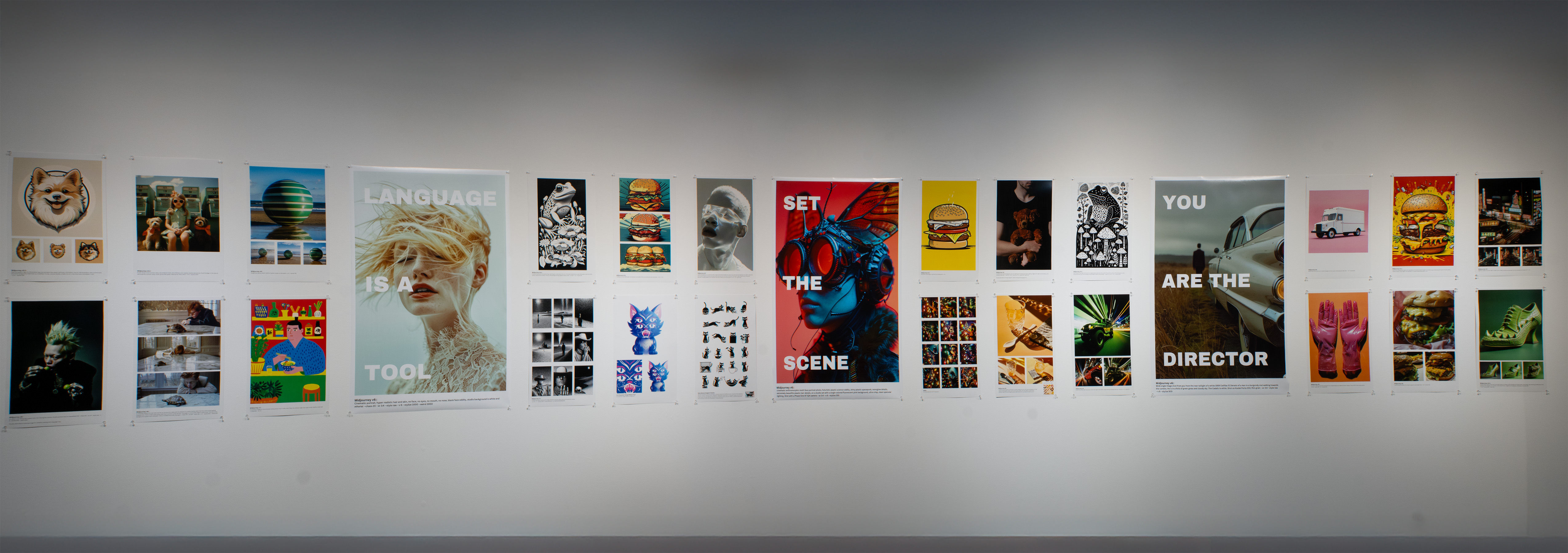
(Photo by: Garrett Lovell)
As AI is quickly evolving, we are growing up in an era where we are told that we shouldn’t be using AI in our coursework, but should we be learning how to use it as a tool instead of staying away from it?
Artificial Intelligence, also known as AI, has become a huge topic of debate in schools and the art world. At the start of the spring 2026 semester, the Fine Arts & Design Studios (FADS) building chose to display an AI Graphic Design Exhibit, sparking many responses from students.
Sydney Ratliff, a student at JCCC, explained that last semester’s gallery featured an artist whose work was interesting and offered opportunities for students to inquire and learn about the artist in their classes.
“I was really shocked to see this current exhibition,” Ratliff said. “I was very disappointed to arrive in the FADS building this semester only to find that instead of a resident artist’s work being displayed, our walls were covered in AI-generated images.”
Another student, Rin Mahoney, was also full of shock and disappointment when she discovered the exhibit through the FADS’ Instagram post. After seeing it on social media, she went to see the pieces and was baffled to see it covering the walls of the first floor.
“JCCC proudly pushes sustainability so much. We have received dozens of national awards for sustainability efforts. Generative AI uses a significant amount of water and is directly harming our environment,” Mahoney said. “The exhibition puts an incredibly embarrassing, shameful and overall negative view on our arts program.”
Associate Professor and Chair of Graphic Design and Visual Design Applications Eric Winter wants to clear the air on what the exhibit truly is.
Winter explained that the FADS stands for fine arts and design studios, and that’s what the building is for. It’s a mix of fine arts and graphic design that shares the space for their coursework. Every other spring, the graphic design department is given access to the gallery on the lower level to host an exhibition.
“I think maybe some of the potential confusion or contentiousness around it is people defining it as an art exhibition, when that’s truly not the meat of what it was,” Winter said. “But I get the confusion because in that space, that’s typically what’s there.”
The graphic design department is a career in technical education degree program. Because of this, they have an advisory board made up of 10-12 industry professionals who have been talking about AI and how it’s impacting workflow for a few years now. That, Winter says, is the reason that the exhibit is AI.
“We’ve been told our expectation is that our grads most likely will, if they’re in a corporate setting, [be] working with AI,” Winter said. “So it’s more of a ‘let’s just rip the Band-Aid off and talk about it.’”
Winter wanted to clarify that the gallery in the FADS building is not explicitly for student work, although it does often have student work in it, it rotates through shows. Kevin Garrison, who has 30 years of experience in the industry and has been playing with AI for a while, is the featured designer in the exhibition.
“So his work is on display to show the gamut, the range, of what AI can do. I installed the show myself, and I would admit some of it is terrifying in how realistic it is, and no one is denying environmental impacts. We all know that’s part of it,” Winter said. “But his idea is just to show the range of it and to speak to the audience about best-case uses, the do’s and don’ts, and really just to start a conversation.”
The exhibit also showcases student work from an AI debate project they did last semester in advanced type.
“Students could choose to be pro AI [or] anti AI. They were asked to try [AI] if they were comfortable [utilizing] AI tools, just to kind of explore and play around in that. So, you know, most of the topic themes in that student gallery are against AI or caution around AI,” Winter said. “It’s just raising awareness. I don’t know of any other graphic design programs in the KC Metro that are explicitly speaking about AI and just the reality of that in front of us.”
After seeing the exhibit and the comments Winter made about it on Instagram, Mahoney felt compelled to do something about the situation.
“Clearly, people had things to say, and I thought there should be a place for them to voice opinions and ensure that whoever allowed the exhibition would see them,” Mahoney said.
Mahoney made a form and posted it to her Instagram account, then later made a poster with a QR code on it that led to the form. The form continued to get shared through other people, even making its way to the Environmental Clubs GroupMe.
“I wanted to spread it so that I could receive as many responses as possible, because the more you get, the higher chances you have of varied opinions, which was not the case,” Mahoney said. “I was pleasantly surprised to see that it was gaining attention, especially beyond art students. I received responses not only from many art students but other students even outside of JCCC, friends of students, teachers, parents, Nerman Museum employees and community members.”
Winter explains that he anticipated reactions but underestimated the intensity and level of them. However, he still appreciates the initiative and the feedback request form Mahoney created.
“Now one of the student pieces is explicitly asking for people to tag it and write to it. So I wish those could have started at the same time,” Winter said. “We were waiting on student work and stuff to come in. And I think if that had been there at the same time, some of the blow-up might have been mitigated by the fact [that] there are students speaking to this.”
Winter mentioned that it is very common for someone who is featured in an exhibition to have either an opening or a closing ceremony, or something like a meet-the-designer or artist. On Thursday, Feb. 12, there will be a designer presentation in the Craig Auditorium at 6 p.m. It is open to any students who would like to sit in.
“Half of that will be Kevin Garrison talking just a bit about his path and design and how he has come to AI. [He will also] talk a little bit about the use cases, but a lot about how he uses AI is already present in the exhibition. So they can learn more from Kevin,” Winter said. “And then three of our students [who] are in the smaller gallery will be talking about their process for their project as well. We’ll try for a little time for Q&A at the end, and then after that, everyone is welcome to come back to the gallery for a reception with some light eats and to get a chance to talk to the representative designers.”
There is going to be a silent, peaceful protest at the presentation. Ratliff explained that after seeing the FADS Instagram page turn off the comments on the post with the AI designs, she was frustrated.
“This was really frustrating to me, because they were not listening to any of our opinions. Honestly, I was kind of waiting to see if anyone else would step up and organize something. When I realized no one had planned anything yet, I thought maybe I would be able to.”
33 people have RSVP’d, which is more than Ratcliff anticipated, but she is glad that her peers are willing to take a stand for something they care about.
“[We will] hold signs with messages regarding why we are taking the stance we have chosen. It is imperative that we are quiet and respectful while Kevin Garrison speaks. At the end of the day, our goal is for him to listen to our opinions and take the display down,” Ratcliff said. “After his presentation is over, we will share our views with the attendees by handing out pamphlets. These pamphlets will explain our reasoning for the stance we are taking, as well as provide sources to verify the facts we provide.”





Leave a Reply