
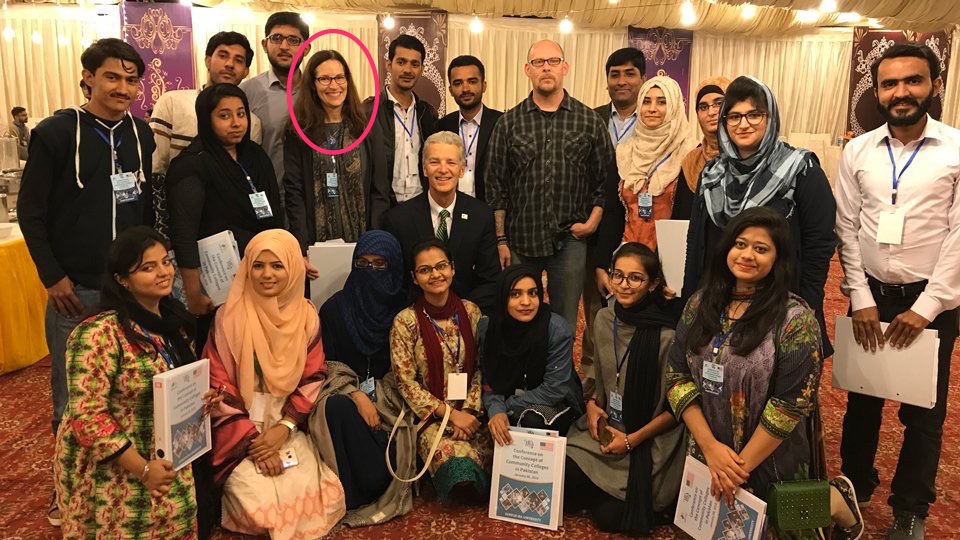
 Beth Gulley, professor of English, was recently featured in a JCCC story on the college’s website. “Partnering with Pakistan: JCCC President Shares Community Colleges Best Practices” summarizes Joe Sopcich and Gulley’s recent trip to Pakistan in January. Gulley presented on developmental education while in Pakistan and was impressed with how Pakistan schools are working to support women. The article quotes her as saying, “Our colleagues in Pakistan are committed to helping their students. For me, one of the big takeaways was their interest in educating women and helping them find careers. Particularly in this area the schools are doing a lot to support and prepare women for the future. It was a humbling privilege for just to go see how hard they work to make their society better.” As part of our “First Friday” English meetings, Gulley will give a presentation over her Pakistan visit at 2pm on Friday, March 2, in the Co-Lab.

JCCC Dept. of English
Office: LIB 342
913-469-8500, ext. 3448
Blog editor: Mark BrowningArchives
- March 2026
- November 2025
- October 2025
- September 2025
- May 2025
- April 2025
- March 2025
- February 2025
- January 2025
- December 2024
- November 2024
- October 2024
- September 2024
- February 2024
- December 2023
- October 2023
- April 2023
- March 2023
- February 2023
- January 2023
- October 2022
- September 2022
- May 2022
- April 2022
- March 2022
- January 2022
- November 2021
- October 2021
- September 2021
- June 2021
- April 2021
- March 2021
- February 2021
- December 2020
- November 2020
- October 2020
- September 2020
- June 2020
- May 2020
- April 2020
- March 2020
- February 2020
- January 2020
- November 2019
- October 2019
- September 2019
- August 2019
- June 2019
- May 2019
- April 2019
- March 2019
- February 2019
- January 2019
- November 2018
- October 2018
- September 2018
- August 2018
- May 2018
- April 2018
- March 2018
- February 2018
- January 2018
- December 2017
- August 2016
- January 2016
- August 2014
- March 2014
- September 2013
- August 2013
- April 2013
- January 2013
- December 2012
- August 2012
- May 2012
Honors Catalog
- Honors Contract: Comp I
- Honors Contract: Comp II
- Honors Contract: Introduction to Literature
- Honors Contract: Introduction to Fiction
- Honors Contract: Children’s Literature
- Honors Contract: Creative Writing
- Honors Contract: Creative Writing Workshop
- Honors Contract: Masterpieces of the Cinema
- Honors Contract: World Masterpieces
- Honors Contract: British Literature I
- Honors Contract: British Literature II