
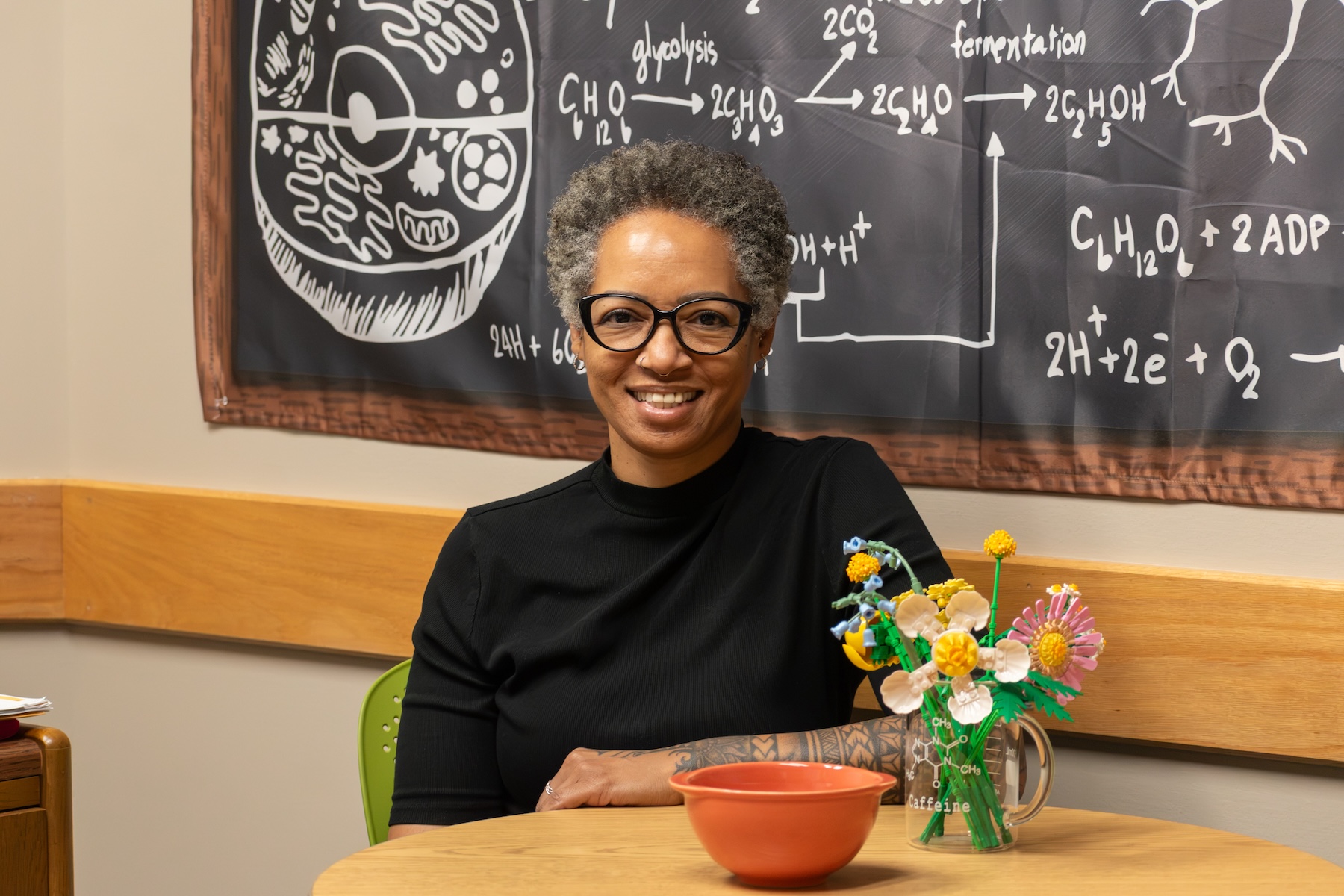
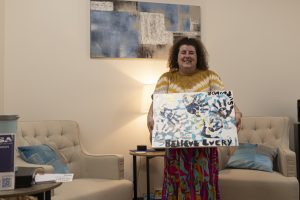
Eulandria Biddle In Her Office. Photo By: Josiah Nelson
Eulandria Biddle was about 7 years old when her mom bought her first microscope for Christmas.
She was already the kind of kid who collected butterflies and grasshoppers, and when she had nowhere else to put them, they went in her pockets. Her mom admitted she was sometimes afraid to do the laundry.
That curiosity followed Biddle all the way through a doctoral program, where she taught anatomy and physiology and microbiology as a teaching assistant. Even then, teaching wasn’t the plan. Speaking in front of people made her nervous, so after graduating, she went into research and spent five or six years working in industry.
Eventually she realized she missed the classroom.
Microbiology, the subject she now teaches at Johnson County Community College, didn’t come easily either. Biddle failed the course the first time she took it. The second time, she dropped it before she could fail again.
“The third time was the charm,” Biddle said.
Biddle starts with simple explanations and builds a strong foundation before moving into harder concepts. Students work through problems together at the board, where getting something wrong is part of the process.
“I tell them that that’s the only way we learn is to make mistakes,” Biddle said.
When Claire Anderson enrolled in Biddle’s microbiology class, she didn’t expect to become fascinated by the subject. Biddle made an impression right away.
“Meeting her was a breath of fresh air and it really set the tone for the class,” Anderson wrote in an email.
Anderson ended up loving the class so much that she returned the following semester as an embedded tutor. Biddle remembers watching her go from asking questions in class to helping other students in the lab.
“I didn’t expect to have so much fun and become so fascinated in microbiology,” Anderson wrote. “I mean that truthfully,”
Isabella Barone could tell from her first lab that Biddle loved her subject. Over the semester, she came to believe Biddle might be “even more passionate about being a teacher,” Barone wrote in an email.
Barone saw that commitment firsthand about a month into the semester, when she went to office hours after wrestling with her lab notebook entries. She wanted to understand how each experiment fit into the class’s semester-long research project. Biddle spent almost an hour walking her through the purpose behind each lab and what the results meant.
Around the same time, Biddle noticed that much of the class was struggling with the conclusion sections of their notebooks. Instead of moving on, she had students resubmit their entries and regraded them, this time with conclusion questions to guide them.
“This was the first time I’ve had a professor adapt their instruction mid-semester to better meet the needs of their students,” Barone wrote.
The class wasn’t easy.
“Her class was enjoyable, but so stressful,” Barone wrote.
There was always a lot to learn and not much lab time to learn it. Still, the experiments kept things exciting. Barone’s favorite was the endospore stain, which involved applying stain to her bacteria, lighting it on fire and repeating the process before finally seeing the endospores under the microscope.
Anderson put it simply. Microbiology can be difficult, and school in general can be difficult, but Biddle’s effort made the class manageable.
“Her energy is contagious,” Anderson wrote.
Between the lab notebooks, the research paper and the poster symposium at the end of the semester, the learning curve was steep. By the time Barone stood up to present her research, the effort had paid off.
“I was proud of myself not only for getting through the semester, but because I felt I really produced something worth sharing,” Barone wrote.
That moment is one of Biddle’s favorite parts of the job. Students are often nervous when they first learn they’ll have to present, but by the end of the semester, they’re smiling and confident in their work.
“It’s a proud moment,” Biddle said.
Erin Buller saw that pride firsthand. When her class presented their Tiny Earth projects, Biddle was smiling from ear to ear as she listened to each student share their findings, Buller recalled in an email.
“Professor Biddle won’t let you fall behind,” Buller wrote. “She wants you to succeed and will do everything in her power to help you out.”
For Anderson, Biddle’s support didn’t end with the semester. Biddle wrote a letter of recommendation for Anderson’s dental school application, and one of Biddle’s favorite memories is the day Anderson called to tell her she’d been accepted.
Away from the microscope, Biddle has a few interests her students might not guess. She’s a longtime mixed martial arts fan who enjoys watching UFC fights, and when she isn’t cheering on a fighter, she might be at a bowling alley. She even ran a small business at one point, making her own handmade soap and lotion.
Since moving to Kansas City about two and a half years ago, she has spent much of her free time getting to know the city, whether that means checking out a local festival or trying a new restaurant.
Biddle once struggled to pass microbiology herself. Anderson went on to tutor it.
“Be prepared to fall in love with microbiology,” Anderson wrote, “because Dr. Biddle absolutely has that effect!”







Leave a Reply