
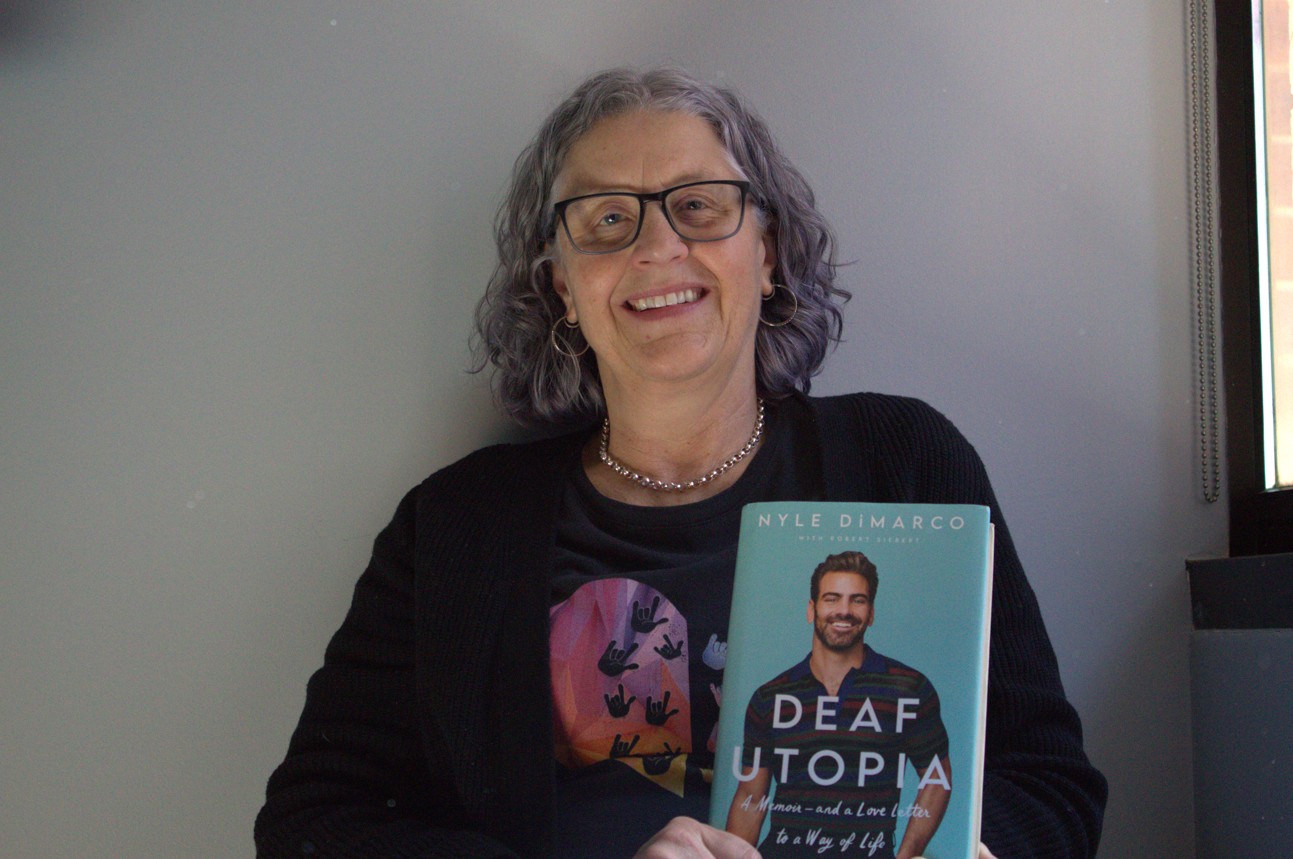
(Photo by: Jasmine Mills)
Did you know that JCCC is located near the Kansas School for the Deaf (KSD), and that the surrounding community has a very large deaf population? Well, Chair and Professor of American Sign Language (ASL)/Deaf Studies Kimberly Kuhns just so happens to be one of those individuals, and on March 4, 2026, she will be showing how the deaf community experiences the world at this month’s Great Book Series. She chose a book called “Deaf Utopia: A Memoir–And a Love Letter to a Way of Life” by Nyle DiMarco.
“He is a deaf gentleman from a deaf family. They’re generationally deaf, as I recall, and I think it’s five or six generations of deaf family members. So that gene has been passed down for many generations in their family. But this book talks about his life,” Kuhns said. “But he talks about his experiences with being in a residential school, meaning a deaf school or a mainstream school, going to school with hearing kids. [He] talks about his identity, where he struggled. Is he straight? And so he [came out as being] gay.”
Kuhns explained how she related to DiMarco’s experience and found the whole story interesting.
“It’s very interesting because I grew up in a mainstream school, surrounded by hearing students, and I didn’t sign until later in my life. And I did struggle as well with my identity as a deaf individual. And while I struggled, I am a lesbian person as well. And he struggled, you know, as a gay individual.”
Kuhns also wanted to point out that there are many misconceptions when it comes to people in the deaf community, and she wanted to clear some of those up.
“If we think about this, he wrote this as a deaf individual. And that just shows that deaf individuals do have the ability to write–and those skills, many people think deaf people can’t [have them]. So we don’t want to judge them for any of this.”
A lot of the book describes his life as an independent person as he travelled all over the world. However, like many deaf people, he experienced discrimination.
“When he was on America’s Top Model… they did have an interpreter, but [they were] not available to him 24/7,” Kuhns said. “So, [try] to imagine that you’re in this group of people that are all hearing, and he might have to use a phone app to be able to catch parts of the conversations and what they were talking about. So that made him feel lonely, and he explains that experience.”
Kuhns explains that she has a very similar situation, where she has an interpreter who is not available all of the time, and she is worried that the communication barrier may cause an issue in the book talk.
“So it’s interesting, because next week, Wednesday, as a deaf individual, it’s hard for me to concise and summarize this information,” Kuhns said. “You know, to make it into 45 minutes, because I’m looking at how thick this book is. How is it that I’m gonna explain everything to get the point of it? So it’s been a challenge.”
Kuhns explains that American Sign Language (ASL) is very important, and when it’s not permitted for a deaf child to use ASL until later in life, it causes language deprivation.
“So language deprivation? They don’t allow a baby to begin signing, but we really should do that. The important point about this is, suppose you were a mom and you had a hearing baby. You talk to that baby, and that baby babbles back, right? Maybe you don’t know what they’re talking about, but they’re trying to communicate with you through language. So babies do the same thing with signs. They don’t perfectly sign, but you can get an idea of what they’re looking for.”
There are pretty high percentages of doctors who tell parents of deaf children to do cochlear implants, according to Kuhns, but she expressed that they don’t work for everyone. She did, however, explain that there are some advantages to being deaf or from a deaf family.
“I would have to look at the specific numbers, but deaf babies, or hearing babies from deaf parents, acquire more vocabulary than babies who don’t have exposure to that. So, for example, we have a visual intake of language,” Kuhns said. “I have a grand niece, and she is not yet two. And she loves watching me sign. She’s just amazed, and she is intrigued, and pays attention to everything that I’m signing. It’s like we have this level of communication. She wants to plug in, convey information to me, and I think that’s really important.”
Kuhns explained that there are many awesome opportunities for students to get involved with the deaf community, especially because KSD is so close by.
“So we do have an ASL class here, and [it’s] awesome for people to take it, because we’re so close to the residential school. We also have the Museum of Deaf History, Arts, and Culture, [and] we have a deaf club here.”


Leave a Reply