
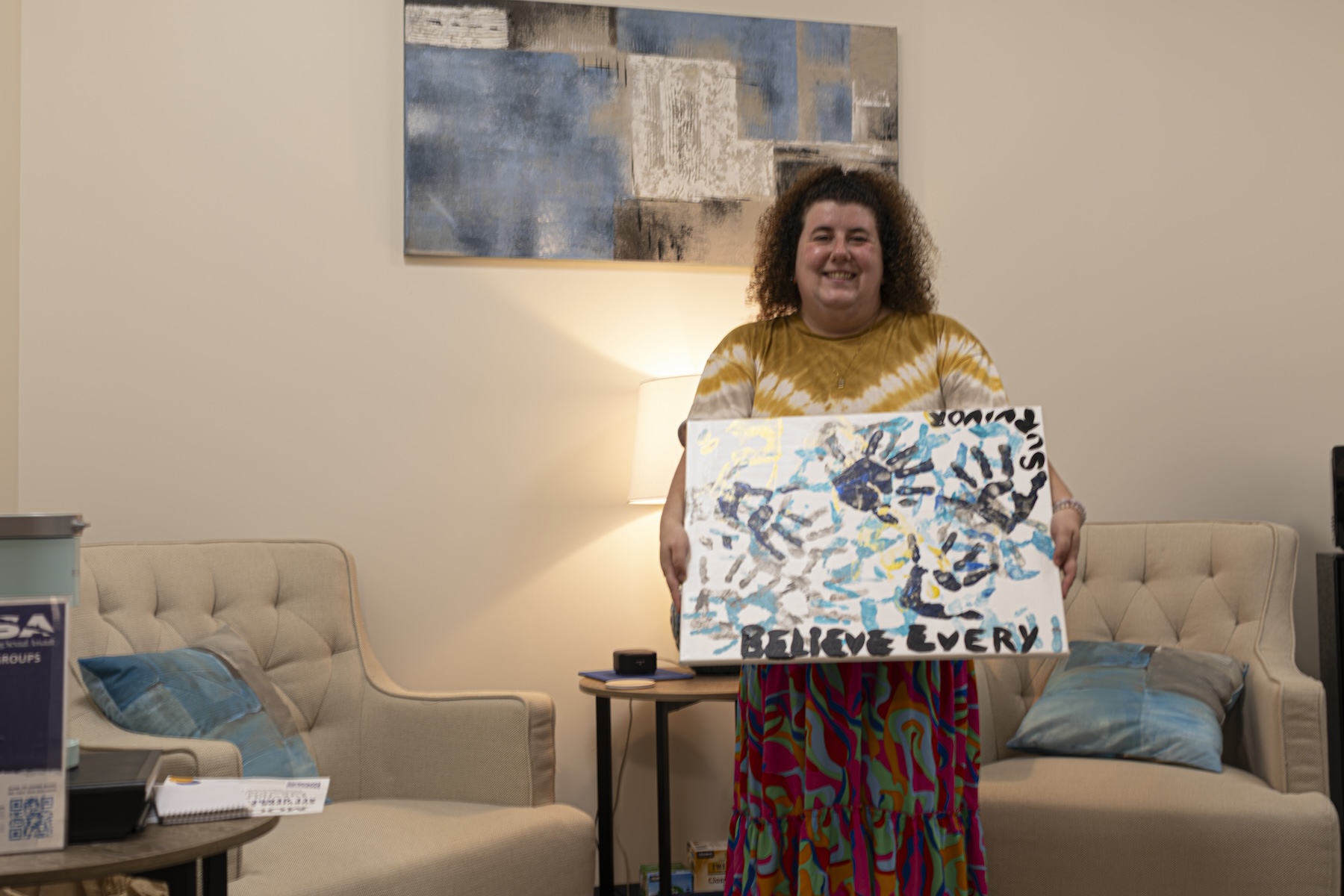
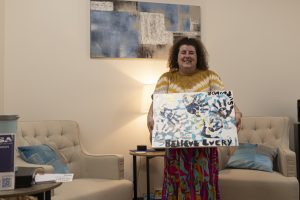
MOCSA Advocacy and outreach specialist – Megan Woodfield – displays art created by members of an all-gender survivor support group that meets at JCCC every Tuesday from 5:30-7:00 PM in RC 170. Photo By: Nathan Schweiger
To support students dealing with matters of sexual assault, the Metropolitan Organization Countering Sexual Assault (MOCSA) has an outreach office at JCCC with an advocate who is available every Tuesday from 9 a.m. to 4:30 p.m. at the Regnier Center, Room 303, to talk.
Since 1975, the Kansas City-based nonprofit organization has served sexual assault survivors in six counties with education, counseling and advocacy. MOCSA has provided outreach services for students at JCCC for over seven years.
Advocacy and Outreach Specialist II Megan Woodfield staffs MOCSA’s outreach office every Tuesday, where she provides in-person support for any student or staff member who walks in. As an outreach specialist, Woodfield works in both crisis and ongoing advocacy services.
“Crisis advocacy is going to be if someone calls our 24/7 crisis support line, I’m one of the people who might pick up the phone. Through that line, we also do ‘activations,’ as we call them, to local area hospitals,” Woodfield said. “So if someone is getting a SANE [Sexual Assault Nurse Examiner] exam done, it’s a part of most hospital protocols that they’ll call MOCSA.”
Woodfield said that within an hour of getting those calls, an advocate will visit a survivor with a resource bag called a “Boost Bundle,” which includes a change of clothes, MOCSA resources and toiletry and hygiene supplies. SANE exams, or rape kits, typically encourage survivors to leave behind the clothes they were wearing during the assault due to the possibility of preserving DNA evidence.
“As soon as they’re kind of done with what has to be done, they can switch into things that are fresh — have that kind of gunk be washed off and be in a better place. So we can be present for those exams, or we can leave the bag and go if folks aren’t comfortable and don’t want us there,” Woodfield said.
People can also call for next steps to report a sexual assault, with advocates able to be present when victims report to law enforcement. The crisis line also serves as a space for people who may need grounding through on-call support or want questions answered.
Through long-term advocacy, Woodfield also works as a Title IX advocate, helping clients navigate breaches of the 1972 federal civil rights law prohibiting sex-based discrimination in education.
“The cool thing is you don’t have to report to Title IX or to police or anything like that to work with us. So I have a couple of clients who I’m helping get resources. I’m helping them feel comfortable and safe, maybe exiting an unsafe environment, so they can get to a point where they feel like they can report,” Woodfield said.
Additionally, Woodfield spreads awareness about MOCSA’s mission through tabling and educational events around the metro.
“We help to train the police academy cadets with trauma-informed care, and we’re doing a training for the SANE nurses over at Children’s Mercy this week,” Woodfield said.
Woodfield first learned about violence prevention work as a student at Pittsburg State University, joining peer education group “Students for Violence Prevention,” which aims to educate students about domestic violence and unhealthy versus healthy relationships and similar topics.
“Originally got into it because I was a psych major. I was like, ‘oh, that’ll look good on my resume’ and then really fell in love with doing the work,” Woodfield said.
The experience propelled her interest in Title IX, with her psychology background serving as an “entry point.” Woodfield additionally received her master’s degree in psychology, focusing on how trauma affects the brain, as well as a minor in youth and adolescent development. She first learned about MOCSA after giving a presentation for a different agency and meeting volunteers.
“A couple of months later, I was looking for a job. It became open, and I was like, ‘Well, that feels like the most aligned pathway I can imagine.’ So three years later, here I am,” Woodfield said.
A typical week for a MOCSA advocate involves a variety of jobs. At least once a week, Woodfield has at least one shift on the 24/7 crisis support line, typically around 4.5 hours, and a client-centered meeting, which may involve going to a law enforcement interview or medical appointment with a client, or a high school meeting for safety planning. Advocates check in with each other during team meetings on Wednesdays. Two days a week, Woodfield works at home and hangs out with her dog. On Tuesdays, Woodfield works out of the JCCC outreach office.
“So from 9 a.m. to usually about 4:30 p.m., I’m here not only doing my work, but this kind of acts as an in-person crisis line of sorts. So anyone can come in at any time, get connected with resources, get information, or sometimes people just stumble in here because they think it’s cute and then learn that I exist,” Woodfield said.
Recent headlines circulating about sexual violence among college students emphasize the importance of knowing that an organization like MOCSA is present at JCCC and in the area. In a series of statistics and trends relating to sexual violence against college students provided by RAINN.org, one of the largest sexual violence advocacy organizations in the U.S., with data from Campus Climate surveys, the scope of the issue is wide.
- According to the organization, about one in eight college students experience sexual violence during their college journey. That equates to one in four undergraduate women (26%) and one in 14 undergraduate men (7%) experiencing nonconsensual sexual contact.
- Two in five college students experience at least one instance of sexual harassment. In a survey, 42% of college students reported experiencing sexually harassing behavior.
- 60% of college student victims of rape between the ages of 18 and 24 reported that they knew the perpetrator, and 69% reported that the perpetrator was an acquaintance or a friend.
Students may find MOCSA flyers and resources scattered around campus and notice tabling at events such as Soberfest, which helps fill gaps in knowledge about the organization’s free counseling and advocacy services for survivors after incidents of violence.
“We’ve been lucky to have a really good relationship with our friends over in Student Life, and so they’ll tend to invite us out to things that feel aligned,” Woodfield said. “Anything that we have the capacity to be at that feels like a good shot, we’re always trying to be there and be present for.”
In addition to providing support during the day, MOCSA at JCCC hosts an all-gender survivor support group open to individuals ages 18 and older on Tuesday nights on the first floor of the Regnier Center.
Woodfield wants all to be aware of MOCSA’s outreach office at JCCC and the fact that it serves as a confidential support space where anyone can explore their options.
“We want to make sure that students on campus are safe and have those resources, and also sometimes people may not be ready for their story to be out there yet or may want to get a little bit better information to know ‘Well, what is that process going to look like’ or ‘If I choose to go down this road, what are my options?’ and so I think knowing that we can be a place for some of that they don’t have to commit to anything to talk with us, or to work with us, and knowing that there’s a support system who is always going to believe them and be there for them.”
For Woodfield, being a MOCSA advocate is valuable to both clients and advocates.
“I can’t tell you the amount of times that someone would be like, ‘You’re the first person I’ve ever told this to’, which is such an honor: ‘Oh my God, thank you, as a perfect stranger,’ but also that heartbreaking moment of, ‘Well, did they not know that we were around and they could have talked to us before?’” Woodfield said.
“I think the biggest thing for me is just letting students know that there is always someone around who’s going to care, and especially with our 24/7 crisis support line, literally at any time you can get connected to someone who gets it, that you don’t have to go into all the nitty-gritty details with and who truly wants to be there for you.”







Leave a Reply