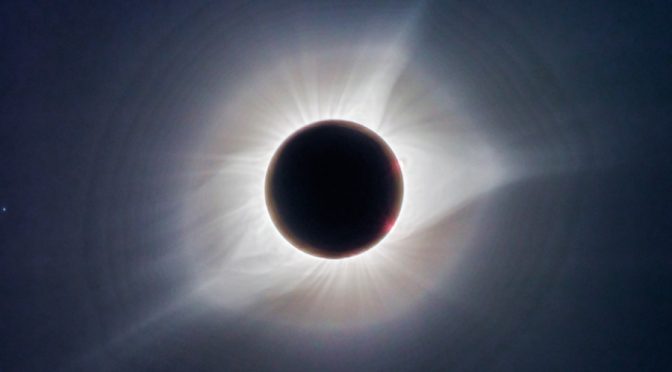
Wow, wow, and triple wow! I expected the eclipse to be pretty cool, but it was absolutely mind blowing! Prof. Koch and I spoke with our Dean last spring and the three of us agreed that he and I needed to be on the path of totality in spite of that day being the first day of class. We were prepared from a gear perspective. We had an 8″ and a 12″ telescope, both fitted with white light solar filters, our new solar telescope with a built-in hydrogen-alpha filter to see prominances, and no less than six DSLRs between us with everything from a fisheye lens to a 400-mm f/4 prime lens. We hosted around 100 people including my fellow space physics researchers at Fundamental Technologies, science educator friends from Rockhurst University, racing buddies from the Sports Car Club of America (SCCA), and of course several other friends and professors and Dean Miller from JCCC.
Prof Koch and I started getting things set up pretty early, around 8am. As we looked to the southwest, though, we saw the rain coming and quickly grabbed some plastic sheeting and covered the telescopes. Thankfully, we didn’t get the torrential rains that the KC Metro received, but it did put a damper on our enthusiasm. The eclipse started a little after 11:30am, but our skies were still completely cloudy overhead. We held on to hope, though, as we could see a patch of blue sky approaching. A little bit past noon, after we had all stuffed ourselves on pulled pork, moon pies, sun chips, and enough potato salad to feed an army, the clouds broke and we had crystal clear skies. Just in time!!!
We watched the partial eclipse deepen using our various cameras, telescopes, eclipse glasses, and pinhole projectors. As the eclipse deepened, it became darker and darker. The dappled light under the trees started to appear more crescent shaped, and we all began to get excited. When totality finally came, I don’t think there was anyone who wasn’t blown away by the sight.
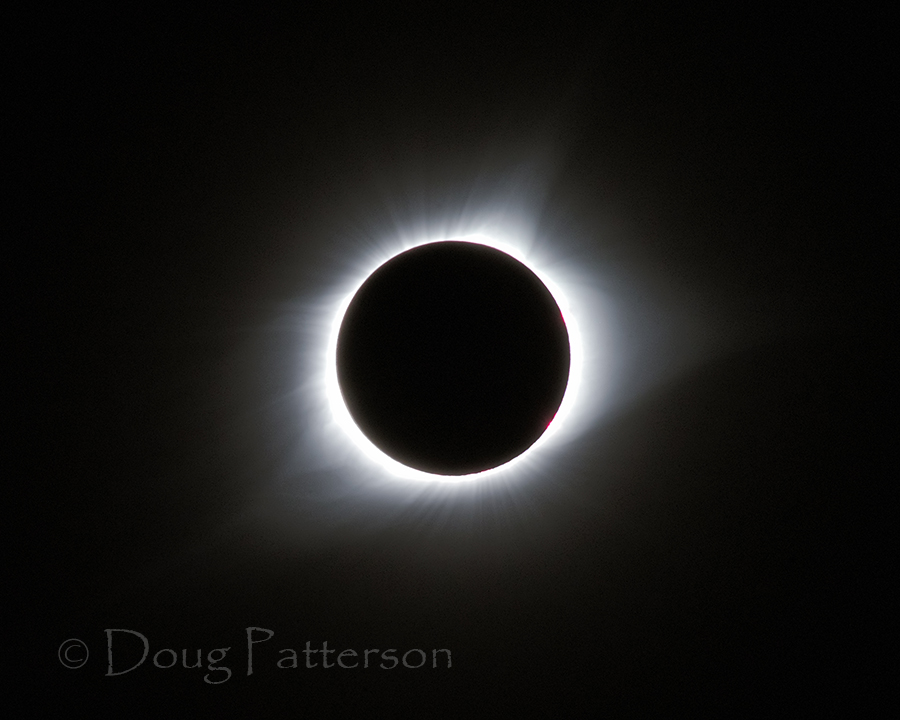
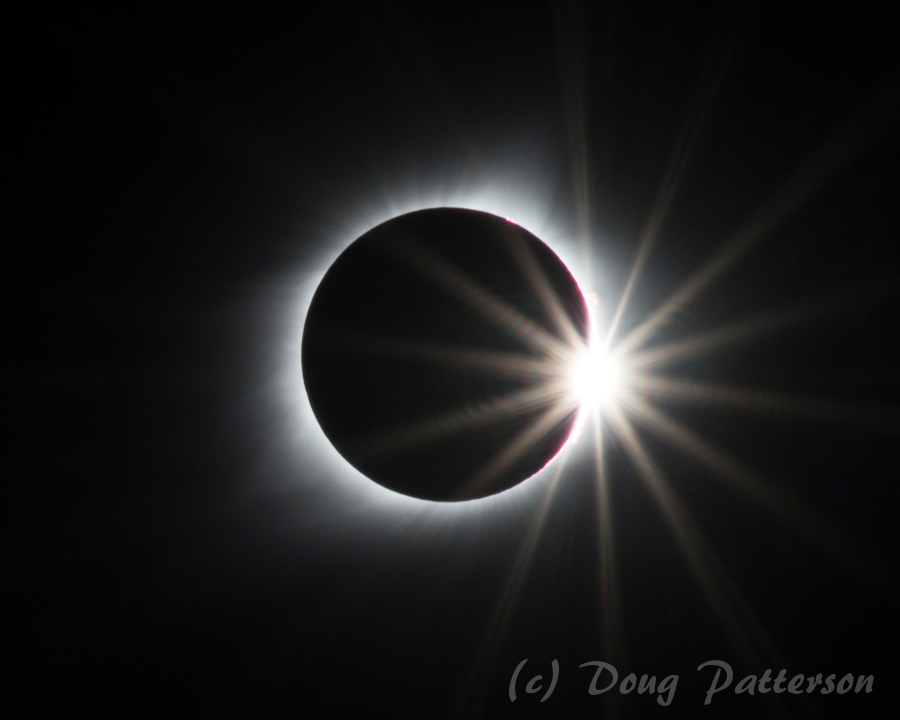
In the shadow of the Moon, we saw what looked like a sunset all around us on every horizon, the temperature dropped, and we saw a couple of planets and bright stars. Of course what was really spectacular was seeing the solar corona. My research focus for the past twenty years has been the solar corona and space weather, but Monday was the first time I have ever seen the object of my research with my own eyes. It was moving beyond anything I had expected.
Our location enjoyed a little over two minutes of totality, but it seemed like only two seconds. Just like that, the Sun began to peek out from around the Moon once again and back on went the filters and the glasses. We admired the partial eclipse a while longer and marveled at the rapidly brightening skies, but then we milled around, some of us packing up, some of us going back for more food. It was Leo, a friend and member of the Astronomical Society of Kansas City, that pointed out the crazy fact that there was a solar eclipse still happening right above us, but after totality, we had all gone back into our routine habits as humans.
As an avid photographer, of course I had gear set up to record the eclipse, but I didn’t let the photography of the event get in the way of my experiencing the event. I had my exposures all preplanned and the camera able to fire with a remote shutter release allowing me to image the sun while not needing to always be peering through the view finder.

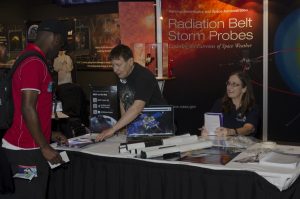 We were at Cocoa Beach for three nights where during the day we interacted with visitors to the Kennedy Space Center where we had a large display assembled sharing information about the mission, its objectives, and its importance to improving our understanding of space weather. As invited guests, we were given the opportunity to witness the launch from the same grandstands in which the families of the Apollo astronauts watched their husbands, brothers, and sons blast off on their epic voyage to the Moon. It was an awe-inspiring, thrilling, and ultimately frustrating experience.
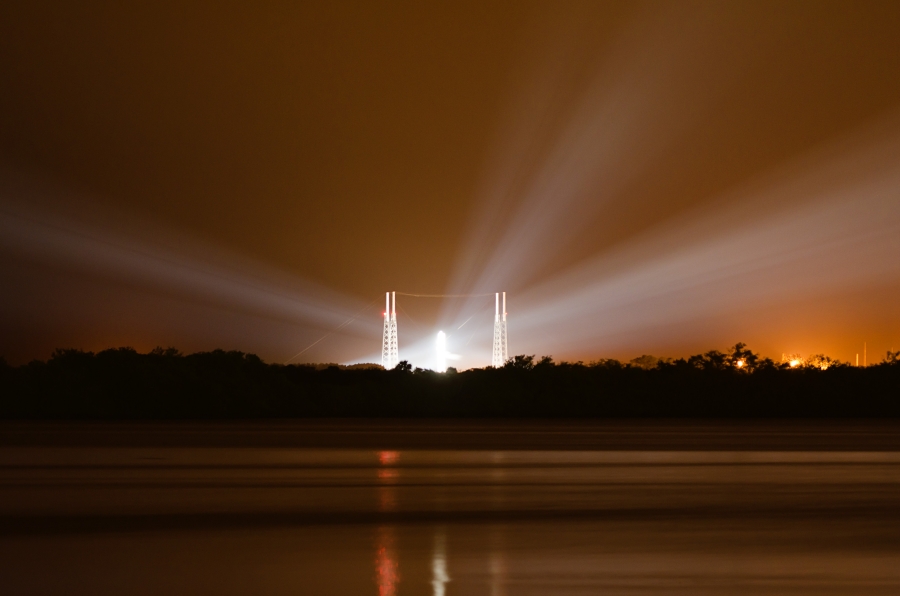
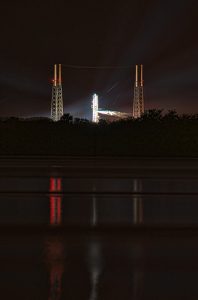 The launch window opened at 0430 which meant that we needed to arrive at Kennedy by 0030 to meet the shuttle busses that would take us to the viewing stands. Once at the viewing location, we had a magnificent view of our launch vehicle standing on its pad and illuminated by the brightest lights you can imagine. The atmosphere at the viewing site was thick with tension, anticipation, and mosquitoes. Lots of mosquitoes! During the long countdown, several speakers gave talks about the mission, which we all knew about already, and details about the launch sequence and timeline, which many of us did not know. What was truly special is that Maj. Gen. Charles Frank Bolden, Jr., Director of NASA, came out to address us and witness the launch with us.
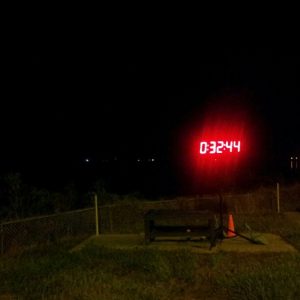 At 0400, we reached the T-4 minute hold. This was a preplanned hold during which final checks on the launch vehicle, the two Van Allen Probes spacecraft, and the launch conditions were made. Talk about tense and exciting! Movies always make the launch readiness poll sound over dramatic and you come away thinking, “Surely it’s not really that tense.” Yes it is; it really is. As each system was called out, the person responsible for that system would call out either “Go!” or “Go, Flight!” I get goosebumps even now just thinking about that moment.