WGBH American Experience . Murder of a President

TV’s most-watched history series airs on PBS and has a library of over250 documentaries.

Source: WGBH American Experience . Murder of a President

Posted in Uncategorized | Leave a comment

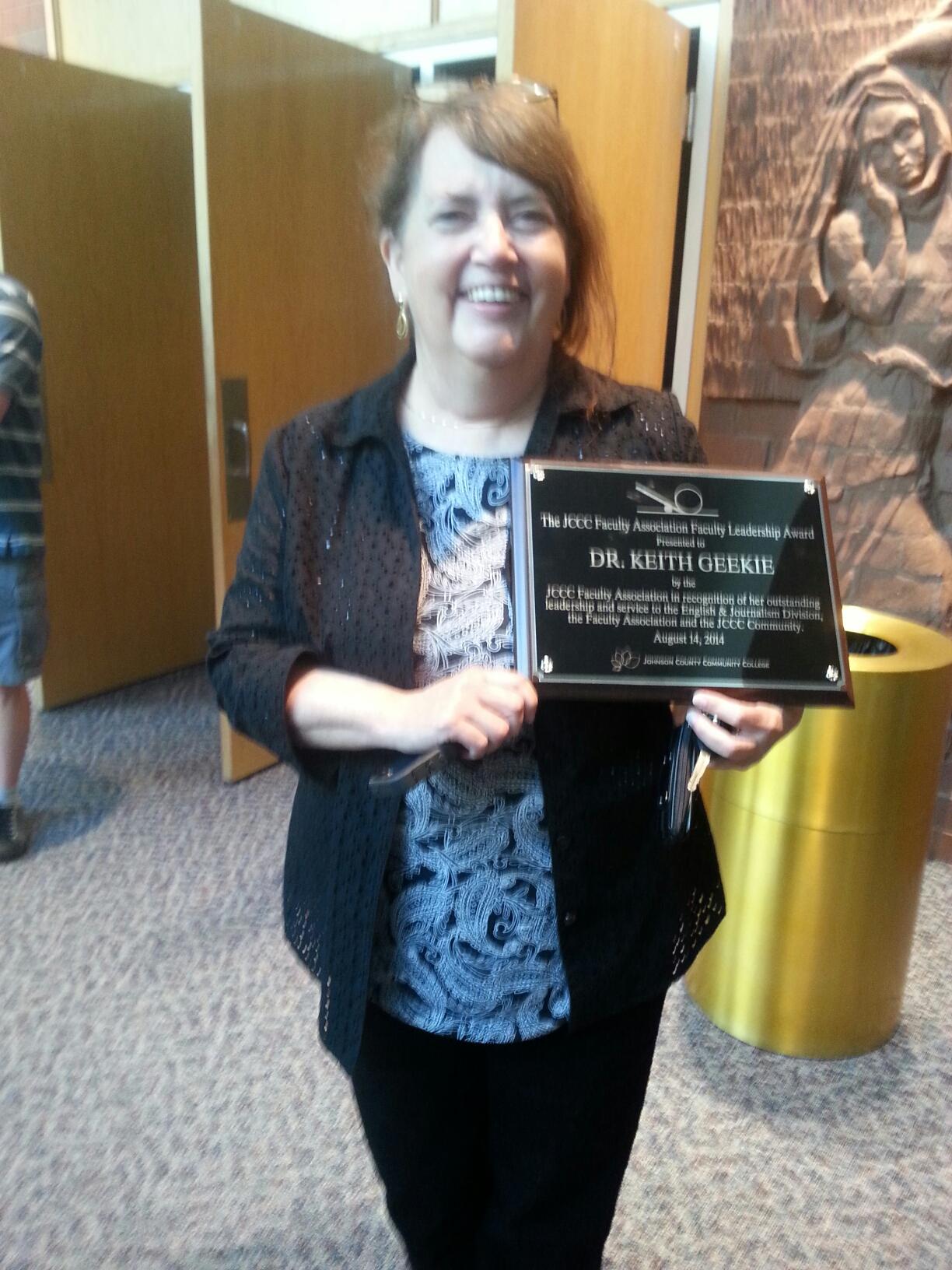
Dr. Keith Geekie Wins FA Leadership Award

KeithAward

The highlight of Thursday’s faculty meeting came at the very end when faculty association president Deb Williams awarded English Chair Keith Geekie with the FA faculty leadership award. The award, established a decade ago, has  been awarded only once before. Keith was nominated by Division Dean Larry Reynolds and the award was enthusiastically endorsed by the FA executive committee.

The presentation of the award was a surprise for the whole faculty and for Keith. As Deb began listing the award recipient’s activities and involvement on campus, every faculty member sitting in the English section began to grin in recognition. The last to catch on was, of course, Keith herself. When her name was announced, Keith (as moved as I have ever seen her) worked her way to the stage to the sound of thunderous applause and a standing ovation.

Diane Davis expressed the opinion of the department in an open email to Keith, writing “Several of your colleagues, while leaving the meeting today after the announcement you had won the  faculty leadership award, commented they couldn’t imagine anyone more worthy of this award than you, and even before the name was announced, their certainty that is had to be you.  You are a person who advocates far more for others than yourself, and who graciously deflects praise and shines the spotlight on the rest of us.  I can’t tell you how much it means to us, then, to witness the entirety of our college community united in their appreciation of all you do.  For the countless hours you spend often behind the scenes looking out for our students, our faculty, our curriculum, our courses, our department, division and discipline, I thank you.  Most of us will never know how often you have pulled this group together, fought to keep our division intact, unified us and strengthened us.  I’m delighted the spotlight is on you, where it belongs.”

Her acceptance speech has been reenacted by Merritt Wever here.

Posted in Uncategorized | Leave a comment

EAP Adjunct List

Here is a list of the EAP adjuncts (http://www.jccc.edu/globalenglish/faculty-list.html).

Dawn Aronoff
Adjunct Assoc. Professor, Global Engl. Inst.

Kate Austin
Adjunct Assoc. Professor

Jennifer Chung
Adjunct Asst. Professor

Linda Fargus
Adjunct Assoc. Professor, Reading & Global Engl. Inst.

Annie Gray
Adjunct Professor, Global Engl. Inst.

John Hewitt
Adjunct Assoc. Professor

Rebecca Kastendick
Adjunct Asst. Professor, Global Engl. Inst.

Ella Lytchnikova
Adjunct Assoc. Professor, Global Engl. Inst.

Maritza Paul Newby
Adjunct Assoc. Professor, Global Engl. Inst.

Emily Nguyen
Adjunct Assoc. Professor

Susan Peters
Adjunct Assoc. Professor

Ann Phillips
Adjunct Professor, Global Engl. Inst.

Mariella Rainwater
Adjunct Assoc. Professor, Global Engl. Inst. & Reading

Victoria Springer
Adjunct Asst. Professor

Shannon Tumanut
Adjunct Assoc. Professor, Global Engl. Inst.

Suzanne Woodward
Adjunct Professor, Global Engl. Inst.


Posted in Uncategorized | Comments Off on EAP Adjunct List

College Scholar Application

seal
Purpose:  To showcase faculty excellence in research fields that go beyond the classroom to make scholarly contributions to knowledge within the professor’s academic discipline; in particular:
All applicants must demonstrate evidence of expertise within their academic disciplines relevant to the topic being proposed
These may include publications or articles about the faculty member’s work in refereed journals, international, national, or regional recognition, or other venues
Applicants must provide two letters of recommendation from scholars outside of JCCC who can testify to the significance of their research in their larger academic discipline
Available to:  All faculty members (successful applicants must wait one year before applying again, and must apply with a different topic)
Nomination/Application:  College Scholars Program
Submit to:  Staff and Organizational Development GEB 275, Box 43
Deadline:     April 11
Approval:     Review by the College Scholars committee,  who may weigh factors such as general interest, timeliness, relevance of topic, and representational qualities of the presentations in totality in making its decision.
Obligations/Awards
Recipients must deliver two presentations, both of which must deliver information or research-in-progress beyond the normal pedagogical content of a JCCC course:
One evening lecture in which the topic is tailored for a general audience
One daytime presentation tailored for students, faculty, and staff
Recipients  must either visit two classes as an invited guest, or lead a faculty seminar/colloquium in consultation with Staff and Organizational Development
The public presentations and class visits (or faculty seminar) should focus on a topical theme to be explained in the application
Recipients  are expected to help promote their presentations, arrange for their own class visits, and work with the College Scholars committee to coordinate all other details, with assistance from the Staff and Organizational Development department
Each recipient will receive a total award of $2000 (if the applicant can prove financial need related to the completion of the project, half will be awarded at the end of the spring semester, the other after the applicant has completed his/her presentations)
Plaque and recognition at the Annual Awards Luncheon for up to four (4) annual recipients
Recipients must participate on the College Scholars committee during the following program cycle
Funding Source:  Staff & Organizational Development Budget
Additional Information:  Staff and Organizational Development, [email protected] or ext. 7654 
Posted in Uncategorized | Comments Off on College Scholar Application

Habits of Creative Folks

18 Things Highly Creative People Do Differently
http://www.huffingtonpost.com/2014/03/04/creativity-habits_n_4859769.html
Carolyn Gregoire  3/4/12
[Carolyn Gregoire is a features editor at the Huffington Post. She has spoken at TEDx and the Harvard Public Health Forum, and appeared on MSNBC and The TODAY Show. She graduated from McGill University in Montreal, where she studied philosophy and English literature.]
Creativity works in mysterious and often paradoxical ways. Creative thinking is a stable, defining characteristic in some personalities, but it may also change based on situation and context. Inspiration and ideas often arise seemingly out of nowhere and then fail to show up when we most need them, and creative thinking requires complex cognition yet is completely distinct from the thinking process.
Neuroscience paints a complicated picture of creativity. As scientists now understand it, creativity is far more complex than the right-left brain distinction would have us think (the theory being that left brain = rational and analytical, right brain = creative and emotional). In fact, creativity is thought to involve a number of cognitive processes, neural pathways and emotions, and we still don’t have the full picture of how the imaginative mind works.
And psychologically speaking, creative personality types are difficult to pin down, largely because they’re complex, paradoxical and tend to avoid habit or routine. And it’s not just a stereotype of the “tortured artist” — artists really may be more complicated people. Research has suggested that creativity involves the coming together of a multitude of traits, behaviors and social influences in a single person.
“It’s actually hard for creative people to know themselves because the creative self is more complex than the non-creative self,” Scott Barry Kaufman, a psychologist at New York University who has spent years researching creativity, told The Huffington Post. “The things that stand out the most are the paradoxes of the creative self … Imaginative people have messier minds.”
While there’s no “typical” creative type, there are some tell-tale characteristics and behaviors of highly creative people. Here are 18 things they do differently.
They daydream.
Creative types know, despite what their third-grade teachers may have said, that daydreaming is anything but a waste of time.
According to Kaufman and psychologist Rebecca L. McMillan, who co-authored a paper titled “Ode To Positive Constructive Daydreaming,” mind-wandering can aid in the process of “creative incubation.” And of course, many of us know from experience that our best ideas come seemingly out of the blue when our minds are elsewhere.
Although daydreaming may seem mindless, a 2012 study suggested it could actually involve a highly engaged brain state — daydreaming can lead to sudden connections and insights because it’s related to our ability to recall information in the face of distractions. Neuroscientists have also found that daydreaming involves the same brain processes associated with imagination and creativity.
They observe everything.
The world is a creative person’s oyster — they see possibilities everywhere and are constantly taking in information that becomes fodder for creative expression. As Henry James is widely quoted, a writer is someone on whom “nothing is lost.”
The writer Joan Didion kept a notebook with her at all times, and said that she wrote down observations about people and events as, ultimately, a way to better understand the complexities and contradictions of her own mind:
“However dutifully we record what we see around us, the common denominator of all we see is always, transparently, shamelessly, the implacable ‘I,'” Didion wrote in her essay On Keeping A Notebook. “We are talking about something private, about bits of the mind’s string too short to use, an indiscriminate and erratic assemblage with meaning only for its marker.”
They work the hours that work for them.
Many great artists have said that they do their best work either very early in the morning or late at night. Vladimir Nabokov started writing immediately after he woke up at 6 or 7 a.m., and Frank Lloyd Wright made a practice of waking up at 3 or 4 a.m. and working for several hours before heading back to bed. No matter when it is, individuals with high creative output will often figure out what time it is that their minds start firing up, and structure their days accordingly.
They take time for solitude.
“In order to be open to creativity, one must have the capacity for constructive use of solitude. One must overcome the fear of being alone,” wrote the American existential psychologist Rollo May.
Artists and creatives are often stereotyped as being loners, and while this may not actually be the case, solitude can be the key to producing their best work. For Kaufman, this links back to daydreaming — we need to give ourselves the time alone to simply allow our minds to wander.
“You need to get in touch with that inner monologue to be able to express it,” he says. “It’s hard to find that inner creative voice if you’re … not getting in touch with yourself and reflecting on yourself.”
They turn life’s obstacles around.
Many of the most iconic stories and songs of all time have been inspired by gut-wrenching pain and heartbreak — and the silver lining of these challenges is that they may have been the catalyst to create great art. An emerging field of psychology called post-traumatic growth is suggesting that many people are able to use their hardships and early-life trauma for substantial creative growth. Specifically, researchers have found that trauma can help people to grow in the areas of interpersonal relationships, spirituality, appreciation of life, personal strength, and — most importantly for creativity — seeing new possibilities in life.
“A lot of people are able to use that as the fuel they need to come up with a different perspective on reality,” says Kaufman. “What’s happened is that their view of the world as a safe place, or as a certain type of place, has been shattered at some point in their life, causing them to go on the periphery and see things in a new, fresh light, and that’s very conducive to creativity.”
They seek out new experiences.
Creative people love to expose themselves to new experiences, sensations and states of mind — and this openness is a significant predictor of creative output.
“Openness to experience is consistently the strongest predictor of creative achievement,” says Kaufman. “This consists of lots of different facets, but they’re all related to each other: Intellectual curiosity, thrill seeking, openness to your emotions, openness to fantasy. The thing that brings them all together is a drive for cognitive and behavioral exploration of the world, your inner world and your outer world.”
They “fail up.”
Resilience is practically a prerequisite for creative success, says Kaufman. Doing creative work is often described as a process of failing repeatedly until you find something that sticks, and creatives — at least the successful ones — learn not to take failure so personally.
“Creatives fail and the really good ones fail often,” Forbes contributor Steven Kotler wrote in a piece on Einstein’s creative genius.
They ask the big questions.
Creative people are insatiably curious — they generally opt to live the examined life, and even as they get older, maintain a sense of curiosity about life. Whether through intense conversation or solitary mind-wandering, creatives look at the world around them and want to know why, and how, it is the way it is.
They people-watch.
Observant by nature and curious about the lives of others, creative types often love to people-watch — and they may generate some of their best ideas from it.
“[Marcel] Proust spent almost his whole life people-watching, and he wrote down his observations, and it eventually came out in his books,” says Kaufman. “For a lot of writers, people-watching is very important … They’re keen observers of human nature.”
They take risks.
Part of doing creative work is taking risks, and many creative types thrive off of taking risks in various aspects of their lives.
“There is a deep and meaningful connection between risk taking and creativity and it’s one that’s often overlooked,” contributor Steven Kotler wrote in Forbes. “Creativity is the act of making something from nothing. It requires making public those bets first placed by imagination. This is not a job for the timid. Time wasted, reputation tarnished, money not well spent — these are all by-products of creativity gone awry.”
They view all of life as an opportunity for self-expression.
Nietzsche believed that one’s life and the world should be viewed as a work of art. Creative types may be more likely to see the world this way, and to constantly seek opportunities for self-expression in everyday life.
“Creative expression is self-expression,” says Kaufman. “Creativity is nothing more than an individual expression of your needs, desires and uniqueness.”
They follow their true passions.
Creative people tend to be intrinsically motivated — meaning that they’re motivated to act from some internal desire, rather than a desire for external reward or recognition. Psychologists have shown that creative people are energized by challenging activities, a sign of intrinsic motivation, and the research suggests that simply thinking of intrinsic reasons to perform an activity may be enough to boost creativity.
“Eminent creators choose and become passionately involved in challenging, risky problems that provide a powerful sense of power from the ability to use their talents,”write M.A. Collins and T.M. Amabile in The Handbook of Creativity.
They get out of their own heads.
Kaufman argues that another purpose of daydreaming is to help us to get out of our own limited perspective and explore other ways of thinking, which can be an important asset to creative work.
“Daydreaming has evolved to allow us to let go of the present,” says Kaufman. “The same brain network associated with daydreaming is the brain network associated with theory of mind — I like calling it the ‘imagination brain network’ — it allows you to imagine your future self, but it also allows you to imagine what someone else is thinking.”
Research has also suggested that inducing “psychological distance” — that is, taking another person’s perspective or thinking about a question as if it was unreal or unfamiliar — can boost creative thinking.
They lose track of the time.
Creative types may find that when they’re writing, dancing, painting or expressing themselves in another way, they get “in the zone,” or what’s known as a flow state, which can help them to create at their highest level. Flow is a mental state when an individual transcends conscious thought to reach a heightened state of effortless concentration and calmness. When someone is in this state, they’re practically immune to any internal or external pressures and distractions that could hinder their performance.
You get into the flow state when you’re performing an activity you enjoy that you’re good at, but that also challenges you — as any good creative project does.
“[Creative people] have found the thing they love, but they’ve also built up the skill in it to be able to get into the flow state,” says Kaufman. “The flow state requires a match between your skill set and the task or activity you’re engaging in.”
They surround themselves with beauty.
Creatives tend to have excellent taste, and as a result, they enjoy being surrounded by beauty.
study recently published in the journal Psychology of Aesthetics, Creativity, and the Arts showed that musicians — including orchestra musicians, music teachers, and soloists — exhibit a high sensitivity and responsiveness to artistic beauty.
They connect the dots.
If there’s one thing that distinguishes highly creative people from others, it’s the ability to see possibilities where other don’t — or, in other words, vision. Many great artists and writers have said that creativity is simply the ability to connect the dots that others might never think to connect.
In the words of Steve Jobs:
“Creativity is just connecting things. When you ask creative people how they did something, they feel a little guilty because they didn’t really do it, they just saw something. It seemed obvious to them after a while. That’s because they were able to connect experiences they’ve had and synthesize new things.”
They constantly shake things up.
Diversity of experience, more than anything else, is critical to creativity, says Kaufman. Creatives like to shake things up, experience new things, and avoid anything that makes life more monotonous or mundane.
“Creative people have more diversity of experiences, and habit is the killer of diversity of experience,” says Kaufman.
They make time for mindfulness.
Creative types understand the value of a clear and focused mind — because their work depends on it. Many artists, entrepreneurs, writers and other creative workers, such as David Lynch, have turned to meditation as a tool for tapping into their most creative state of mind.
And science backs up the idea that mindfulness really can boost your brain power in a number of ways. A 2012 Dutch study suggested that certain meditation techniques can promote creative thinking. And mindfulness practices have been linked withimproved memory and focusbetter emotional well-being, reduced stress and anxiety, and improved mental clarity — all of which can lead to better creative thought.
Posted in Uncategorized | Comments Off on Habits of Creative Folks