
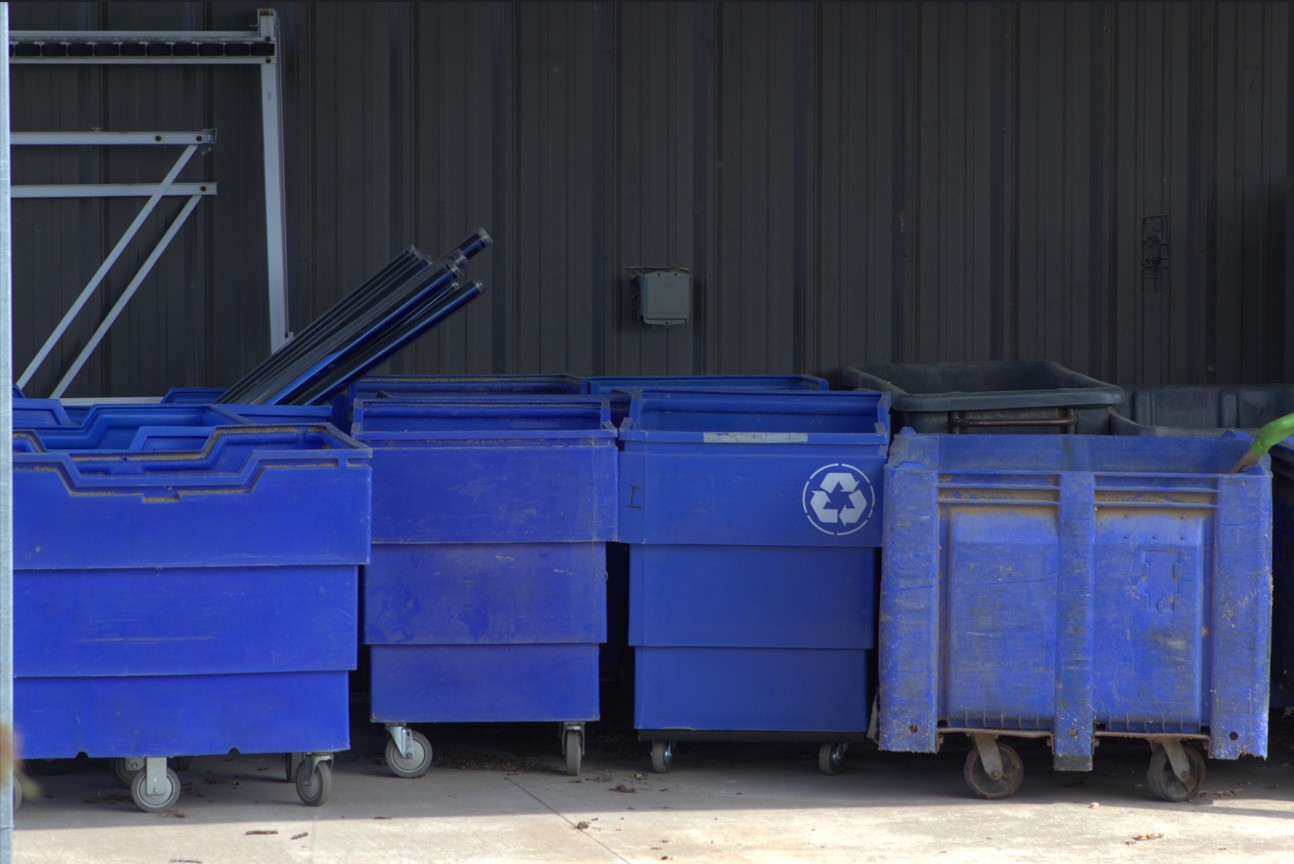
(Photo by: Jasmine Mills)
In 2011, the Center for Sustainability set two major goals: to become a zero-waste-to-landfill campus by 2025 and to be 100% reliant on renewable energy by 2050. While the 2050 goal was met early in 2017 by moving to solar and wind energy, the 2025 zero-waste goal remains unmet.
“I’ll just say I was incredibly naïve when I started here, because I was like, ‘10 years, no problem.’ We are not even close,” said Krystal Anton, Zero-Waste Coordinator at JCCC’s Center for Sustainability.
According to Anton, JCCC throws away around two million pounds of trash every year. Food waste, picked apart air conditioning units, outdated firefighting equipment, fabric scraps from the fashion department — since 2015, it has been Anton’s job to divert as much of it from landfills as possible.
Anton said the school has a diversion rate of up to 64%, but the average is about 55%. That means that more than one million pounds of trash is being diverted from the landfill each year—a hard-won accomplishment, but short of the 90% diversion rate needed to be considered zero-waste.
According to Anton, obstacles to the goal include limitations on space and labor for processing waste. Another is outside infrastructure — she noted that, even if JCCC were able to collect and process all waste on campus, the question of where to send it would remain.
“Our region doesn’t have enough infrastructure to support it,” Anton said, though she expressed hope that regional infrastructure is starting to catch up with the Center of Sustainability’s ambitions.
In April of 2024, Lee Summit Recovery Park, operated by Summit Transfer, was enlisted to handle the school’s Construction and Demolition (C&D) recycling. Contractors involved with any JCCC construction are required to use Summit Transfer, which sifts through the C&D materials. Items like concrete, wood, metal, asphalt and plastic that can be recycled will be diverted from landfills. According to Anton, the C&D recycling rate is 82%.
Scraps KC can find homes for items that are otherwise difficult to recycle, especially art and school supplies. These are used for the Teacher Resource Center, a non-profit that provides materials to local Pre-K and K-12 teachers.
More than $350,000 in student scholarships have been funded by recycling revenue.
The Center for Sustainability celebrated composting one million pounds of food this year. Nitrogen-rich food waste is collected from kitchens around campus, including the cafeteria, coffee shops, the culinary department and the daycare. Carbon-rich waste, such as leaves and sawdust from campus tree maintenance, is used to balance the nitrogen-rich waste. All this is brought to the shed, which houses the In-Vessel Compost and three compost bins. Finished compost is used to grow organic food on the JCCC farm, then served in meals on campus, creating a closed-loop system of waste management.
Anton credits the success of the compost program to the dedication of student interns who work under her. Raeyn Gallegos, a horticulture student, holds the position respectfully referred to as Shedhead, since she spends much of her time in the composting shed. Gallegos explained that the compost program is limited, for the most part, to pre-consumer food waste, which is waste that has not yet reached the consumer. Post-consumer food waste, like the leftovers from a plate in the dining hall, runs too high a risk of contaminating the compost.
“Even with pre-consumer composting, contamination is such an issue we run into,” Gallegos said. “Trying to do post-consumer is not feasible with the people and systems we have in place currently.”
Raeyn Gallegos outside of the shed.
Gallegos, who starts at K-State next fall, expressed optimism that future interns will bring new ideas to combat the obstacles blocking zero-waste.
“I think, with every internship, we get a little bit closer to a more thorough and efficient way of doing things,” Gallegos said.
According to Gallegos, letting students tackle these problems provides an educational opportunity.
“It is very much applied learning,” Gallegos said.
When asked about zero-waste during an in-class press conference, Tony Miksa, the newly appointed President of JCCC, said he trusts Dr. Antle to lead that area of the college. Miksa stated that JCCC takes sustainability very seriously and highlighted the importance of work-study programs centered on sustainability.
He also noted that JCCC has earned a Gold rating from The Sustainability Tracking Assessment & Rating System (STARS). STARS is a sustainability assessment framework offered by The Association for the Advancement of Sustainability in Higher Education (AASHE).
JCCC is currently the highest-rated community college in the United States and is fifth internationally.
“So that next step is Platinum,” Miksa said, referring to the highest rating offered by STARS.








Leave a Reply