
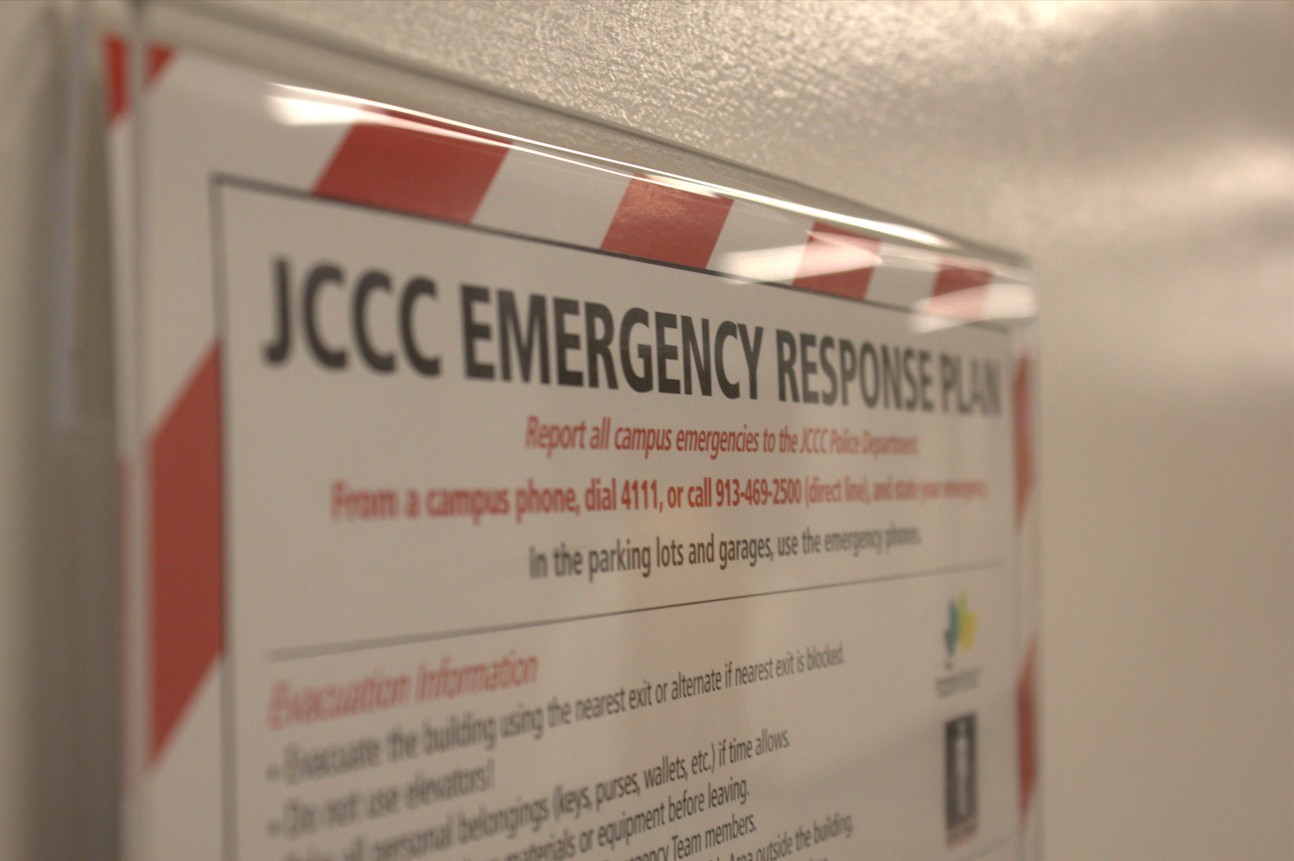
(Photo by: Jasmine Mills)
The beginning of this spring has been busy with disasters, and with Kansas being in tornado alley, mass shootings becoming more prevalent in our society, and fires a possibility, it’s important to know what to do in those types of situations.
JCCC Chief of Police Seth Mullis explains that the police department plays a critical role in protecting lives, responding to situations and restoring safety as quickly as they possibly can.
“From the first moments through recovery, our focus is always on the safety and well-being of our campus community,” Mullis said. “We treat every report seriously, but it’s important to confirm the situation as quickly as possible so we can make informed decisions.”
Officers receive regular, ongoing training throughout the year that is focused on active threats, with a goal of preparing officers to act quickly, safely and effectively in an emergency.
“This includes decision-making under stress, coordination with other responders and lifesaving medical care,” Mullis said.
There are also drills conducted where faculty and students are involved. The department keeps clear communication and coordination with local partners to make sure everyone is prepared.
“These exercises help everyone better understand emergency procedures and allow officers to practice communication and coordination in realistic, but controlled, scenarios,” Mullis said. “We train together regularly and maintain strong working relationships so that, if a crisis occurs, everyone understands their role and response is seamless.”
As Director of Emergency Management, Alisa Pacer is responsible for planning for emergencies on every level. She ensures that there is a timely, effective and coordinated response.
She explained the college uses an “all hazards” approach, which includes prevention, protection, mitigation, response and recovery phases of emergency management best practices. She also works with community partners, building relationships to ensure they are polished and ready to respond when needed.
“Emergency Management takes the lead on all mass notification systems in the event of an emergency or threat to the campus community and is responsible for ensuring all systems are operational,” Pacer said.
Mullis and Pacer explained what to do during three different types of emergency situations: tornado, fire, and active shooting.
Tornado:
Pacer explained that people typically confuse a tornado watch with a tornado warning. In order to better explain, she used an analogy of a tornado being compared to a taco.
Think of a tornado watch like this:
You have all the ingredients to make tacos—tortillas, meat, cheese, salsa—and they’re sitting on your counter or in your fridge.
- The conditions are favorable for tacos.
- You might make tacos.
- You’re paying attention and thinking ahead.
- Nothing is happening yet, but it could.
Synopsis: A tornado could develop. Stay aware, check your plans, know where to go and be ready to act.
Think of a tornado warning like this:
The taco is made and sitting right in front of you—or someone is actively handing it to you.
- This is no longer hypothetical.
- The taco is real and happening right now.
- It’s time to eat the taco, not debate recipes.
Synopsis: A tornado has been observed or indicated by radar. Take shelter immediately.
When a tornado warning is issued on campus, the emergency department springs into action and notifies the campus in every possible way they can, such as through text, email, computer alerts in offices and classrooms, and posting to social media.
She explained that the best places to go during this situation are grayed out on emergency response floorplan posters as well as online, and are marked as such outside the room.
“As a general rule, interior core spaces within the buildings with few or no windows and away from exterior walls, enclosed cement stairwells, and restrooms are often the best places and easily recognized. In some cases, an interior hallway may be the best area to shelter,” Pacer said.
Fire:
In a fire emergency, Pacer explained that everyone inside the building should evacuate immediately. The emergency department asks that everyone gather in a designated emergency assembly area that is highlighted on all campus maps.
“During a fire alarm notification, it is not the time to wonder what is happening and sit around thinking it will go away. Evacuation should occur any time there is a fire alarm, which is indicated by the flashing strobe lights via the fire alarm notifiers, with a very clear message that there is a fire emergency in the building and one should evacuate now,” Pacer said.
In a situation where someone is trapped or can’t evacuate properly, it’s recommended that they contact JCCC Police at 913-469-2500 or reach out using the Guardian Safety app via phone or text to JCCC Police to let them know of their location.
“Typically, an enclosed stairwell is a good place to wait for responders to rescue that individual if they can safely get there with fire-rated doors, etc,” Pacer said.
Fire drills are typically held during the summer to practice and are communicated in many ways before they occur.
Active shooter:
Mullis explained that JCCC teaches the ALICE approach: Alert, Lockdown, Inform, Counter and Evacuate. It’s designed to help people know what their options may be if a situation like this were to occur.
“No two situations are exactly the same, so situational awareness is critical,” Mullis said. “Students should trust their instincts, follow available guidance and focus on getting to safety, whether that means leaving the area if it’s safe to do so, or securing themselves in a locked and barricaded space.”
Mullis explained that the college is very fortunate to have Pacer, who he explained as outstanding and a diligent provider of training, resources and timely information to students, faculty and staff. Pacer explained that it’s very important to communicate and keep people informed on what’s going on.
“People can react very differently, but I am of the opinion that the campus community has trust in their law enforcement and emergency planning teams to handle the threat at hand. Words matter to communicate the threatening situation and not to cause extra panic–so templates exist based on best strategies,” Pacer said.
Pacer wants students to be more involved and get prepared. One method she suggests is the Be Ready in 5 system, which includes:
- Know the campus police phone number.
- Put 913-469-2500 in your cell phone because you never know when something can happen.
- Know where to go for shelter/emergency evacuation in the buildings you frequent.
- Be familiar with the ALICE Program for active threat situations.
- Download the Guardian campus safety app, which provides text and phone capabilities to Campus Police, plus more. You are automatically enrolled in the JCCC Alert text and email system as an active student.
Pacer explains that awareness is key in any of these situations.
“Being aware of your surroundings, your exits, suspicious items or people, red flag behaviors and reporting as such is so important,” Pacer said. “Scenario training your mind as to if this happened, what would I do and repeating that thought process will help one take action versus [freezing] in a critical event.”











Leave a Reply