
(Photo by: Khadeeja Saleem)
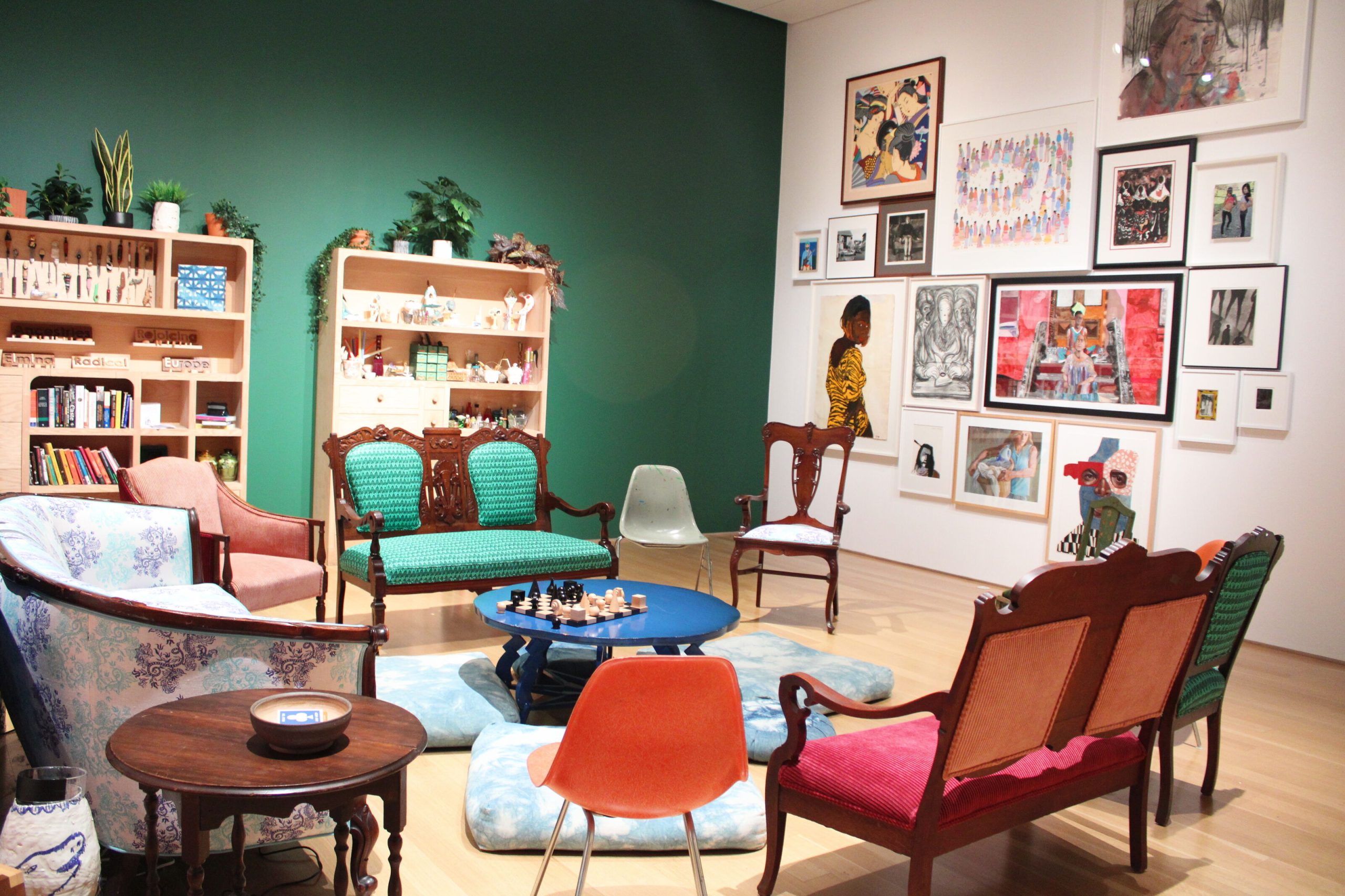
One aspect of art that many enjoy is the community it builds. Art builds connections that can be very cohesive, even if it’s not the intention of the artist. The Nerman’s most recent exhibit takes that cohesion and puts it into action. The Salon for Possible Futures is located on the second floor of the museum and was organised by Amy Kligman.
Employee and artist Cosmo Fouch explained that the exhibit has an interactive feel to it.
“What I enjoy most about the space is the circle, with all the different seats,” Fouch said. “Everyone can find a seat that they feel comfortable in, have a good conversation together… like a community space. And [there’s] a lot of creativity going on in there too. You can use the art supplies and everything else. And there’s all these little doors.”
The exhibit features different objects that viewers are encouraged to be curious about, as well as interactable books, games and furniture. Everything that is featured is different from each other, fueling creativity when one interacts with the exhibit.
Fouch also talked about how they feel the exhibit builds on itself and how the community builds on their personal artwork.
“[Students get] to leave a part of [themselves], whether they’re like contributing to that community sort of oriented space… Going back to the community aspect, we think of visual art a lot as its own thing, like its own moment. But really, it all goes back to [the] community, the artists, [and] connections with people. In my work, I try to really include community in the scenes and stuff that I do, so I really resonated with that space for that reason.”
The exhibit is a great opportunity to connect with members of the community and fellow students. It also features pieces on the wall from multiple artists. While actively interacting with the exhibit, fellow artist and member of the local community, Chuck Allen, described his feelings about the collection featured in the exhibit.
“It’s very eclectic. It’s a representative tapestry of American culture and shows how America is not a monolithic fabric,” Allen said.
The Salon for Possible Futures is not just an exhibit, but an opportunity to connect through art. Even as a viewer makes their exit, they are encouraged to leave something behind, making it so the community continues to build that connection.
The exhibit is on view until Dec. 22, 2026, giving you time to make connections until then. But even beyond the view of the exhibit, its impact is shown through how it connected the community so far.








Leave a Reply