
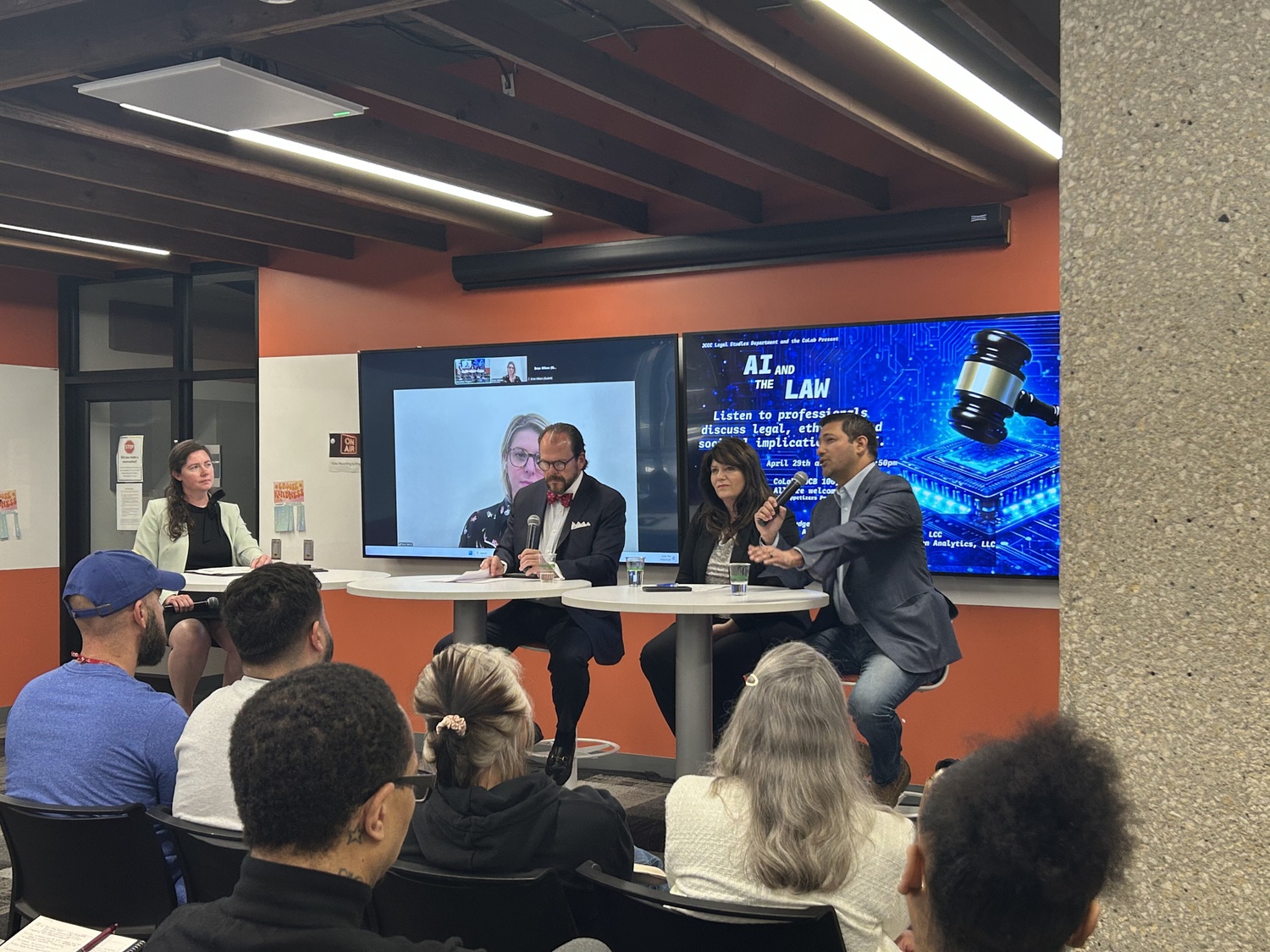
(Photo by: Sammie Magee)
Across the JCCC campus, the use of AI is still a topic of debate. JCCC continues to work toward a use of AI on campus that is both productive for the students and the professors. JCCC’s position on the matter is not to fear AI.
The Legal Studies Department hosted an AI and the Law roundtable in the CoLab to help accomplish this. While this was primarily directed toward law students on campus, it addressed some overarching issues regarding the use of AI.
The roundtable included the following panelists:
- Rachel Pickering, Judge, Kansas Court of Appeals.
- Jason Purinton, Founder & Vocational Consultant, Purinton Analytics, LLC.
- Joseph Cruz, Partner Attorney, Shook, Hardy & Bacon, LLP.
- Rose Moran, Chief Revenue Officer, ICVM Hawk.
The roundtable moderator, Madeline Rogers, an assistant professor in the Legal Studies Department, led the discussion and provided basic themes to serve as talking points. Some overarching themes discussed were how AI is showing up, when AI is wrong, and the line between useful assistance and unacceptable risk.
The first theme of the roundtable was how these experts are seeing AI used in the legal field, either directly or indirectly.
“In our field, we’re typically seeing AI as a supporting role right now in terms of efficiency processes,” Purinton said.
The roundtable saw more use of AI for office tasks, but not for work that needs to be completed and submitted to the court. If AI were allowed to generate cases and briefs that are turned into the court, it would create hallucinations, which the panel described as an inaccurate response generated by AI.
“Be very careful, especially when it’s citations or mathematical formulas,” Purinton said. “Anytime you do a search, and you want it to quote something, it’s really bad.”
The next theme was a question from the moderator about who is responsible when AI is wrong.
“I would say that the responsibility lies on the professional,” Purinton said.
The line between useful assistance and unacceptable risk was another theme of the panel. The most important information to come out of this part of the talk was the use of AI after you’re already an expert in your field.
“One piece of advice is use it when you are an expert, and you know what it should say,” Pickering said. “Versus, let’s see what this is, let’s draft an order in an area of law that I don’t know about.”
One thing is clear with AI in relation to law: if you don’t know the law or your job, AI will not help. It will only make someone look like they do not know what they are talking about.
“AI is going to make the good paralegals even better. They’re going to make the vocational experts and expert witnesses even better,” Purinton said. “But the bad ones are going to make bigger mistakes faster, and it can be super dangerous in the wrong hands.”
Gwenda Hawk, Professor and Chair of Legal Studies, said she was happy with the outcome of the roundtable and highlighted the value of students’ own work.
“We want to stress the importance of that creative thinking, that critical thinking, the human brain can come up with ideas that the computer can’t–at least not yet,” Hawk said.










Leave a Reply