
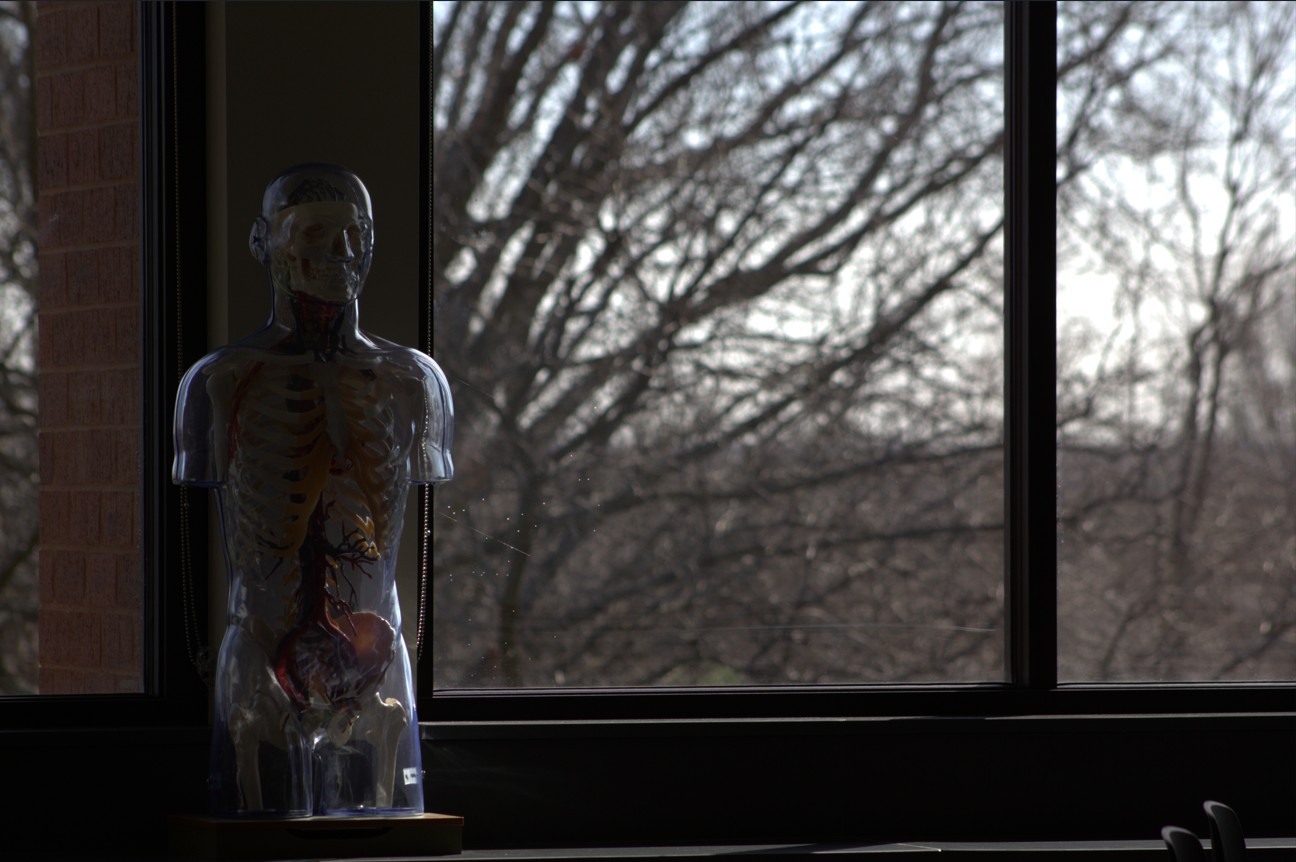
(Photo by: Jasmine Mills)
According to JCCC’s website, “JCCC was recently ranked the #2 nursing school in Kansas by RegisteredNursing.org.”
The Registered Nurse program offers interaction in the classroom and helps students prepare for a beneficial career as a registered nurse.
In just two years, students will gain experience in:
- Pediatrics
- Obstetrics
- Gerontology
- Medical-surgical
- Mental health
Evelyn Sheput-Gonzalez is a student at JCCC taking prerequisite courses for the nursing program, as well as a mother of four. She explained that she picked JCCC’s nursing program because it offers high-quality, affordable education, including its top-tier NCLEX-RN pass rates, state-of-the-art simulation labs and strong clinical partnerships.
“The program is accredited, offers accelerated pathways to a BSN through KU and is eligible for the Kansas Promise Scholarship, making it a premier, cost-effective choice for aspiring nurses,” Sheput-Gonzalez said.
She states that the program provides comprehensive career preparation, which can allow many students to graduate and enter the workforce immediately.
“While further schooling is not strictly needed for many, it is optional for bachelor’s transfer, while technical fields may require additional certifications,” Sheput-Gonzalez said.
According to the Registered Nursing Program website, “you’ll earn an Associate of Applied Science in Nursing from JCCC and be eligible to take the NCLEX-RN exam for licensure.” They also explain that graduation from the program does not guarantee licensure as a registered nurse.
Sheput-Gonzalez went on to say that her faith is a big factor in her desire to pursue nursing, and she explains that it has allowed her to blend her faith with her career.
“It is a calling that embodies Christ-like compassion, serving vulnerable populations while demonstrating love in action,” Sheput-Gonzalez said. “It offers profound purpose through ministry, service and sacrifice.”
She explains that because she is a mom of four, managing the intense mental load, time management and endurance required to handle the fast-paced work and clinicals with her personal life has been a struggle. However, she has found new ways to manage the workload.
“I have learned to prioritize essential strategies, including using a planner for all deadlines, creating dedicated block times for my study schedule and kids’ schedules,” Sheput-Gonzalez said. “I like a flexible study routine that includes breaks, setting boundaries on my study time and working on protecting my sleep.”
Although there may be hardships that come along with working in an intense program and taking care of her family, Sheput-Gonzalez is excited to continue her journey.
“As I begin this nursing journey and program, I am most excited about the opportunity to deepen my expertise in nursing and to apply this knowledge to real-world challenges in a hospital setting.”
Asilya Courtney is four semesters into the program, graduating in May. She chose JCCC because of its affordability and reputation for producing good-quality nurses.
Courtney clarifies that, depending on what hospital you work in, more schooling may be required. Courtney will be working outpatient in the clinics at KU, and the university has given her five years to complete her BSN.
“A lot of BSNs you can take online if you have your RN already, and a year and a half is pretty much the fastest you can get it done. So that’s what most of us would be doing,” Courtney said.
Courtney took inspiration from her mom, who is a nurse practitioner. She stated that she got her CNA to see if she liked it and ended up loving helping people.
“I love working as a CNA, and I still do that now while I’m in school. I just love taking care of people when they’re at their worst, and you can make them feel better,” Courtney said. “So then they can get to, hopefully, their best; and when you can see, Oh, you made a difference in my day, even though I’m having the worst of my life being in the hospital.’ I feel like that’s really rewarding.”
Courtney says that the mental organization is the hardest part of the program for her.
“You have to organize not just your day-to-day, your weeks have to be planned out around tests, assignments, clinical, hospital clinical, because we have simulation clinical, hospital clinical, lecture [and] lots of assignments,” Courtney said.
In order to keep up with organization, Courtney keeps a physical planner that’s color-coded for each thing she has to do, as well as setting reminders on her phone.
Courtney advises students to make sure that this is a profession they want to work in before joining because it is a hard program. She explains that students have to find their why.
“So I’ve had a lot of people go to the hospital and, you know, how would I want the nurse to be taking care of my family? Like, I want to be that nurse for somebody else’s family, because the institute’s going to make a difference in their care and advocate for them and make sure they’re taken care of,” Courtney said.
Courtney says that the professors and clinical instructors in the program really helped make sure they all knew what they were doing, so she feels prepared to move on and further her career.
“I feel like we’re really well prepared and we can critically think well to know what to look for in our patients, so we ask a lot of questions because we want to know why you’re doing that,” Courtney said. “Can you back it up and explain it, make sure it’s safe for your patient. And so I feel like we do really well at that. That’s this program.”










Leave a Reply