
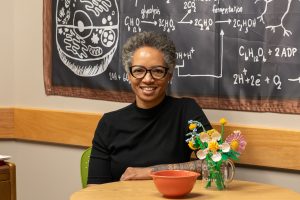
“I graduated high school here in Johnson County,” said Stephene Moore, a scholarship donor at Johnson County Community College. “There was no hope whatsoever that I’d be able to go to school.”
That reality wasn’t unusual in the late 1960s. It was simply the way things were.
“My brother was in college, and I was help paying his tuition working after [school],” she said. “I mean it was that, it was just the situation. I’m not crying about it. It just is what it is.”
She did not let her situation stop her. She was so intent on getting her degree, she spent over two decades obtaining it.
And she didn’t stop there. With her schooling finished, Moore decided she wanted to help future students by making their educational journey a little easier.
Moore was the oldest girl in a family of six. Her father worked steadily, but money was tight. Her mother stayed home. And in the late 1960s, expectations for young women were narrow.
“Women and girls were still not having all the opportunities men and boys had,” she said. “We were very much expected to get married or get a job as a teacher, secretary or nurse… Many were still staying at home after HS [high school] to help with running the home/farm or family business.”
But that did not stop her from quietly holding on to hope.
“But I sure dreamed over the brochures I sent off for about going to school,” she said.
Five decades later, that same dream looks very different for students like Eleyna Vasquez-Kimball. Thankfully the opportunities for women have drastically improved, but the financial barriers are still very much a deciding factor for most people.
“I graduated when I was 18, and then I was working at Home Depot at the time,” Vasquez-Kimball said. “As soon as I graduated, I went full-time, 40 plus hours a week. I was working overtime. I did that for two years straight.”
Her goal was clear. She would have to save enough money to afford college.“I don’t come from a family of money at all,” she said. “And that… was the biggest hurdle for me. Like, I can’t go to college if I don’t have the money.”
Two women, facing similar circumstances, with a shared reality: one without financial support and with higher education feeling out of reach.
People often talk about scholarships in terms of dollars awarded to help financially support students. Their true impact, however, is more personal and becomes cyclical.
Moore eventually began taking classes at Johnson County Community College in 1973. Almost 20 years later, after raising four children and navigating life’s challenges, she ultimately completed her associate degree and went on to earn her Bachelor of Science in Nursing.
“I never gave up on myself,” she said. “Eventually I was able to complete my two-year degree… and transfer to KU to earn my BSN.”
Today, Moore is not just a former student. She is a donor.
Along with her late husband, U.S. Representative and former JCCC Trustee Denis Moore, they decided to start a scholarship.
“The way we wrote it, I think, is that anyone can apply to it,” she said of the scholarship she and her husband established. “You can be in any school… nursing, HVAC, whatever you’re doing. It doesn’t matter to us.”
What does matter is something deeper.
“We’re very big on public service, community service,” she said. “That’s one key.”
Her motivation is rooted in both gratitude and perspective.
“I’ve been fortunate,” she said. “It’s a way to give back… It’s not going away. My kids know they’ll get to continue it.”
Moore’s story illustrates a powerful idea: those who once faced barriers are often the ones most committed to removing them for others.
Like Moore, Nancy Ingram, is a long time supporter of JCCC’s students through the Foundation.
“I was a trustee here for eight and a half years,” Ingram said, reflecting on her long-standing connection to the college. After her time as a trustee, she joined the Foundation board, continuing her commitment to education.
“So, it was really more a matter of just supporting education in our community,” she said, and that support is often given in many different ways.
“They always talk about time, talent, and treasure,” Ingram said. “We’ve given time, we share our talent—but I think it’s really important to share treasure too. You do what you can.”
Through her work, Ingram has seen firsthand the realities students face.
“I have seen and heard and met directly with students who face challenges that I never could have imagined,” she said. “Ever. Ever.”
Often overlooked or forgotten about are the impacts of stepping in to help others.
“My dad always said, ‘If everybody did a little, can you imagine what would be?’”.
Scholarships are that “little” multiplied across the generosity of a community.
For Vasquez-Kimball, that impact is tangible.
“But you know what? With the scholarships that I’ve been exposed to… it’s been possible,” she said.
She entered college with a clear financial ceiling, and it was one defined by her savings.
“I can only go as far as my money can go,” she said.
Vasquez-Kimball was given an opportunity to work in the Financial Aid Department where both the FAFSA and scholarships changed that equation.
“Okay, I’m not just doing it by myself anymore,” she said. “I’m doing it with the help of people that have been through what I’ve been through… and that alone gave me the hope that I can go further than my money.”
In fact, the financial impact has been life changing.
“For my education… none,” she said of out-of-pocket expenses. “Combined with all the scholarships that I have received, I have not touched my savings.”
Financial security is just the beginning of the effects scholarships have had on her life. The emotional impact, however, may be even greater.
“It makes me happy,” she said. “It makes me proud too, because… I wouldn’t even be able to do it without the people that have helped me.”
Vasquez-Kimball’s story shows by decreasing financial burdens, scholarships expand possibilities.
Moore and Vasquez-Kimball’ may have had different obstacles to overcome, and as a society some may have opened up some opportunities, however, there is still work to be done.
Moore grew up in a time when financial constraints and societal expectations limited her access to education. This was the norm. Vasquez-Kimball’s reality is different. For her the opportunity was there, but affordability remained her hurdle.
This is where the generosity of others comes in. Donors realize talent and ambition are everywhere, but access is not.
Enter scholarships.
Scholarships provide students with the ability to decrease work hours by decreasing financial stress, allowing them to focus more on coursework and pursue opportunities that will enhance their overall success.
For donors, the impact of a scholarship may begin with a single student, but it rarely ends there.
Moore recalls reviewing applications and feeling the weight of each story.
“I want them to get it,” she said about her scholarship. “And we did have an awful lot of people [apply] last year. I like to read through each application, such one tugs at my heart.”
One applicant stood out in particular.
“A young man who was working on a degree to help his family,” she said. “He simply would not be able to continue without the financial support of a scholarship.”
That is the moment where giving becomes personal, and the donor becomes part of the recipient’s future.
And that future extends far beyond any one recipient.
Students who receive scholarships are more likely to persist, graduate, and contribute to their communities. Many go on to mentor others, support their families, and some, like Moore, decide to give back.
This not only creates but perpetuates a cycle of generosity and allows for our continue to prosper.
Through The Johnson County Community College Foundation, scholarships are made possible by a community that believes in education.
“We’re so fortunate here in Johnson County to have people who care about education,” Ingram said.
That care is reflected not just in large gifts, but in collective action.
“If everybody did a little,” Ingram said, “can you imagine what would be?”
The answer is visible every day on campus. It is visible in the classrooms, and in the student support resources available on campus.
Most importantly, it is an overwhelmingly apparent theme in the stories of students who are able to pursue their goals because someone chose to invest in them.
For Moore, the journey has come full circle. From a young woman who saw no path to college, to a bachelor’s in nursing over 20 years in the making, to a donor helping create an easier educational path for others.
Vasquez-Kimball’s path is still unfolding. Her’s, is one made possible through the generosity of people she may never meet.
Bringing them together is the Foundation, where generosity becomes impact.
Scholarships are often thought of as time sensitive, an impact fleeting from semester to semester. But in reality, they are something more enduring.
Scholarships are really a helping hand extended by one generation to the next.
Moore puts it simply when she says, “Investing in the education of others is an investment in the future.”.







Leave a Reply