
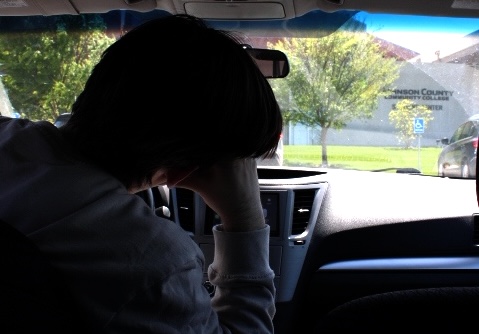
(Photo by: Sammie Magee)
________________________________________________________________________________
First-Generation college students often enter at a disadvantage, navigating academic and financial requirements without guidance or resources.
The traditional full-time path to a bachelor’s degree is four years. Timelines can be affected by life circumstances such as family responsibilities, school transfers, and part-time enrollment.
Abigail’s undergraduate journey has been anything but easy. During her junior year, she was forced to drop out of school due to immigration issues regarding her parents. At one point, she was supporting her family financially, “I had to help [my family] get out of debt and then help pay for the lawyer as well,” Abigail said. From the start, Abigail has been at a disadvantage. During her first years at the University of Kansas, she was managing three jobs and an executive position, all while being a full-time student. While she is now in her final year, her struggles still appear in some ways. This is a reality for many first-generation students with no financial support from their families.
For many first-generation students, college can feel isolating. Without parents who have experienced higher education themselves, many are left to figure things out on their own. Things such as financial aid or internships can be hard to navigate when you don’t have any prior knowledge of the topic. This is a major disadvantage that creates an endless cycle, where they are trying to catch up with their peers who entered college already having an understanding of how the system works.
From the start, these disadvantages can impede someone’s journey to graduation. According to Scholaro, First-generation college students make up 54% of U.S. undergraduates but graduate at just 24%, compared to 59% for continuing-generation students. Without enough support, these combined pressures can force some students to leave college before earning their degree, hindering and delaying their long-term educational and career goals.
Although a bachelor’s degree is traditionally completed in four years, that timeline could be unrealistic for first-generation students. A 2024 report from Ballard Brief at Brigham Young University found that only 27.4% of first-generation students graduate within four years. Even for the average continuing-generation student, the four-year timeline can be difficult. A lack of money or unexpected life emergencies can easily set someone back a semester or even a year. While it would be ideal to complete a degree in four years or less, that standard is one that is often easier to achieve with some level of privilege. Being able to work fewer hours, focus mainly on school, and still havefree time outside of academics is a privilege in itself.
The differences between students can become noticeable quickly. Some students have more free time, which can lead to more opportunities to attend organization events or club meetings, things that are important when building a resume and gaining experience outside of the classroom. Socially, this can also result in having more time to make friends and build connections with other students.
Being involved and active within your school community can be difficult if you are required to work multiple jobs with long hours while also balancing academics and responsibilities outside of college. Abigail mentioned she noticed the differences between her and her peers at school, “two different worlds, two different priorities,” but that she doesn’t let it get to her or change her experience. However, for other students, constantly comparing themselves to their peers can create feelings of insecurity.
“Sometimes I feel frustrated because it’s unfair, I don’t have that time, I wish I did,” said Cinthia, a first-year student. Seeing other students spend their free time socializing or participating in campus activities reminds her of how different her college experience feels. Cinthia recalled feeling insecure toward peers who appeared to havean easier path through higher education, especially those who did not have to balance the same financial or personal pressures. Even with multiple scholarships, she still has financial burdens, occasionally helping her family out when she can.
Having a support system during your path to a degree can help with feelings of doubt. A family can be supportive, but also still lack the understanding of higher education without realizing it. Unfamiliarity is common in immigrant and first-gen households. A report by Enrichly found that first-generation college students often go through college without the same support systems as some of their peers. In many cases, their parents want to help but may not fully understand the process because they did not attend college themselves. This can leave students figuring out things like financial aid and academic expectations on their own. According to the Pew Research Center, only 20% of first-generation students complete their degree, a much lower rate than students whose parents attended college.
Abigail and Cinthia are in completely different stages of college, but a lot of their experiences overlap. Cinthia is still trying to balance school with responsibilities at home. Abigail, now in her final year at KU, has already spent years dealing with many of those same pressures. Even though their situations look different, both described feeling like they had to figure things out on their own while carrying responsibilities outside of school that many of their peers do not have. Both also spoke about the pressure that comes with wanting to succeed, not only for themselves but for their families as well. While some students enter college already familiar with the structures, first-generation students are often learning as they go.
Their experiences have demonstrated how a student’s circumstances outside of school might affect how they interact with higher education. For Abigail and Cinthia, the journey to pursue higher education has been much more than going to classes and getting a degree. For students like them, a degree not only demonstrates their ability to problem-solve and think critically, but it also reflects the work ethic and perseverance required to complete long-term goals despite the obstacles thrown at them along the way. Despite these disparities, first-generation students continue to pursue higher education while overcoming obstacles that are frequently unseen to those around them.






Leave a Reply