
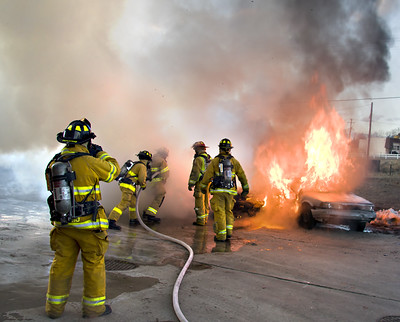
Photo Courtesy of Creative Commons
_________________________________________
The complex process of extinguishing fires is a regular, everyday activity for firefighters. For more of them these days, the simple process of showing up for chemotherapy or cancer treatment is also part of the routine.
This is now the reality for Olathe firefighter Daniel Rafols, who was recently diagnosed with stage 1 grade 2 papillary renal cell carcinoma. This diagnosis is a common form of kidney cancer and can be very aggressive as the stages progress.
“Mine was found on accident through our life scan at work,” Rafols said.
Firefighters across the country have similar stories to Rafols. Line-of-duty-related cancer is proving a major problem in fire departments. According to https://www.firefightercancersupport.org/, firefighters have a 68% higher risk of being diagnosed with cancer than the general population.
Former firefighter Jason Stenberg, who served alongside Rafols, was involved in hazmat. Hazmat is the handling of hazardous materials and chemicals in firefighting.
While talking about smoke and chemicals within the smoke, Stenberg said, “I learned all about all the chemicals that are carcinogenic, and I mean it’s just 100’s and 100’s of them,”
This further heightens concerns about safety and the proper protocols that should be put in place to help reduce such disease.
The Olathe Fire Department has now put safety at the forefront of its mission to protect those who serve after the line-of-duty cancer-related death of firefighter Mark Godbold, my father.
Mark Godbold was a widely recognized figure in the Olathe Fire Department, where he served for 28 years and gave nothing but his all.
Stage 4 colon cancer was his diagnosis. Although severe, he battled this terrible disease for two years until his tough-fought battle came to an end on May 9, 2022. Marking the end of a life that was valued and loved by many.
Mark finished his career as a battalion chief, known more for his character than his work. Many firefighters were blessed to work alongside such a character, who often gave nicknames to whoever he wanted, whenever he wanted. The title of the morale officer was quickly formed.
Losing a friend and family member like this really puts into perspective for many how dangerous this line of work can be, with indirect factors playing a significant role in health.
Because of the realization that the job is dangerous, well after the fire is extinguished, firefighters are looking at their work differently these days.
“It used to be cool to have the bunker coat that’s all dirty with ash and soot, and your helmet burned up and not clean,” Rafols said. “The stereotype is changing,”
The American Cancer Society stated that firefighters find themselves at a greater risk of cancer, such as skin, lung, liver, gastrointestinal tract, and mesothelioma, which can all be caused by asbestos and arsenic.
This, however, seems preventable, as safety precautions might not have been properly enforced.
“I was on a call, and he was inside without an air pack, in a house fire,” Stenberg said.
The lack of awareness when it comes to inspecting fire even after they are put out. This is referred to as hotspots, and even though the immediate danger might not be there, the lingering, invisible dangers can still cause just as much damage.
Incoming firefighters were not educated enough about the risks of job-related cancers, but that is changing.
“It is getting much better,” Rafols said.
As a young firefighter, he said, the last thing he was worried about was getting sick versus the immediate risks of burning to death or falling through multiple stories.
What helps firefighters face those fears is the idea that firefighting is to help those in need. A trade-off of your life for another to help satisfy an idea of betterment for others. This is why firefighters sign up to do what they do.
But that was about the immediate dangers. Worrying about what will happen to them years after the job is something they have to take more seriously than in the past.
Firefighters are starting to pay attention now because the costs are high.
Not only do fire departments create a sense of brotherhood, but also a family that cannot be separated. After Rafols let the people around him know what was going on, the only way to describe the care was to say it was overwhelming.
Additionally, the Rafols discussed maintaining a healthy lifestyle at the fire station to help reduce cancer risks.
“Always have a healthy habit to fall back on,” he said, “Just being outdoors has proven to be really healthy for you and the repair of your body.”
This is also neglected within fire departments across the nation. Although some stations provide gyms and areas for proactive activities, it ultimately falls to the firefighter to make the conscious decision to improve their health and repair any damage sustained during previous calls.
Conclusion- Firefighters know the risks they take when they sign up for the job. Whether that be falling through floors, burning up, or being exploded; however, many may not take into consideration their own long-term health and dangerous cancers that linger around at all times.
Research still continues to highlight the dangers of cancer within firefighting and proves that stereotypes need to be changed, awareness needs to be taken a step further, and safety and or health precautions need to be improved on to help protect those who [protect us.
Even with all the dangers at stake, “My life really meant something because I affected and helped so many people through the course of my job,” Rafols said.
The Olathe Fire Department has implemented an annual life scan to detect early-onset cancers and tumors. With Rafols finding his cancer early, he has taken it upon himself to help other departments implement this new and much-needed technology. The National Fire Protection Agency (NFPA) has new rules in place. This directly affects the Olathe Fire Department, requiring them to change out the hoods firefighters wear after every fire. There are extractors at each fire station to clean and extract smoke and chemical burn-off from the suits.











Leave a Reply