










Monday, December 8, 2025

Yearly Archives: 2013

Son of HeLa cell donor visits the college

0

Flores- Sonny Lacks onlineBy Michael Fancella

Immortality means many things to different people. In the case of a young black woman named Henrietta Lacks, immortality means to truly live forever, biologically speaking.

In 1951, Lacks went to John Hopkins Hospital with concerns about a tumor. That tumor ended her life, but some samples of the cells in and around the tumor were extracted. The cells were hearty and grew at an amazing rate, even taking over cells around them. These cells have become famous in medical science, referred to as HeLa cells after the deceased donor. They were most famously used in the experiments that led to the polio vaccine.

In 2009, Rebecca Sloots authored the book “The Immortal Life of Henrietta Lacks,” detailing the situation surrounding her story. This book has been discussed in many classes at the college, including nursing, dental hygiene and English classes.

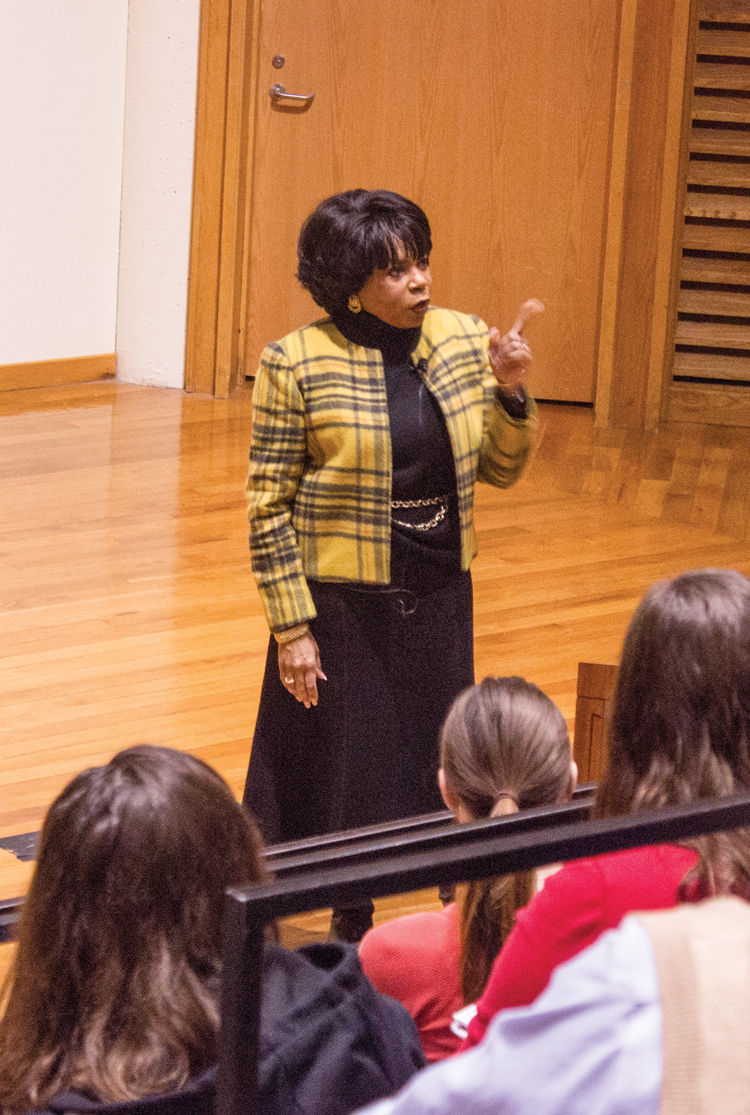
Lacks’ son David and his wife Shirley are touring colleges and answering questions students have about the information Sloots presented in her book. On March 28, English professor Danny Alexander moderated an open discussion with David “Sonny” Lacks and his wife in the Polsky Theatre.

“David and Shirley Lacks have been touring schools for months,” Alexander said. “There were some health issues that might have caused concern, but I feel the interview went well and we are definitely glad to have them here.”

David Lacks was four years old when his mother Henrietta passed. His only memory of his mother is the funeral, “Something I will always treasure,” David said.

Deborah, David’s deceased sister, was the family member from which Sloots drew most of her information. Both Shirley and David recounted anecdotes of Deborah, calling her quite the family character. Perhaps the best description given of her was the hamster story, in which she performed mouth to mouth on a dying hamster.

“Who does that?” David said. “I’m going to put a straightjacket on her.”

The issues of racism and cultural differences came up during the discussions. Alexander said he was “schooled on the racial and cultural issues” presented in the book.

In response, Shirley said, “Times have changed, but the older generation keep [racial issues] in the forefront.”

David expressed a great deal of admiration for his mother. He felt she would be proud of her legacy, and he expressed pride in his family for donating tissue and cell samples during the 1950s.

During the discussion, David also told of his experience when he visited John Hopkins Hospital, and how it was fascinating to “see the [HeLa] cells divide, multiply, and take over other cells.”

Henrietta Lacks has supplied science with a series of experiments with her HeLa cells. Modern ethical code no longer allows for cells to be taken without the consent of the donor.

David feels the good the cells have done are adequate compensation. Shirley would like to see the profits from the research used to provide healthcare for those who cannot afford it.

While a great deal of attention is given to the medical advancements the HeLa cells facilitated, David has a different view of his mother. To him she is a hero, but most importantly, “She was a mother, she was a wife, she was a person,” he said.

Contact Michael “Bernie” Fancella, special to the Ledger, at [email protected]

Board approves raising student tuition

0

By David Hurtado

The Board of Trustees voted to increase tuition for the next academic year by $1 per credit hour at their March 14 meeting.

“Through the fiscal year 2013-2014 budget process, a need was identified for additional funding for the Student Activities Fund,” said Jerry Cook, trustee. “The primary purpose of the fund is to provide scholarships, and we all know there’s a need for that out there. As tuition has increased in the past few years, the credit hour fee for scholarships has not increased.”

The Board of Trustees last voted to raise student tuition at their Feb. 16 meeting during the spring 2012 semester. The increase went toward classroom furniture and equipment.

Prior to the Board’s decision, tuition for Johnson County residents cost $81 per credit hour.

Contact David Hurtado, staff reporter, at [email protected]

The robot invasion has arrived

0

By Stephen Cook

They always say if science fiction can think it up, it will happen.

So where is the robot invasion? Well, it’s already here – just look around.

According to a report released by the International Data Corporation (IDC), 79 percent of smartphone users reach for their devices within 15 minutes of waking up. Then throughout the day, they will go on to check Facebook an average of 14 times from their phone. And that’s just Facebook – Twitter, Instagram, Pinterest and all the others just add on to that!

Now tell me that doesn’t sound robotic.

I’m not saying that checking your Facebook is wrong, I’m just saying that too much of a good thing can be a bad thing. We are becoming gluttonous with the interwebz.

That, in turn, is morphing us into creatures who would rather spend time with a computer or a phone chatting with one of our 2,000 “friends” than with actual, 3-D, living, breathing friends.

I know, unfortunately, we are a campus where folks would rather look at their phone in order to avoid eye contact with the person next to them; it’s an easy way out. But look at it this way, what are you missing by always staring at a tiny screen?

I’ll be honest and admit I often check Facebook or Twitter before classes, but it’s good to put away the phone and look up, look around and talk to people. It’s refreshing to stop and think without the distraction of the blue glow. Also, even if you are checking your phone, you can still be aware of your surroundings and be courteous to others. Besides, hunching over and holding your phone three inches away from your face is bad on your eyes and your neck.

The modern smartphone may be an amazing invention, but it is obviously both a blessing and a curse. On one hand, it allows us to communicate with anyone in the world in a matter of seconds. On the other hand, it’s turning us from compassionate human beings into computerized machines. Instead of verbally socializing with others face to face, we thrive through faceless, emotionless, often poorly-spelled words on a screen.

As we go into spring, nicer weather should hopefully arrive soon. Try to spend time outside, meet with others face to face or take up a new hobby or interest. Slow down, relax and take some time to think about what matters in life.

After all, what will you look back on? The cat memes that you posted on your friends’ walls or the actual time you spent together with your friends?

Contact Stephen Cook, editor-in-chief, at [email protected].

Bar Trek: The search for mom and pop

0

By Jon Parton

There’s a corporate formula for everything. From where the products in a grocery store are located to the amount of lighting filling the store. Howl at the Moon feels like it was built by test groups.

Howl at the Moon, located at 1334 Grand Blvd. within the Power and Light district, is part of a chain of dueling piano bars.

It features a stage with two baby grand pianos and two or more entertainers who take song requests from the audience. The concept hearkens back to American cabaret shows of the Roaring Twenties, when restaurants and bars featured live jazz music and dance.

They charge a ten dollar cover to get in on a Saturday night. This is one of the worst complaints I could ever have for any bar. In addition to spending money on drinks, you’re forced to spend money just to get in the door.

This wasn’t an amusement park. The place wasn’t big enough to house an indoor roller coaster. The idea of paying money for the privilege of paying even more money is ludicrous.

Back to the formula, there are some things every corporate establishment needs. First, they need a lot of neon signs. Check. Second, they need the female wait staff to wear skimpy outfits. Check. Third, they have to offer weird or unique drinks. Check.

A waitress approached us shortly after we got in, offering us some weird drink served from a huge fake syringe. We passed on her offer. Instead, like any classy bar patron would, we ordered a “bucket of booze” called the Hurricane.

It was a combination of rum, dark rum, grenadine, orange and pineapple syrup, Bacardi 151 and cola. Although I’m not much of a mixed drink type of guy, I have to admit the combination of fruity flavors mixed well with the cola.

Unfortunately, the bucket wasn’t stirred very well, leaving most of the bottom of the bucket with a strong taste of rum. That’s not something you want to drink out of a straw. It definitely wasn’t worth the 35 dollars I paid for it.

The entertainers were the best part of our experience. They kept the atmosphere lively with covers of famous pop, rock, country and even rap songs.

Another positive aspect was the people watching experience of our visit. A man was celebrating his 50th birthday that night and brought his friends with him. It’s always fun to watch people try their best to dance.

We were less than impressed with the level of noise in the bar. Although it’s expected to run into loud volumes at most bars, it’s downright annoying when you have to shout to the person next to you in order to communicate.

We cut out of the place after about 40 minutes. The quality of the show wasn’t worth the quality of the booze and the noise of the place. Although I wouldn’t completely write the bar off, I probably wouldn’t go again unless I was with a large group of people.

Contact Jon Parton, managing editor, at [email protected].

College seeks replacement system for ANGEL

0

By Sara Maleki

The college is investigating proposals for a new Learning Management System (LMS) which would gradually phase out the current system, ANGEL.

Procurement Services is one of the departments involved in the process of finding a new LMS.

“JCCC Procurement Services facilitates the expenditure of college funds in a manner that maximizes the ultimate value and meets the college’s needs, consistent with Board of Trustee’s policies as well as statutes and other guidelines,” said Gary Cromer, senior buyer.

The process of finding a new LMS system involves inviting various companies, such as Blackboard, to submit proposals to the college. At the end of February, a request for proposals (RFP) was released, with a deadline of March 7. Procurement Services at the college provide open opportunities for companies to make proposals and defines the terms and conditions of the proposal.

The RFP contains basic ‘yes and no’ questions for companies to answer in order to identify a suitable LMS for the college. Questions for companies include ‘Does the LMS support mobile learning?’ and ‘Can students create their own portfolio?’

Prior to using ANGEL, the college used the Web CT system. The ANGEL system was developed in 2002 by the University of Indiana, and has been used by the college since 2008. In 2009, ANGEL was acquired by Blackboard, which has also acquired other competitor learning systems, such as Prometheus.

An updated LMS is needed to fit the needs of students and faculty. The options for mobile technology, sending texts to students and the use of ANGEL on iPads, are not available under the current system.

“ANGEL has worked well,” said Ed Lovitt, director for distance learning. “[There is] the option of staying with Blackboard, but [we] owe it to students and faculty to see what changes are available.”

On March 27, a Student Senate Town Hall meeting sought student opinions on what features were important in an LMS.

The current system has received some positive feedback from students, such as Ben Anderson.

“I think ANGEL is a pretty efficient way of checking my grades and homework”, Anderson said.

However, other students think there is room for improvement.

“I’m not a huge fan of ANGEL,” said Kelsey Sparrow. “I think it’s too hard to get to see your grades[…] a good change would be to make grades easier to see and have them automatically update.”

In April, three companies will be invited to the campus to demonstrate the features and functionality of their systems. Students and faculty will have the opportunity to fill out survey sheets to provide feedback on how well these companies answered their questions.

“The first priority is to meet student and faculty needs,” Lovitt said.

In making a decision about the potential choices, the college will look at whether other schools are currently using the system, and whether the LMS can be customized to the college. The final decision will be made in May, taking into account feedback from faculty and students.

If a new LMS is adopted by the college, it will be run parallel alongside ANGEL over the course of one year, with spring 2014 being the final semester with ANGEL. Washburn University, which also used ANGEL, has now switched to another LMS, and will phase out ANGEL by the fall 2013 semester.

The final decision about a new LMS will be approved by the Board of Trustees, and students will be informed of any changes to the LMS by August.

Contact Sara Maleki, reporting correspondent, at [email protected]

Cavalier star watch: Matt Blackham

1

Matt Blackham

By Mac Moore

As of the writing of this story, sophomore pitcher Matt Blackham is holding 13 consecutive innings without giving up a hit. The Cavaliers have won 7 straight games, in no small part because of the strength of Blackham and the rest of the pitching rotation.

HOW DO YOU FEEL ABOUT YOUR RECENT PERFORMANCE?

I am very thankful of all the support I received from my teammates, coaches, and family. I wouldn’t have been able to be where I am today without them. It wasn’t just my performance that I pitched as well as I did. It was a total team effort. I couldn’t have done it without them. I am glad to have shared such an accomplishment with my team I couldn’t have done it without them. I set very high goals for myself and it’s a pitcher’s dream to throw a no hitter and I’m very thrilled how well I’ve pitched.

HOW HAS THE TEAM PERFORMED AS FAR THIS SEASON?

We started out slow but the more we have played with each other the closer we have become as a team. We are currently on a seven game win streak and it seems like every game we learn something new to build upon to get better and play Johnson County baseball.

WHAT IS THE TEAM’S BIGGEST STRENGTH? WHAT IS YOUR BIGGEST STRENGTH?

Our biggest strength has to be our potential. We are playing good baseball right now but when we put everything together there aren’t many teams that beat us. My biggest strength is I will do whatever it takes to win. I am very competitive. I get to play the greatest sport in the world and there is no greater feeling than stepping up on that mound.

FAVORITE ARTIST

Foo Fighters

FAVORITE MOVIE

For Love of the Game

Contact Mac Moore, sports editor, at mmoore82@jccc. edu.


Plaguestate: Are you in clean hands?

0

By David Hurtado

Our hands are vital when it comes to the everyday hustle and bustle; without them, we couldn’t prepare food, grip tools or greet friends.

However, these same hands that allow us to construct skyscrapers or paint a canvas of stars also serve as a breeding ground for bacteria. From shaking someone’s hand to using that dingy gas station bathroom, our hands are constantly under assault from unseen microbes.

Karen LaMartina, nursing director, said having good personal hygiene is where healthy practices begin. She said it’s vital to wash our hands thoroughly to limit exposure to harmful pathogens.

“Certainly our hands are one of the big ways we tend to get sick,” LaMartina said. “Through shaking hands, it’s a point of entry. If you touch any of the mucus membranes on your eyes, mouth or nose, that’s how those viruses and microorganisms get into our system. I think our hands are vulnerable, that’s why we stress good hand washing.”

According to the CDC, hand washing can reduce the risk for respiratory disease by 16 percent. The CDC also estimates washing hands thoroughly with soap and water can reduce diarrheal disease related deaths by up to 50 percent.

The introduction of hand sanitizer in 1988 provided an alternative means of cleansing the hands of germs, but it wasn’t until the late 1990s it gained popularity. LaMartina said she felt hand sanitizers could sometimes be overused.

“There really isn’t a substitute for good, vigorous hand washing with soap and warm water,” LaMartina said. “If you don’t have access to soap and water then sure, hand sanitizers are fine, but I don’t consider them to be a substitute. If they’re overused, they can cause you to build up some resistance to the normal flora of bacteria that reside on our skin. If you knock all that out, that can actually knock out some of that defense system of our immune system.”

Diseases that can be contracted due to inadequate personal hygiene include Typhoid, Hepatitis A and Gastroenteritis.

Hassaan Shaikh, student, said a time he’s had to deal with someone else having poor personal hygiene was during a meeting at Chipotle. An acquaintance Shaikh was seated near neglected to wash his hands.

“He had dirty hands and he didn’t wash them and he started eating with those,” Shaikh said. “I really didn’t like it and I told him to go ahead and wash his hands because we were sharing a table and I didn’t like it.”

In addition to personal hygiene, oral hygiene is essential for maintaining a healthy body. Like our hands, our teeth are responsible for many different tasks. Breaking down food or forming words to converse with others would be challenging with just two toothless gums.

Margaret LoGiudice, dental hygiene director, said brushing your teeth should be done after every meal, up and down in small circles. LoGiudice said brushing horizontally should be avoided because it can lead to abrasions along the gum line. She also said mouthwash is no substitute for a full two minutes of brushing with toothpaste.

“Mouthwash can do some things, but the important thing about plaque is that you remove it, physically from your teeth,” LoGiudice said. “That’s where the brushing comes in. Mouthwash can boost that if you have some problem areas and can decrease the bacteria in the mouth. It doesn’t take the place of brushing.”

LoGiudice also said sharing a toothbrush with other people should be avoided. If the brush is still wet, bacteria are still alive and growing and can cause an array of health problems. This is caused by residue food particles that are naked to the human eye after brushing.

Common symptoms of poor oral hygiene include tartar, cavities and gingivitis. Red, bleeding or puffy gums are all signs of inflammation. LoGiudice said you can’t always tell if infection is present just by feel alone.

“That’s one of the biggest problems, because gum disease doesn’t always hurt,” LoGiudice said. “It might be a little sensitive to hot or cold, but it’s not a thing that you’re aware of all the time. Your gums will probably bleed.”

LaMartina said the best way to ensure a healthy body and good personal hygiene is eating a healthy amount of fruits and vegetables.

“The better nourished you are, the better your diet exercise and rest are; all of those good healthy lifestyles are going to help boost the immune system,” LaMartina said. “It kind of works together with good hygiene, really; it’s all one big package.”

Contact David Hurtado, staff reporter, at [email protected].

News briefs – March 14, 2013

0

SPEED BUMPS TO BE INSTALLED

This week, two speed bumps will be installed in front of two parking garages on campus.

One will be installed at the northeast Regnier Center parking garage at 6 a.m. on Friday, March 15. The second speed bump will be installed at the south entrance of the parking garage at Galileo’s Garden at 6 a.m. on Saturday, March 16. The following week, the north main section of North Campus Drive will be closed from 6 a.m. to 5 p.m. March 18 through March 22 due to further road construction.

Compiled by Sydney Studer, special to the Ledger


JCCC TRUSTEE CANDIDATE FORUM

JCCC and the League of Women Voters will present a trustee candidate forum at 7 p.m. Friday, March 22 in GEB 137.

The candidates in the forum are Jerry Cook, Lee Cross, Robert Drummond, Melody Rayl, Richard Schroder and Stephanie Sharp. Dave Helling, reporter for the Kansas City Star, will be the moderator.

The candidates will present their views regarding impending legislative changes affecting higher education and Johnson County public schools. The moderator and audience members will be able to question the candidates on these issues.

Compiled by Sydney Studer, special to the Ledger


JCCC GENERAL SCHOLARSHIP DEADLINE NEARS

The college’s general scholarship application deadline is Monday, April 1.

Students can apply through the My JCCC EASI tab by clicking the “Student and Financial Aid” tab, the “Financial Aid” link and then the “2013-14 General Scholarship Application” tab. Students must be enrolled in at least six credit hours and have a GPA of 2.5 or higher. Over fifty general scholarships are offered to eligible students.

Visit the financial aid website for more information.

Compiled by Olivia Fox, special to the Ledger
DIVISIONAL SENATORS ANNOUNCED FOR FACULTY SENATE

Nineteen professors have been elected as divisional senators for the faculty senate. They are:

AHHS: Vin Clark, Jim Leiker

Business: Cherie Leiker, Hugh Forbes

Communication: Terry Helmick, Christine Buta

English and Journalism: Dave Davis, Lorie Paldino

Health Care/Wellness: Bob Parker, Joe Weiss

Math: Ron Palcic, Theresa McChesney

Public Safety and Cosmetology: Kay King

Science: Melanie Harvey, Steve Giambrone

Technology: Damon Feuerborn, James Hopper

Twelve-month: Marsha Cousino, Dave Ellis

The second senator for public safety and cosmetology has not been determined.


JCCC STUDENT WINS ACHIEVEMENT IN LITERATURE AWARD

Ben Orman, an honor student at the college, won the Kansas region of Phi Theta Kappa Achievement in Literature award for a paper he wrote for in art history class. His paper was titled “Art Nouveau and Gaudí: The Way of Nature.”

Two other students, Arthur Collins and Elizabeth (Aislin) Reynolds, received honorable mentions for their submitted work.

Compiled by Hannah Davis, news editor, at [email protected]

Letter to the editor from Jack Van Kirk

0

Hannah [Davis],

I found your op-ed piece ignorant and intellectually dishonest. You say that ignorance fuels oppression, and yet your entire piece is intolerant, closed-minded, and dogmatic. The long and the short of your argument is that everyone who is against abortion and same-sex “marriage” is a stupid, brainwashed bigot and chauvinist, and those of the opposite school of thought are freethinkers. Do you not see the irony of that? How dare I question your secular liberal doctrines! It’s a childish ad hominem that does nothing but shut down discussion.

To lump everyone who is against abortion in the same category as Todd Akin is intellectual dishonesty at its finest. I am pro-life, and I know Akin made a stupid comment. He admitted he was wrong, that he misspoke, and he apologized, so you can drop it. Instead, check out the March for Life (full of women our age), or Abby Johnson (a former Planned Parenthood director), or the late Dr. Bernard Nathanson, former chairman of NARAL, both of whom became pro-life advocates. You will see the real face of the pro-life movement, not the straw-men Planned Parenthood and the media have been attacking since the 70’s.

As for LGBT activists, they just want to reduce everybody to their sexual orientation, ignoring all other aspects of the human person. Their in-your-face obnoxiousness is on par with the Westboro Baptist Church. And saying I can marry another dude is like saying I can make 2 plus 2 equal 5.

This is dangerous thinking when we say, “don’t like this, don’t do it”. It is a sign that we are moving towards a dictatorship of moral relativism. Ironically, this worldview claims nothing is absolute, but such a claim is a claim to an absolute truth. We need not worry about being oppressed by Big Brother. We need to worry about being oppressed by the ego, from becoming Aldous Huxley’s Brave New World. True freedom is doing whatever we want, but in freely choosing what is right.

God bless,

Jack Van Kirk

JCCC student

Counselors provide academic advising for transfer students

0

By Hannah Davis

The Counseling Center, located on the second floor of the Student Center, provides academic advising for students who plan to transfer to another institution.

“We work with a student who has just come in to determine what courses to take,” counselor Amy Warner said. “We help them figure out how that coursework fits with their plan, whether that course work is undecided, or if it’s something very specific. We talk about what options they have with a specific interest. […]That’s the piece of academic advising that we do. We work with somebody prior to becoming a student, first semester and then throughout their time here.”

The main roadblock that students run into during the transfer process, according to Warner, is that certain courses they may have completed at the college don’t always transfer to the school they’re considering.

“First thing the student needs to know is, when you’re considering transferring, […] you need to understand that certain courses transfer for certain majors and certain schools,” Warner said. “I always tell students, two main things determine what I advise you to take: what major you’re considering and what schools you’re considering, because a degree in general, doesn’t transfer overall.”

Parker Fitzmaurice, a student at the college, met with a counselor for advice to transfer to the University of Kansas.

“They showed me what kind of degrees KU offers and helped me see what interests me, and what’s required and prerequisites needed,” he said. “I’m planning on getting a business degree.”

The counseling center offers ‘transfer guides’ to different colleges or universities, which list the courses offered at the college that will transfer and fulfill requirements.

“The research that we have are these fantastic guides that are formal agreements between JCCC and the receiving school, and it’s a course by course evaluation,” Alicia Bredehoeft, faculty chair for the counseling center, said. “So whether it’s an agreement with Ottawa, or Pitt State, or an agreement with another institution, that institution is going to go above and beyond to make sure that our students have a seamless transition. That agreement is basically a ‘formal, gentlemen’s handshake’ that these two institutions are going to partner to the best interests of the students.”

These guides are updated almost every semester for clarity and accuracy.

About 60 percent of the college’s students intend to transfer to a four year university, and both Warner and Bredehoeft encourage students to utilize the counseling center.

“I would also hope that students would take the time to come in,” Warner said. “Not every student visits with us, and we find students who are close to the end and they will have taken what they thought was a list of requirements and then we end up telling them ‘okay, well you have all these other things you need to take to transfer, but these other things you have taken may not.’”

All the counselors are available by appointment, Monday, Tuesday, Thursday and Friday, and by walk-in Wednesdays. They provide not only academic advising, but personal and career counseling as well.

“When you talk about transfer, our goal is to see what the individual needs are, see what their education goals are, help them to find those goals, and partner with the career center to help them effectively figure out what their strengths are,” Bredehoeft said. ”Then [we] put together that academic plan to empower and encourage them to get engaged beyond the classroom to verify ‘is this the discipline or the career path that I want to go?’”

Contact Hannah Davis, news editor, at [email protected]

Photo Essay: “Making Headlines” Fashion Show

0

Fashion Show(Click image to view full-size)

New measures created to crack down on piracy

0

By Stephen Cook

The Center for Copyright In­formation (CCI) has created a new ‘Copyright Alert System’, partner­ing with Internet Service Provid­ers (ISPs) in an effort to crack down on piracy.

The system is designed to alert individuals when they have down­loaded an illegally shared file from a peer to peer network, according to the CCI website. Major ISPs, such as AT&T, Time Warner Cable or Comcast, will display a mes­sage telling you there was illegal activity. If the activity continues, then users will be able to receive up to six alerts before they are is­sued a “Mitigation Measure”. This will include consequences such as reduced Internet speed or the re­quirement to complete an “online copyright education program”. The CCI said that ISPs will not be able to use account termination as a means of a Mitigation Measure.

In light of its recent debut, the program has received some nega­tive responses regarding its meth­ods and processes.

Patrick Lafferty, assistant pro­fessor of interactive media, be­lieves that although the program is “low enforcement”, it is arbitrary and is not set up to be transparent. It is dangerous to allow private corporations to police what he called “the most important com­munication tool.”

Lafferty said it is all about how systems have not yet caught up to the modern world.

“We don’t have the same pro­tections on opening an email as we do opening a snail mail,” Lafferty said. “I can mail you a letter and it’s illegal for anyone else to open that, but everyone can open my email to you.”

The way people go about pur­chasing and discovering their mu­sic has changed too, according to Lafferty. Thanks to the Internet, fans can buy directly from artists, allowing the band to be fully sup­ported monetarily.

“Piracy is an industry problem,” Lafferty said. “We as fans want to support the artist; I really don’t care about supporting the guy in a suit, who’s making millions of dol­lars off that artist.”

Kevin Tehan, student, said he stays away from pirating because it runs the risk of ruining a com­puter. Additionally, Tehan said it comes down to an artist’s rights.

“There are some people who it might not hurt, but there’s defi­nitely principle behind it,” Tehan said.

Since these files are available to anybody with an Internet con­nection and a computer, Tehan be­lieves that people pirate because it is easier than paying for it.

“It’s a shortcut,” Tehan said. “It’s always out there.”

Piracy is a worldwide issue, Lafferty said. If there is a movie or music available in another part of the world, some people turn to the Internet and file sharing to obtain it if it’s unavailable in their coun­try.

“Personally, I think that in­formation wants to be free and I think that we are seeing a transi­tional time,” Lafferty said. “It really started with the birth of the Inter­net but it’s come into focus since Napster.”

Free music doesn’t always mean piracy is involved. Brian Pa­davic, adjunct assistant professor, music, said the freedom of dis­tributing one’s music depends on whether the artist is with a record company or is independent. Pada­vic, who teaches songwriting and digital audio classes, said artists who do not have a contract are less restricted than those who do.

“I think it comes down to an individual’s choice, how do you want your music to be heard and how do you want to make a living off of it, some people, some art­ists only do their art,” Padavic said. “Whereas if you have a full time job or maybe you’re a part time or full time instructor, you’re making a decent income and you might not be as restrictive on who owns your music.”

However, although giving away your music for free can give you good publicity, Padavic said. You have to step back and see what you are really gaining.

“At some point you’ve got to ask yourself, when am I losing finan­cially and what am I gaining glob­ally,” Padavic said. “At what point is it a risk that you’re giving away your music for free or that people are just burning CDs and [handing them out].”

Padavic said he believes it is up to the artists to decide for them­selves what the best way is to dis­tribute their music or movies.

“I think we live in a very special time and I think those who adapt to the times are those that are go­ing to be more successful,” Padavic said. “Only time will tell where this technological age is going to take us. But I think it’s a beautiful thing and I’m embracing it and I think a lot of other artists are too.”

Contact Stephen Cook, editor-in-chief, at [email protected].

Bar Trek: The undiscovered tavern

0

By Jon Parton

It’s odd to find a dive just a block away from a martini bar unless you’re in Westport. Rather than surround ourselves with high-priced fruity drinks to begin with, my two companions and I set out to visit Buzzard Beach first.

Upon first glance, I had a hard time finding an employee or customer not wearing leather or sporting multiple tattoos.

The best dive bars don’t offer anything except a darkly lit place to sit and drink for cheap. In that, Buzzard Beach notably succeeds. If you drop something, cut your losses and leave it because the floors weren’t that clean.

The men’s restroom was small, cramped and uncomfortable for everyone that had to use it. It was the dirty, broken-down atmosphere that really led to my enjoyment of the bar. There was no cover charge to get in and the drinks were really cheap, a rare occurrence in a lot of Westport bars.

The wait staff was friendly and quick to get you another round. No one said a word to us as we played cards at our table. It’s the kind of spot that lets you come as you are and enjoy some cheap drinks.

After playing a few hands, we left for our next destination, wherever that may have been. We wound up inside a smoke shop since one of my fellow trekkers wanted to pick up a few fancy cigars. I’m not much of a smoker, but I am a freeloader when someone else wants to buy.

With our cigars in tow, we made our way over to Harry’s, a really crowded martini bar. Rather than try to navigate through the massive amounts of people, we stepped outside onto their patio.

Freezing ourselves out in the winter wind, we did our best to enjoy the recently acquired cigars. Our friendly waitress braved the cold to deliver our martinis to us, while we did our best to light the cigars in the midst of a Kansas City winter night.

The prices were more expensive, running anywhere from eight to ten dollars for a martini. I gladly paid the price in order to use a clean restroom that didn’t feature walls filled with graffiti.

After finishing a couple of cheap ciders at a juke joint just an hour before, sipping on martinis while smoking cigars seemed like the most contrasting part of our adventure.

We were joined by another lost soul, a woman who was waiting for her husband and friends to finish watching some game on TV. I truly felt content as everyone talked about the things you only talk about over drinks.

Harry’s is a decent place. There’s no cover charge. Most of the lower level is taken up by the bar, though there are a few tables and plenty of seating on the patios. Although they also serve food, we didn’t have a chance to sample their offerings.

I recommend Harry’s, especially if you’re a people watcher. Their patio gives you a great view of the hustle and bustle of Westport. If you like your drinks a little cheaper and don’t mind going to a dive bar, Buzzard Beach isn’t that bad either.

Contact Jon Parton, managing editor, at [email protected].

“The Great and Powerful Oz” Review

0

By Joe Hofbauer

“The Great and Powerful Oz” fits well with the notion of a 1905 crusty Kansas backdrop.

Oz seems to fall short of any deep intricate plots to feed a curious mind. Anyone with an inkling of intuition can see where this story leads. If you have children or the mental capacity of a 13 year old, then I suggest seeing this film. It has enough CGI to sparkle and dazzle any young mind, yet lacks the serious plot depth to keep any adult occupied.

The film starts off in the traditional fashion; a quick black and white introduction to the protagonist. James Franco plays a good-natured con man who tries to charm his way into the hearts of many Hollywood Vixens.

However, his antics soon catch up with him, casting him on his adventure.

When the dust settles, you are left in the vibrant land of Oz. Much like Speed Racer, the producers are eager to get your head spinning with all those unnecessary CGI graphics to capture the attention of any poor soul in the theater.

Action is slow and the plot is spoon-fed to you. I found myself wishing they would explain more of the backstory, such as where the Ruby Red Shoes came from or information on the sisters and their relationship. Character transformations happen too quickly with no real room for building emotional substance to create such actions.

Where were the Tinkers and normal citizens of Oz in the original film? This prequel does a fine job of setting up how Oz got to his position, but offered no helping hands as to a rich history of the supporting cast. However, this movie isn’t all bad. The Munchkins made a small appearance and you knew as soon as they introduced them they were going to burst out in a chipper song and dance.

Men dragged to this film against their will should take comfort in knowing there will be some nice shots of the always delectable Mila Kunis in tight leather pants, despite the fact that she looks as if she stepped off the set of “Where in the World is Carmen Sandiego.” Yet every time I heard her voice, I heard myself saying, “Shut up Meg!”

I highly recommend you wait to rent this movie. If you decide to waste the money and see it in theaters, make sure you bring your two best companions to help you conquer this pitiful attempt at entertainment; Jack & Coke.

Contact Joseph Hofbauer, Reporting Correspondent at [email protected]

Looking ahead

0

By Stephen Cook

As the new editor-in-chief of the Campus Ledger, I would like to say that I feel extremely blessed to have this opportunity to lead this publication and serve you, our reader. In my time at the Ledger, I have become friends with a great group of very talented people that make this publication run smoothly.

One of my goals is to get our readers even more involved. We want you to be a part of this publication just as much as you are a part of this college.

Looking ahead, I can guarantee you that I will do everything in my power to make sure the Campus Ledger continues to be a publication of excellence and interest.

Thank you for reading and I hope you’ll enjoy what we have in store!

Contact Stephen Cook, editor-in-chief, at [email protected].

History of St. Patrick’s Day

0

History of St. Patrick's Day(Click image to view full-size)

Column: An apology for my profanity

0

By Jon Parton

The Campus Ledger printed a bar review in Issue 11 written by me. The article contained two words that are deemed vulgar by most publications, including ours. I would like to apologize for their inclusion in my review.

The words printed were the words I wrote. Neither the adviser to the paper nor any other members of the editorial staff were responsible for my decision.

I make no excuses for my language. Profanity is vulgar, sometimes funny, but more importantly, can be offensive.

The Campus Ledger holds itself up to the standards of the Society of Professional Journalists (SPJ) and the Kansas Press Association.

Under the SPJ’s Code of Ethics, journalists are required to minimize harm. Part of that includes showing good taste. I did not show good taste by my inclusion of profanity in the review. By using vulgar language in my article, I neglected the code I believe in.

I have damaged the public trust not only in myself, but in The Campus Ledger as well. My apology extends not only to our readers, but to my fellow staff members who work hard to make the newspaper the best it can be.

In my arrogance, I reached out to one part of our readership while shutting out another. As a journalist, it’s my responsibility to reach as many people as possible. I can’t do that by pushing people away with my use of language.

Above all else, my greatest goal as a journalist is to help create an informed society. I do that by reporting on our world in a clear and objective manner that invites everyone to read and discern the truth.

Although vulgarity may appeal to some, I want to reach everyone. I apologize for the profanity that appeared in my review.

The Campus Ledger is your newspaper, not mine. I never wanted to leave out any part of our readership and I sincerely hope I haven’t.

Contact Jon Parton, managing editor, at [email protected].

College produces stories to spotlight students

0
Banners all around the JCCC campus illustrate the friendly and productive environment that the campus has to offer. Photo by Andrew Shepherd

By Stephen Cook

The college will add new banners to the tree-lined walkway in front of the science building this spring, in an ongoing effort to promote student recognition and inspiration.

Banners all around the JCCC campus illustrate the friendly and productive environment that the campus has to offer.  Photo by Andrew Shepherd
Banners all around the JCCC campus illustrate the friendly and productive environment that the campus has to offer.
Photo by Andrew Shepherd

Examples of these banners can be seen around campus, hanging in the Carlsen Center and the foyer of the Student Center. The “Changing Lives Through Learning” banners are part of a student stories project, started around four years ago by Paul Kyle, Dean of Student Services/Success.
Kyle said the project was created as a way to make students feel more “connected” at the campus.

“[We] felt like the campus was a little sterile,” Kyle said. “We wanted to try and get people’s faces up there, and their story and their ideas and so it’s been multi-faceted, and one of them was the banners.”

The project also includes a series on the JCCC YouTube channel as well as the stories seen on the homepage of the college website. Between the different outlets, there have been a total of about 70 student stories.

The students are selected to be a part of the student stories project when they are referred by faculty or by their friends, according to Kyle. The college has been doing this for four years now, with two iterations of banners.
Jane Shipley, Program Director, Success Center, is one of two co-chairs that serve on the project committee with Kyle. Shipley said she hopes students have been able to enjoy the project.

“I hope it’s been positive for students, I know it’s been positive for faculty and staff,” Shipley said. “The one way that I have to gauge that is that students, most of them want their posters, most of them are really excited to be a part of it when they’re asked.”

Ada Martinez-Medina, who grew up in a household as the oldest of nine children with a single mother, was selected to be on one of the new banners after taking a strength finder test from the college.

Before coming to the college, Martinez-Medina had only finished the eighth grade. Previous circumstances had prevented her from graduating high school. Now Martinez-Medina has not only earned her GED through the college, but is currently working towards an associate in liberal arts. She is also married, works a full-time job and takes care of her children.

Martinez-Medina said being a part of the student stories project has meant a lot to her.

“Getting this all fulfilled [is] so rewarding,” Martinez-Medina said. “It feels like somebody just said, ‘Hey, we’re recognizing everything you went through.’”

It was one of her professors, Kit Gorrell Frankenfield, who suggested she be a part of the project. Martinez-Medina described Frankenfield is an “amazing professor.”

According to Martinez-Medina the college is here to help students and see them achieve their goals.

“They recognize their students,” Martinez-Medina said. “They really appreciate each and every student and the help is there, you just have to go look for it, they give you so many resources it’s unbelievable.”

Martinez-Medina’s story can be found on the JCCC website, along with many other stories produced by the college about students and staff.
Kyle said the stories he has heard from students are inspiring to him and hopes they inspire other students as well.

“It’s fascinating the stories that you’ll see and hear from students that, from their perspective, ‘no big deal,’” Kyle said, “But when you look at the scope of their story and some of them have really [overcame] lots of obstacles.”

Shipley said her favorite part of the process is getting to know the students.

“It’s like you get a little window into someone’s world,” Shipley said. “I think all of us, everyone of us, that have sat in on those interviews we feel the same way, we just come out so inspired around, what students do, what they do, what they overcome, what they’re capable of, their great spirit: spirit of hope.”

Contact Stephen Cook, copy editor, at [email protected].

Campus star watch: Q&A with Christian Hildebrandt

0

Top scorer Christian Hildebrandt leads team to Regionals

By Mac Moore

Sophomore forward Christian Hildebrandt is the leading scorer for the Cavaliers this season. Despite a 10-20 record heading into regionals, Hildebrandt averages 17 points and more than six rebounds on the year.

Cavaliers forward Christian Hildebrandt attempts a guarded jumper. Photo by Daniel De Zamacona

As top returning scorer from last season, Hildebrandt knew he would have to take on a leadership role for this team and bore a large load for this squad. Hildebrandt is the 11th player in school history to score 1,000 points in his career.

Q: How do you feel about your performance and the team’s performance this season?
A: My performance, I always feel like I can do better. I feel like my performance has been alright but there have been so many close games. I feel like I could have made a difference in those games. As far as the team goes, I feel like we’ve done okay but like I said, there were so many close games that we could have done something different. There were times we played really well and that’s what I’m hoping to see in these later games.

Q: Biggest highlight?
A: Probably my 32 point performance against Labette at home.

Q: How excited are you for Regionals?
A: I’m very excited. It’s win or go home. Moments like that always get me excited because in the past I’ve always had pretty good success in those situations. So I’m pretty excited to see how our team will play, hopefully have another good run.

Q: Favorite artist?
A: My favorite artist might be The Weeknd.

Q: Favorite movie?
A: I just saw “Django” and really liked it, but my all-time favorite movie would be “Friday.”

Q: Dream vacation?
A: On this one Twitter page they have pictures of all these beautiful places on Earth, nice resorts and stuff. There is this one in particular, it’s like a bunch of villages, a bunch of huts and in the middle there is a big swimming pool, so you just swim around everywhere. I would like to go there.

Contact Mac Moore, sports editor, at [email protected].

Behind in the count

0

Early under 500 record doesn’t deter baseball team’s optimism

By Gabrielle Fitzgerald

Matt Ham practices with a teammate tossing a medicine ball to build up strength for future games. Photo by Andrew Shepherd

The college’s baseball season may not have started out the best, but head coach Kent Shelley predicts victory in the future.

The Cavaliers are 3-4, starting the season with three consecutive losses to Bossier Parish Community College in Louisiana.

“Prior to going to Bossier City, we had only been outside twice on our new field,” Shelley said. “We had not seen live pitching until this series and that was very evident, and we had a very difficult time scoring runs.”

Shelley said he was proud of the team’s pitching over their last seven games. In a game against DuPage Community College, Matt Blackham and Nick Kolarik combined to pitch a no-hitter.

“We made great strides from the first series to the second,” Shelley said.

The new field dries quickly, but with the recent snowfall the team has been forced to cancel games and move practices inside. According to Shelley, what the ball club needs most is to play and gain experience, especially with the constant change in roster.

“As we do every year, we lose key players,” Shelley said. “You only have them for two years and every year you’re recruiting a new team, so it’s nothing that we haven’t experienced or dealt with in the past and we’ll continue to deal with in the future. We just have to have some players step up, and have some sophomores have some big years for us.”

Juan Bauers, first base, had a rocky season start with an injury during the Bossier Parish series. Darius Hampton, shortstop, also hasn’t started out as well as he hoped to. However, both have high expectations for the season, provided the team can find the confidence to believe in success.

“Coach has been talking to us about confidence,” Bauers said. “Just knowing that when we get in there we can do it, instead of just hoping to get it done.”

Hampton pinpointed an issue plaguing the team.

“We haven’t been outside that much to see live pitching, but that should come around so we really just need to work on our hitting,” Hampton said.

The team had great offense the past season, so Shelley expects the offense to improve over the season.

“The kids have kept a fantastic attitude. Their work ethic remains very strong, so we have high hopes,” said Shelley.  “Last year we started the season 0-4; we finished with 40 wins and a Jayhawk Conference championship so nobody’s panicking… I have all the faith in the world in them that we will get it turned around offensively and I know that we’re going to be a very strong defensive club. We remain optimistic that we will continue to progress and continue to improve, and we will be ready when the Jayhawk Conference kicks off.”

Contact Gabrielle Fitzgerald, features editor, at [email protected].

Serving up a strong season

0
Erika Castillo and Shannon Beckett high five after winning a point during practice on February 27, 2013. Photo by Andrew Shepherd

By Mac Moore

The snow days and snowfall have interfered with the early season practice for the tennis team, but they still have bright plans for themselves during the sunnier days in March.

Erika Castillo and Shannon Beckett high five after winning a point during practice on February 27, 2013. Photo by Andrew Shepherd

The women’s squad ranks sixth in the NJCAA heading into the season. Sophomores Shannon Beckett and Erica Castillo-Lopez are ranked third in the nation in doubles, as well Beckett being ranked fifth in singles. With no matches played, the tandem has already made a step forward through another team’s mishap.

“The number two team, one of the girls had surgery and is out for year,” head coach Glen Moser said. “So technically, I guess, [Beckett and Castillo-Lopez] are the number two doubles now.”

Sophomore Daniel De Zamacona and freshman Spartak Rahachou are currently set to lead the charge for the Cavaliers as the team’s number one doubles. De Zamacona is also ranked sixth in singles. Overall the team is ranked eighth heading into the season.

“Ranked number eight, that’s a fair assessment,” Moser said. “I like to think our men are better than eighth but the top 10 teams are looking pretty even and pretty close.”

Moser said most years there is a distinct advantage between the top squads. While his team is ranked similarly to last year, he feels the field is much more even from top to bottom.

Part of that can be attributed to the new international rule. Previously, teams would stock themselves with the top foreign players. Local talent was nearly non-existent.

This season, junior college teams are only allowed two total international players. Draper believes this will allow mid-range squads the chance to compete against the top teams.

Sophomore Michael Draper believes because of this, both teams can put together a quality season and make a run at nationals.

“I feel as if we play to our full potential then we have a real shot,” Draper said. “With the international rule, you are going to see some teams not be as deep all the way through the lineup as in years past. The bottom of some team’s lineups will be much weaker than before.”

The international rule should shrink the talent differential of the top and bottom teams. It should also give the team trouble with the four-year universities they face throughout the year. Moser knows this, but still believes this will definitely benefit Cavalier tennis in future seasons.

“In 2009, I looked at the top 50 JUCO players and 45 were foreign, five were American,” Moser said. “We had three of them. That’s in the top 50, that’s how foreign the sport has become. Now JUCO teams are forced to go out and get American kids. Personally I like it; it’s more a of ‘community college’ philosophy.”

The team will really get a feel for their ability to compete once spring break arrives. Both squads will compete in a five-day, five-tournament stretch from March 15-19. The men’s team is facing three of the top 10 teams during that time.

“The neat thing is we are going to face the number one, four, five, seven and 10 squads during our season,” Moser said. “There are not a lot of sports where you can play five of the top 10 teams on your schedule.”

Editor’s note: Daniel De Zamacona is an employee of The Campus Ledger.

Contact Mac Moore, sports editor, at [email protected].

Sports briefs – March 4, 2013

0

Men’s basketball

The Cavaliers halted an eight-game losing streak by defeating Allen County in a 58-57 thriller on Feb. 27. The win was a much needed confidence booster as the team heads into Regionals. The team had come out on the short end of multiple games, including two overtime games during their losing streak.

Women’s basketball

The Lady Cavs finished off the season 28-1 and undefeated at home. Their sole loss was a three-point loss in the first game of conference play vs. Highland. The team is heading into regionals with an 18-game winning streak and three players averaging double figure scoring for the season.

Baseball

After a rough start vs. Bossier Parish, the baseball team rebounded against DuPage College. The three-game stretch saw a 13-1 run differential. The squad was hoping to continue this run before the snow interfered with their February schedule. The team hopes to improve their 3-4 record to this side of .500 when they face Highland in a double-header on Tuesday, March 5.

Compiled by Mac Moore, [email protected]

Staff Editorial: School’s out for no one

0

On Wednesday, Feb. 27, we normally would have been sending these pages to the printer and happily preparing to distribute them to you the next day.
Instead, half of us drove through treacherous conditions to make it to classes we found out were canceled upon arrival. The other half was stuck at home in neighborhoods where the streets weren’t plowed, and have now gained an unnecessary absence from any class they missed.

From our small staff, which in no way represents the entire campus population, one employee took the chance of driving through the harsh conditions and ended up getting his car stuck in the snow.

Those of us who made it safely to find parking behind the tennis courts were lucky if we could climb over the giant mountains of snow and ice that blocked the ends of the sidewalks.

This is a community college with a very diverse population. This is a commuter college that draws students from all over the metro area and beyond. A decision that should have been simple was made prematurely and in poor taste.

The Cavalier community let out a groan audible to the entire county when we received that alert text around 8:42 p.m. Tuesday night.

After seeing the Shawnee Mission, Olathe and Kansas City Public School Districts all closed, many student parents had to scramble to decide what to do to care for their children.

Any elderly or disabled person who attempted to cross the parking lots was putting him or herself at risk. Even a professional athlete would have struggled to climb Mount Snowpocalypse to make it inside the buildings for shelter.

Despite the best efforts of valiant workers, this campus was unsafe. Our administrators made a poor decision when they announced the college would be open last Wednesday by failing to take into account the long commutes some students face, family problems that arose and the general safety of this community at large.

If the college is closed, no profits are to be reaped by Dining Services, the Bookstore, C-Store or any other businesses. Naturally, it was acceptable to stay open even if only half the general population could actually make it.

We appreciate the cancellation of classes on Thursday, Friday and Tuesday, Feb. 21, 22 and 26, but on the evening of Tuesday, Feb. 26, our administrators made a selfish and dangerous decision for the sake of pure economics.

Letter to the editor: Golden Girls overexposed on cover of Issue 10

0

Mackenzie [Clark],

We, a few students, were upset by the most recent issue of The Campus Ledger because of the over-exposure of the Golden Girls that was portrayed on the cover. It doesn’t make sense that there should be photographs of the drill team half-naked in the school paper, especially on the front page. You could at least have had photos of them in their uniforms. Not everyone feels that comfortable exposing their body that way, which detracts from our school being a ‘community’ college, which is something we pride ourselves on as a community college. We care for their well-being and dignity, and feel such images would make young women feel inadequate or insecure about themselves. The story is called “What it takes to be a golden girl”. Shouldn’t a golden girl understand her own worth?

Also, there are parents of young children here. This could be potentially harmful to any children who happen on campus (example: teen moms and the child care center). Furthermore, what does this tell the men on campus other than that women are to be treated for their external appearance only? Finally, we feel this is downright unprofessional for a newspaper. It would be one thing if this was a dance academy or a gym, but not a college.

Sincerely,

Mary Khadivi, student
Abraham Khadivi, former student
Emily Bragdon, student
Jack Van Kirk, student
Madison Wasco, student
Peter Williams, former student
Kelsie Gartner, future student

Review: Bar Trek: The Next Inebriation

0

By Jon Parton

A pub should provide two simple things: alcohol and a bathroom you don’t have to clean up. Everything else is a matter of taste.

Don’t mistake a bar review as an endorsement for getting wasted. In historic times, the town pub was where townsfolk met after a hard day of work. They shared news and stories and built up community ties over a pint of ale or rum. The word “pub” is short for “public house,” a place where everyone is welcome.

The Bier Station, located at 120 E. Gregory Boulevard in Kansas City, is a decent embodiment of the classic pub.

They only stay open until midnight on weekends and 11 p.m. on weekdays. True to form, they don’t open at all on Sundays. It’s a place you go to have a drink, not to get drunk.

It’s Kansas City’s first tasting bar and bottle shop, meaning you can walk out with a six pack or just enjoy a pint at the bar.

The prices for bottles are cheaper if you buy them “to go,” comparable with most liquor stores. If you stay to drink, it’s a little more expensive.

The first thing I noticed when walking in was the huge wall of coolers. Every international and domestic craft beer I never knew existed sat behind glass doors.

The entire place is decorated to look like a German train stop, right down to the authentic train signs hanging on the walls. A large LCD screen displays a list of beers on tap, about 20 altogether.

The pub features community tables and benches, harkening back to the days when people were encouraged to drink and socialize rather than just drink and listen to bad music at maximum decibels.

My drinking companions and I ordered a variety of beers and ciders for our first round. Rather than just take the top off the bottle, the friendly staff poured drinks into glasses. If any beer was left over, they’d save it for you behind the bar when you needed a refill.

I picked out a bottle of cherry cider, the taste of which still beckons me. If only I could remember the name of it.

The Bier Station features a few food offerings from local farmers and bakers, including soft pretzels, cupcakes and cheeses.

Although the quality was good and I enjoy supporting local farmers, $12 for cheese and crackers is still $12.

After spending a fair amount of money at a vegetarian restaurant earlier in the evening, I was tired of paying for food that never said “moo.”
Another thing I didn’t care for was the cramped parking. Most of my companions had to park down the street because there wasn’t any room.

As we settled in for the second round, we got to know some of the other patrons there. There may have been a game playing on TV, but everyone was too engrossed in conversation to pay attention to it.

Friendly conversation, decent drinks, and a clearly marked restroom; that’s the hallmark of what I think makes a great pub.

I recommend trying The Bier Station, but bring your wallet and try to carpool.

Contact Jon Parton, managing editor, at [email protected].

Failed kidnapping succeeds in scaring community

0

By David Hurtado

White with grey hair, a mustache and glasses driving a silver four-door sedan. This was the description a Holy Spirit Catholic School student gave of a man who allegedly tried to abduct her on Feb. 14.

The incident was one of four stranger danger kidnapping incidents reported in the last month in the Johnson County area. Half of them occurred in Overland Park and the other half took place in Shawnee.

watchfuleyeSara McElhenney, director, Hiersteiner Child Development Center, said children tend to be easy targets due to their trusting nature and their dependence on someone else to care for them.

“I think anyone who can’t care for themselves, or any human being that isn’t able to manage their own self is at risk,” McElhenney said. “A child just really needs someone to be with them, look after them, care for them and so forth. They are a real easy target from that standpoint.”

Although there have been four attempted kidnapping incidents in recent weeks, Gary Mason, Public Information Officer, Overland Park Police Department (OPPD), said there is nothing to indicate this might become an increasing problem.

“We’ve been fortunate not to have any kids that have been kidnapped,” Mason said. “Our goal with the police and working with the community and school districts is to not have any. […] These kids walking to a school bus stop by themselves in the morning are very good targets for sexual predators out there that are looking for an opportunity to nab a child. Overland Park and Johnson County haven’t had that problem, so we’ve been fortunate.”

However, Mason noted that these recent reports have put some local residents on edge. He said even with one or two reported incidents, people become more hypersensitive to what is going on around the area. Mason said the department has received a few more calls about what he termed as “suspicious activity.”

In determining the appropriate age for children to begin walking to school on their own, McElhenney said a child’s maturity is one of the primary factors to consider.

“I think that is the decision of the family,” she said. “I know kids in elementary school who are quite capable of walking to school on their own, and I know others the same age that probably shouldn’t be walking on their own.

Wendy Dunwiddie, student, said she doesn’t feel like the really needs to watch her kids around their school and neighborhood. She said the most she worries is when they get hit during a basketball game. Dunwiddie has two sons and one daughter.

She said the most she worries is when they get hit during a basketball game. Dunwiddie has two sons and one daughter.

“In terms of them going places, if they go to someone’s house, it’s someone that we’ve already met,” Dunwiddie said. “We usually invite families over so we can get to know them.”

If approached by a stranger, Mason said the best thing kids can do is to not communicate with them, run in the opposite direction, and find an adult they can trust to tell what happened.

In teaching children about stranger safety, Mason said it is possible a child could take the lessons to the extreme and mistrust everyone they don’t know; albeit a remote one. Even so, he said because of the world we live in, it is in the best interest of children to teach and prepare them for what to do if they encounter a dangerous situation.

“When we deal with stranger danger, I think we as a community need to keep an eye out on our children,” Mason said. “If you see kids walking through the neighborhood, keep an eye out for them and make sure nothing happens to them. The best eyewitness we can have if something does happen if the neighborhood in general watches out for these young kids as they are walking to and from school or are just out playing.”

She said the most she worries is when they get hit during a basketball game. Dunwiddie has two sons and one daughter.

“In terms of them going places, if they go to someone’s house, it’s someone that we’ve already met,” Dunwiddie said. “We usually invite families over so we can get to know them.”

If approached by a stranger, Mason said the best thing kids can do is to not communicate with them, run in the opposite direction, and find an adult they can trust to tell what happened.

In teaching children about stranger safety, Mason said it is possible a child could take the lessons to the extreme and mistrust everyone they don’t know; albeit a remote one. Even so, he said because of the world we live in, it is in the best interest of children to teach and prepare them for what to do if they encounter a dangerous situation.

“When we deal with stranger danger, I think we as a community need to keep an eye out on our children,” Mason said. “If you see kids walking through the neighborhood, keep an eye out for them and make sure nothing happens to them. The best eyewitness we can have if something does happen if the neighborhood in general watches out for these young kids as they are walking to and from school or are just out playing.”

Contact David Hurtado, staff reporter, at [email protected].

Column: Ignorance fuels oppression, knowledge fuels freedom

0

By Hannah Davis

A few weeks ago, I was approached by an old man at the restaurant I work at. I was chatting with another server as he invaded my personal space.
He grazed my arm with his finger and gave me some generic compliment about my appearance. I just smiled politely and stepped back a few inches, knowing that he and his pals had been drinking wine all night.

He began to tell us about his friends and how they are all “good ol’ Kansas boys” that are “pro-life” and “traditional.” He then asked the other server and me questions about where we grew up and which high schools we attended.

He eventually asked me what I was majoring in. When I hesitated and then stated that I was “undecided” he winked and exclaimed, “So, you’re majoring in finding a rich husband.” I held my tongue as he continued to banter on. Eventually, a few of his friends whisked him away. Once he was gone, I felt an overwhelming sense of relief.

That encounter, though it may seem brief and insignificant, had a profound impact on me. I realized that this man, who I found out later was part of the education system in Johnson County, represented something extremely disturbing. This is a man who holds chauvinistic ideals without knowing he does.

This type of ignorance plagues many Americans, including many members of public office. I probably don’t need to recycle the names Todd Akin and Richard Mourdock to make my point.

I am certainly not saying that anyone who may call him or herself “pro-life” or “traditional” is a chauvinist. I will certainly say, however, that in my non-scientific analysis as a 20-year-old woman that seems to be the observable trend.

I grew up in a very religious home. This religious home was also a very conservative one. I spent many evenings watching programs such as Hannity & Colmes and The O’Reilly Factor with my dad. I spent three hours at church every Sunday. I spent many hours fiercely defending right-leaning ideals that I did not know a thing about. One of these ideals happened to be that a sperm cell plus an ovum equaled, without a doubt, a sacred life of a human-being. I believed a lot of things then that I do not now.

As I matured, I realized that there was a difference between what I knew and what I believed. And ironically, that realization drastically changed my beliefs. I opened my eyes to the world around me, and I realized, with my chin a little lower, that I knew very little.

Joni Mitchell wrote, “Good or bad, we think we know, as if thinking makes things so. All convictions grow along a borderline.”

People’s beliefs will always differ from one another. Our beliefs, however, should determine our personal choices and actions, not public policy. If you believe that abortion is a sin, don’t have one. If you believe that gay marriage is wrong, don’t marry someone who has the same sex organs that you have. And if you believe that an omniscient being will sort everyone into the good place or the bad place, don’t worry about what other people are doing because you believe it’s already taken care of.

Ignorance fiercely plagues this country, and it needs to be defeated. Women should have equal pay for equal work, gays and lesbians should be able to get married and marijuana should be legalized.

Ignorance fuels oppression. Knowledge fuels freedom. Let’s labor towards freedom.

Contact Hannah Davis, news editor, at [email protected].

Expanding horizons: New scholarship can take you to China

0

By Sara Maleki

The college offers study abroad experiences in 31 different countries, and will be offering 10 fully funded study abroad scholarships to China this fall.
Students will have the opportunity to study at the college’s partner college, Northwestern Polytechnical University, in China’s ancient capital of Xi’an.

The scholarship will cover textbooks, tuition and registration, dormitory fees (excluding water and electricity) and also provide approximately a $250 monthly stipend for living and educational expenses.

“Students just have to pay airfare, application fees for the visa, the physical exam and spending money,” said Janette Jasperson, coordinator of International Education.

To qualify for the scholarship, students must have a GPA of at least 2.5 and have completed at least one semester at the college. Furthermore, students do not need to take a Chinese language class before departure.

“Generally, for students going to China we do require one semester of Chinese language college level classes […] we are waiving that for this program,” said Barbara Wilson, administrative assistant of International Education. “It’s easier to learn a language when you’re surrounded by it. Osmosis is a factor – it helps you learn that language faster.”

Without this scholarship, Wilson estimates the total cost of studying in China (not specifically in Xi’an) for one semester would be approximately $12,000. With the scholarship to Xi’an, pre-departure costs – depending on airfare costs and acquisition of a passport – would be about $3000 to $4000. Food expenses and spending money could add an additional $100 per week.

As part of a 20-year-long exchange program between the college and its partner school, visiting professors from Northwestern Polytechnical University have come to the college to teach Chinese for one academic year. This year, Professor Tan Kang came to teach Elementary Chinese levels one and two.

“[Xi’an] is one of the top three educational cities […] there is the chance to communicate with students from all over the world,” Kang said. “In terms of higher education, food, history, scenic spots, [it] is one of the top choices in China to visit or live.”

China is becoming increasingly relevant as one of the top economic powerhouses in the world.

“The news is full of information about China,” Wilson said. “So many American businesses are trying to get in to the Chinese market. [There is a] long tradition of history in poetry, philosophy, religion, fine arts.”

Living in a new country with unfamiliar language, culture and customs can be intimidating, but Kang said excessive fear is unnecessary because his people are warm-hearted and helpful.

“No matter what your major is, you can really benefit from a semester in China,” Jasperson said.

For more information about these scholarships, JCCC to the Max, which provides academic support presentations and various workshops, will hold sessions in COM 319 in the first week of March to allow students to gain more information and ask questions.

The sessions will be held on today, March 4, from 12-12:50 p.m., Tuesday, March 5 from 11:45-12:45 p.m., Wednesday, March 6 from 1-2 p.m. and Thursday, March 7 from 1-1:50pm.

Scholarship applications to study in China in the fall 2013 semester are due March 31 to the International Education office located in COM 220 and successful students will be notified by April 10.

Contact Sara Maleki, reporting correspondent, at [email protected].

The consequences of unfriending

0

By Stephen Cook

Prior to the invention of social media, nobody had to worry about being “unfriended.” Now, what started out as a way for college students to stay connected has turned into a widespread phenomenon with some very real implications.

According to recent studies, Facebook is having a direct effect on how people view, treat and interact with others in real life. A study by Professor Catalina Toma, from the University of Wisconsin-Madison, and Professor Jeffrey Hancock, from Cornell University, concluded that the popularity of Facebook can be better understood by looking at how it fulfills the needs of peoples’ egos and gives them self-affirmation.

Ryan Darrow, adjunct assistant professor of Psychology, said he sees people viewing themselves as quasi-celebrities, looking for attention from their peers.

“They can tweet funny quips, they can post funny updates or YouTube, upload some crazy video and they do it all to this fictional audience,” Darrow said. “It’s a stretch for them to sit down, to have an emotionally connected conversation or to deal with disappointments and to deal with rejection.”
Diane Kappen, adjunct professor, Psychology, also said an inflated, built-up self-esteem is one of the root problems.

“The basis of a lot of this stuff too, you have high self-esteem, but it’s rather baseless,” Kappen said. “We’re trying to make our kids and our students feel good about themselves, but they have to be based on something that they had done.”

Another study by Christopher Sibona, a doctoral student at the University of Colorado Denver Business School, found that 40 percent of people surveyed said they would avoid a person in real life who unfriended them on Facebook.

According to Darrow, the millennial generation already has a difficult time expressing and dealing with their emotions. If they are unfriended by somebody, then the problem is only exacerbated.

“The idea that they’ve been rejected, couple that with the lack of emotional intelligence their inability to identify, assess and control their emotions, to have emotionally intelligent conversations, they can’t face those issues at all,” Darrow said. “So they just ignore it, they go onto the next friend, the next person, drown themselves in a passive aggressive post, never address the issue, they don’t sit down one and one.”

Emily Gliserman, student, said on Facebook, people are more likely to say something to you that they wouldn’t normally say in person.

“It takes more courage to say something to someone’s face,” Gliserman said. “[On Facebook] you don’t have to face the consequences of their reaction immediately, if you don’t want to. You can act like it didn’t happen, and you don’t have an actual exchange with somebody.”

Logan Blackburn, student, believes online interaction through Facebook is starting to parallel real life when it comes to relationships.

“When someone isn’t your friend on Facebook, people kind of take it seriously in real life too,” Blackburn said.

When you’re online, it’s human nature to try and make yourself look as good as possible, Gliserman explained. With Facebook you can do that, but it may or may not be who we really are.

According to Kappen, we are naturally built to be social people. Our brains react a certain way to face to face communication. However, today people are changing how their brains react by changing how they communicate. In 1988, when Kappen first came to the college, she said students would wait in the enrollment line and be forced to talk to and get to know other students. Nowadays, students have become accustomed to electronic interaction rather than face to face.

“My students come in and instead of talking to each other[…] they use their cellphones and their texting,” Kappen said. “They don’t get to know the people around them. […]The weird thing about it, is not like people do that on purpose, ‘I’m just not going to talk to anybody because I don’t want to,’ you have kind of trained your brain that way.”

This isolation has had an impact on how people respond to conflicts and personal issues. Darrow said before, people would sit down and have a face to face conversation if there was a disagreement or if somebody had hurt feelings. Now, instead of resolving matters, Darrow said young people are reacting with a ‘click’.

“I think there’s a lack of emotional intelligence in that millennial generation,” Darrow said. “I think there is a definite lack of ability to identify, assess and control their own emotions […] because it just goes back to, if you don’t like what’s being said, you just unfriend somebody, or you hang up the phone or you just don’t retweet what they said.”

Ultimately, Darrow believes it is important to not let other people influence your outlook and attitude, especially when it comes to social media.

“I think one of the most powerful things my mom ever said to me growing up was, ‘Not everybody’s going to like you,’” Darrow said. “It’s even funny, because Facebook doesn’t even have an unlike button, it just has a like. There’s something to be said psychologically about that.”

Contact Stephen Cook, copy editor, at [email protected].

Column: Governing through logic instead of emotion

0

By Jon Parton

The Kansas Senate is currently drafting a bill that would require drug testing of any unemployment or welfare recipient suspected of doing illicit drugs.
While Kansas is not the first state to create such a law, it is the first to also add drug testing for all lawmakers as well.

Not only do I like the idea of having some elected parasite pee into a cup, I think poetic justice would be served if both politicians and public assistance recipients were forced to get tested at the same clinics.

I’m not morally opposed to drug testing welfare recipients. The money is there for people in need, not for people to support their habits. However, I’m opposed to the idea because of the amount of money it takes to implement the program.

A standard urine test usually runs employers about $100, while more thorough tests requiring hair samples can cost even more.

In addition to the costs associated with the tests, the state would also have to hire, train and pay officials who could then report suspected illegal activities.
The draft currently being debated in the Senate requires those who fail the test to complete a drug treatment and job program before their benefits would resume. A second failure would result in a year-long suspension, while a third failure would ban them for life.

’m amazed this bill is even being considered. I believe the government can do a better job at saving money, but this doesn’t seem to be a solution. If anything, the state will have to spend more money just to make sure government assistance isn’t helping someone buy pot.

This sort of legislation happens when you govern by emotion rather than logic. Much like the gun control debate, people want to treat the symptom rather than the cause.

Instead of banning guns, fix the situation that leads to gun violence. Instead of testing welfare recipients for drugs, fix the situation that leads to drug use.

It’s easier and even reflexive for lawmakers to make a bill like this. They make the assumption that there are enough drug users on welfare and unemployment to make the bill necessary. Furthermore, they assume the state will save enough money to make the initiative worth it.

Another amendment got shot down, one that required business owners who received subsidies from the state to face the same drug testing. I would have loved to see that part pass as well. However, funny as it may be, it doesn’t make for good, responsible government.

Instead of asking people to take drug tests, let’s do our best to create an environment where welfare isn’t even needed.

Contact Jon Parton, managing editor, at [email protected].

Sports Column: Trading publicity for practicality

0

By Mac Moore

The weeks leading up were filled with endless possibilities. Kevin Garnett to the Clippers. Would the Lakers give up on Dwight? Josh Smith could just walk after the season if the Hawks don’t deal him.

Teams needed to make that final change, that final tweak, to try and compete with the Miami Heat this June. As 2 p.m. Feb. 21 passed, that didn’t happen.

This was the last time the NBA will be relevant until March Madness is over and teams start fighting for playoff spots. The league’s last moment in the spotlight for the next couple months dimmed out rather quickly.

The NBA trade deadline came and went with minimal excitement. Trade rumors centered around playoff teams that knew they didn’t quite have what it took to challenge the Heat in postseason play.

The only trades that actually went through involved teams looking at their bottom lines, figuring out which contracts they didn’t want. Few of the trades that came at the deadline will impact this season.

The Heat is the team to beat and only two teams truly have a chance to compete: the Spurs and the Thunder. The Clippers, the Celtics, and the Knicks have quality teams that will not hold up against LeBron’s squad. They need something more.

The Knicks stayed pat because they did not have the flexibility to make a move. The Clippers weren’t willing to give away a potential superstar in G Eric Bledsoe for a big man that would make them more competitive. The Celtics made the best move, grabbing Jordan Crawford who is a streaky player who adds the scoring threat that will help them come playoff time. It won’t be enough.

The Thunder made an intriguing move in grabbing F Ronnie Brewer. Giving up a draft pick to gain a solid backup for Durant was crafty. This team seems to be the same squad that lost to the Heat down the stretch last year, minus James Harden, of course. The bench is the thing most likely to stop them from changing their fortunes this postseason. Adding Ronnie Brewer should stop the hemorrhaging of bench play caused by Harden’s move to Houston.

The Spurs have continued to be the most successful team in the NBA. That hasn’t translated to post-season success in a few seasons. The lack of trade deadline moves show that the Spurs are banking on the belief that last season’s series loss to the Thunder was because of Manu Ginobili’s injury. Some speculated that if he stayed healthy, they might have won that series and even beat the Heat in the Finals. I doubt it, but I guess we will never know, unless of course they meet up this year.

I was personally hoping for a couple trades that might have made the contenders a little more prepared to face the Miami Heat in the playoffs. Thing is, I’m not really sure it matters. LeBron is playing some of the best basketball that has ever been played. These teams might have no chance either way.

Some of the best moves made this year were teams that did nothing and teams that traded off assets for nothing in return. The Lakers specifically seem to be gearing up to par Dwight Howard and LeBron James once his contract is up in South Beach. The question is, how many rings will James have before he has to make that decision? More importantly, does LeBron James want to become a gypsy champion that just goes from city to city, bringing in MVPs and championship rings? That would be pretty cool.

Contact Mac Moore, sports editor, at [email protected]

Issue 11 to be delayed

0

Our apologies, Cavs. Due to the weather we won’t be able to publish Issue 11 until Monday, March 4, but look for it on newsstands then!

-Mackenzie Clark, editor-in-chief, [email protected] 
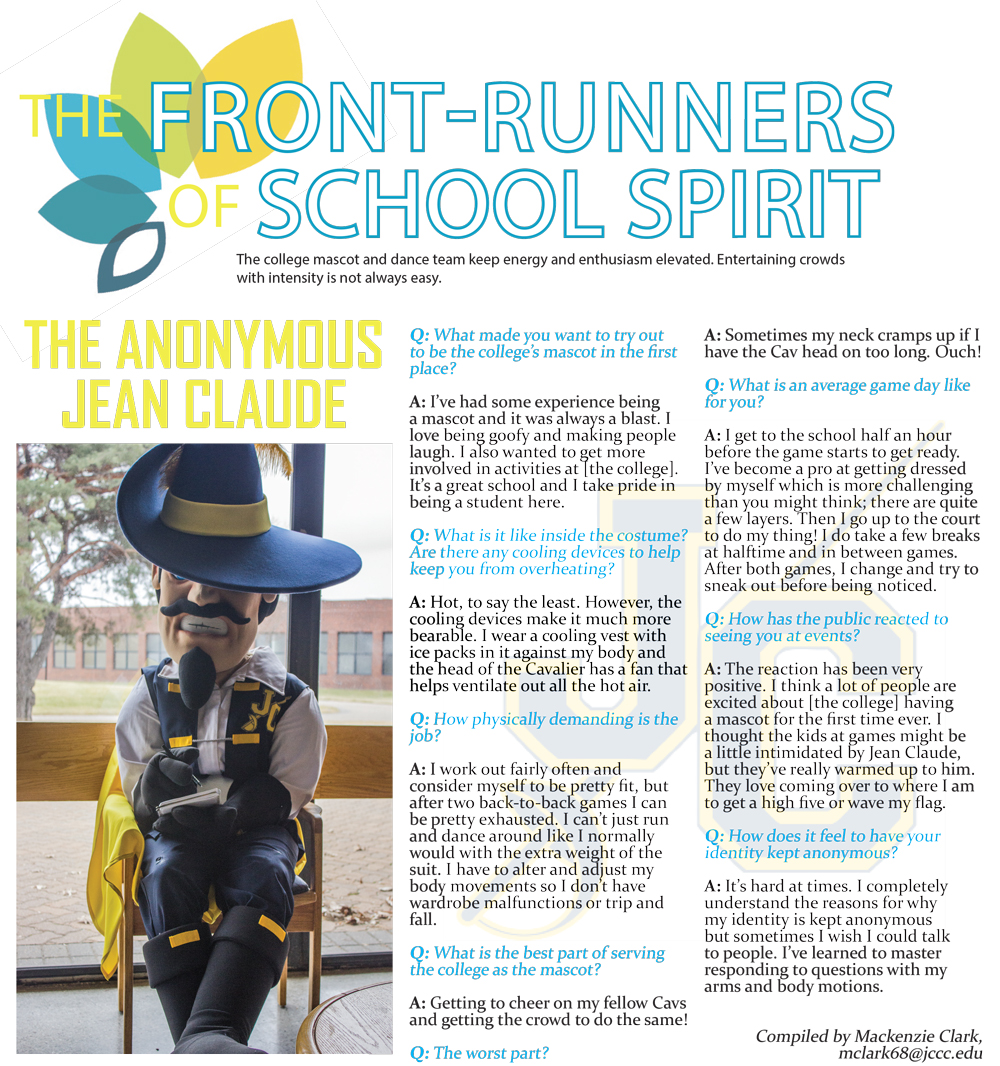
Web-exclusive Review: How to find the perfect ‘Pride and Prejudice’

0

In its 200th anniversary, this classic book-turned-movie is still perfect

By Gabrielle Fitzgerald

Oh, February: the month when all the adorable couples pull out every romantic movie ever made and all the single people go to their respective corners to play Xbox or eat chocolate. Surprisingly enough, there is a movie that all of these people should watch and enjoy: “Pride and Prejudice.”

Now, before the single men go running back to the safety of “Dead Space 3” (yes, I know, it’s brand new!), let me just say that if you want a date with a human woman this Valentine’s, inviting that hot chick over for an evening of “Pride and Prejudice” is a sure way to go.

For all you single women crying and eating chocolate in your pajamas, a little bit of Mr. Darcy will brighten your world. And, naturally, for all the couples, this movie is a must.

For those who don’t know the story at all (I’m looking at you, poor, uncultured men), here’s your cheat sheet, so you can impress the lady love of your life.

Elizabeth Bennet lives with an overbearing mother, an absent-minded father and four sisters in early 19th century England. Jane, the eldest, is the prettiest and Lydia, the youngest, is silly and flirty. The other two are irrelevant. The wealthy, single Mr. Bingley moves to town with his sister and his friend Mr. Darcy, who is even richer and also single. Jane and Mr. Bingley hit it off, while Elizabeth and Mr. Darcy can’t stand each other.

The book/movie proceeds from there with all the twists, comedy and passion of an endearing romantic tale, complete with Kitty’s scandalous elopement and the arrival of the Bennet family’s creepy cousin.

With that plot, you should promptly be heading to the college library to rent the movie, but once there, you discover there are multiple versions. What do you do when your girlfriend asks which your favorite is, your crush asks which version you rented, or you really just want to ogle over the most attractive Darcy? Don’t worry. Here’s the breakdown so you can impress all your peeps and get the best “Pride and Prejudice” experience.

The first version, directed by Robert Z. Leonard, was made in 1940. You can expect the voluptuous-figured women of the ‘40s complete with pin-curled hair, ridiculously fake eyelashes and sultry voices. Their gowns are poufy, covered in bows, and show the least amount of skin possible, looking suspiciously like characters from “Gone with the Wind.” Mr. Darcy, portrayed by Laurence Olivier, isn’t horrible looking, but honestly, it’s hard to drool over a man who died 24 years ago. The screenplay was written by Aldous Huxley, author of the classic Brave New World, so you can expect scenes to be changed or completely altered compared to the later versions.

Welcome to 1980. Yes, unfortunately, even Elizabeth Bennet couldn’t escape the frizzy pomp of bangs the ‘80s heralded with pride. While the plot is accurate and fun to watch unfold, especially with Mr. Darcy’s manly jaw and dark pools of eyes, it is really difficult to fall in love with this six-hour long movie. This may be one to leave to those viewers who loved the ‘80s because otherwise, I think the hair on the Bennet girls’ heads should stay hidden in the past.

The most timeless is the 1995 Colin Firth version. Naturally, ladies, who doesn’t love Firth as Mr. Darcy? The biggest problem I have with this film is in order to enjoy the magnificence of this movie, I have to spend 300 minutes of my life on it. The plot is thorough, to say the least, and it contains the famous “Darcy in the water” scene.

This is that movie, boys. If you’ve seen it or suggest it, the ladies will love you. It’s a classic and it gives you plenty of time with the love of your life. If I had the time, this is the version that I would always choose, and I think many women would agree.

Lastly, there is the 2005 version starring Keira Knightley. I love this version because of the attractiveness or star quality of all the actors: Knightley, Matthew MacFadyen, Donald Sutherland and Rosamund Pike to name a few. This movie is a doable two hours, but with that short amount of time, much of the plot is lost.

More problematic than that is director Joe Wright’s apparent fascination with filling up the movie with artistic shots of Elizabeth Bennet on a tire swing, on a cliff, or staring in a mirror. The first time it’s charming, but for girls like me who watch this movie about once a month, I just want to punch Wright for wasting my time. But for all the single boys out there, if the date with your crush doesn’t work out, at least you got to spend your night watching Knightley.

So, with that, I leave you to go find your perfect “Pride and Prejudice,” because “nobody don’t like ‘Pride and Prejudice’!”

Contact Gabrielle Fitzgerald, features editor, at [email protected].

1,100 Johnson County children sleeping in the cold tonight

0
Photo illustration by Kelly Daniels

By Jon Parton

On a Sunday morning, the homeless and the needy stood in line for a warm meal at the Wilhelmina Gill Center in Kansas City, Kan. An elderly woman dressed in a dirty oversized jean jacket bared a toothless smile as she stood in line.

Photo illustration by Kelly Daniels

“God is good,” she said. “God is good.”

The woman did not have long to wait, as the people in front of her ushered her ahead in line. An unwritten rule says that the youngest and oldest are first to be served. According to James Harrison, one of the homeless visiting the center, poverty means looking out for one another.

Harrison, 33, said he has been living on and off the streets since high school.

“When I first came here from Manhattan, I kind of had a place to stay with my uncle,” he said. “But everybody wants money. And if you ain’t got no money, it takes a long time to make some money and find a job.”

The center is one of many attending to Kansas City’s local homeless population. In Johnson County alone, the public school districts reported more than 1,100 students classified as homeless last year. That number represents 13 percent of all homeless youths in the state of Kansas.

According to David Burch, volunteer at the Wilhelmina Gill Center, demand has been on the rise since he first started four years ago.

“We’re open seven days a week,” Burch said. “We always have people coming in.”

homelesspoemThe center also offers hygiene products, free health screenings and a survival skills workshop for women. In addition, the center offers short-term monetary assistance and even mediation programs for families facing eviction and utility termination notices.

Burch said the center helps provide more than just food to the local homeless.

“We set up a voicemail system for people without phones so they can list a phone number on a job application,” Burch said. “We provide people an address or P.O. box so they have a place where they can pick up their food stamps.”

Leo Easterwood is a former police officer with the KCK Police Department. He was assigned to the center as part of his beat but continued to provide security after his retirement. While sitting to talk, Easterwood was greeted by a few visitors.

“I’ve been here about 15 years,” Easterwood said. “I’m the kind of person who is, if I’m given a job, then I’ll stay there and stick with it until something else happens. And I guess you might say I’ve been here so long, I’ve got a rapport with the people.”

Easterwood said his ongoing presence provides a sense of stability for visitors to the center.

“A lot of these people have mental problems,” Easterwood said. “Whether it’s from alcohol, drugs or a combination of mental challenges and they don’t know how to react in any given case to any given thing. So it has to be someone who can kind of, you know, bring them to themselves and let them understand that everyone’s not their enemy.”

Although the number of homeless visiting the center has increased in recent years, Easterwood said he has seen a lot of people move forward with their lives.

“We’ve had people come in here who literally have nothing,” Easterwood said. “Shirts on their backs. But they had enough about them that they wanted to do more. I’ve known people that leave here and come back just to see the people and help.”

Easterwood said aside from mental health problems, drugs have also played a role in the current homeless situation in Kansas City.

“A lot of people who come here, we’ve had ex-police officers who lost their job because of drugs,” Easterwood said. “We’ve had probation officers who lost their job because of drugs. We’ve had a number of people with multiple degrees lost their jobs because of drugs.”

Harrison said drugs are a daily routine among a lot of homeless.

“It’s the lifestyle, so to speak,” Harrison said. “Now yes, I do indulge in drug activity. I sell it, smoke it, sniff it, whatever it is. It’s around me everyday. In a sense, I guess you could say I’m an addict. Consuming it with a certain person, just even interacting with somebody can get you a benefit. It’s just building rapport. Drugs aren’t the best thing to be doing, but I do.”

Harrison said his addiction began before he was born, as his mother took various drugs while she was pregnant with him. Harrison pointed to his mother, standing no more than twenty feet away carrying a tray of food.

“My mom’s been smoking since before I was born,” Harrison said. “She doesn’t like anything but that. She’ll run down anybody to get it now. It’s consumed her soul.”

Contact Jon Parton, managing editor, at [email protected].

Record-breaking Raynor rises to top

0

By Stephen Cook

When Caniggia Raynor says that his friends and teammates are like family, he means it in a way that many athletes can’t relate to. Most of Raynor’s family lives more than 1,800 miles away on the island of Jamaica.

Click images below for gallery view

Raynor, sophomore track athlete, grew up in Greater Portmore, Jamaica and first started throwing discus when he was 16. After he graduated he was looking for offers to throw for a post-secondary institution, but didn’t receive any that were suitable. Eventually head track coach Phil Groves asked him to throw for JCCC.

Now Raynor is nationally ranked, currently holding first place in the NJCCA indoor weight throw. Before coming to the college, Raynor had never even thrown the hammer or weight before.

“I think Caniggia’s biggest success is just he committed wholeheartedly to achieving excellence,” Groves said.

Groves, who works with Raynor, said that he has been recruiting international athletes as long as he’s been a coach. He first heard about Raynor from an athlete he coached while at UMKC.

Raynor came to the college two years ago, in the fall of 2011. He said that although his first semester was rough, the second was better and this year has been fantastic. His friends and prayer have helped him stay encouraged.

“The main thing is, I always have this urge, always trying to be successful in anything I do,” Raynor said. “I think this college experience, where I’m in right now, [has] kind of given me a better view of life.”

In addition to his persistence, Groves believes Raynor’s personal and international background makes him push a little harder.

“Let’s just say, a typical American athlete: you come here, you flunk out or whatever it may be, you don’t do well and you end […] at home living in Mom and Dad’s basement,” Groves said. “A lot of times these international guys, they have a little bit more to lose, and so they’re willing to really commit and work a little bit harder.”

After nationally qualifying for indoor shot and weight, Raynor said he received an offer to throw for another school, but decided to stay at the college for a second year.

Hayes Grissom, who throws javelin for the college, has known Raynor for two years, but he says it was this year that he has really become good friends with him. Grissom described Raynor as being “distinctly Caniggia”.

“He walks all loud and proud, he walks with his chest all puffed out and he’s proud of who he is and the way he talks to people, you can tell,” Grissom said. “It’s not that he thinks he’s better than them, but he’s just really confident with himself.”

Grissom said he sees Raynor as his other half. Since Grissom throws javelin and Raynor throws shot put, discus and hammer, the two of them have all of the throwing events covered. Grissom, who was national runner-up in javelin, said he keeps encouraging Raynor to do well so that their track team can be national champions in all of the throwing events.

This season at an indoor track meet, Raynor scored 19.11 meters in the weight throw. According to Raynor, that throw has opened a lot of doors. Additionally, he recently broke both a fieldhouse and a school record in the event.

Looking towards the future, Raynor has his expectations set high.

“My main goal, to be honest, is trying to get that Senior Olympic Games or a world championship,” Raynor said. “I really wish to be one of those things one of these days.”

Contact Stephen Cook, copy editor, at [email protected].

Off to a running start

0
Jessica Tingle practices her pole vaulting. Photo by Andrew Shepherd

By David Hurtado

As the crisp morning air and frost-coated windows begin to withdraw, sporting events for the spring semester are kicking into gear. The men’s and women’s track teams, who opened their 2013 season in January, are off to a promising start.

Jessica Tingle practices her pole vaulting. Photo by Andrew Shepherd

Sophomore thrower Caniggia Raynor set a new school record at 62-8.5 in the weight throw on Jan. 25 at the Fieldhouse. The same day, during the Cavalier Night Relays, sophomore Monet Jackson broke the women’s record in the same event, finishing at 56-1.75.

Phil Groves, assistant coach, track and field, said he attributes the success of the student athletes toward hard work and determination.

“Our desire to work hard and get better every day, that’s spread throughout the team,” Groves said. “We’ve got some really good leaders in our sophomores, and they’ve helped mentor our younger kids along. We try wholeheartedly toward achieving excellence. That’s our motto.”

Groves added the team has quite a few new faces this season, including new javelin throwers and jumpers.

Last year, the Lady Cavaliers finished up the season taking fifth place overall at the NJCAA Outdoor Championships at South Plains College in Levelland, Texas. The men’s team completed the season with 12th place overall.

Mike Bloemker, head coach, track and field, said replicating the same success the teams saw last season is a top priority.

“We would like to repeat as regent champs,” Bloemker said. “That would be the first goal.”

Groves said one of the major challenges the teams faced prior to the start of the season was the difficulty of training in an indoor facility.

“Having our facility resurfaced over the winter break and not being able to train inside, that was a bit of a challenge,” he said. “Just dealing with some weather issues and practice restrictions, but that’s a challenge that every school faces. We’ve managed to deal with it.”

As for the competition, Groves said both teams have faced a healthy dose of it.

“Competition’s been good,” he said. “Our region is pretty deep, there are quite a few good schools in the Kansas area and nationwide. We’ve seen a lot of good competition from Division I and Division II schools that we compete against as well.”

Groves went on to say the camaraderie amongst the student athletes is strong.

“Team chemistry is awesome,” he said. “I don’t have to worry about doing running lists; we can just put them together with whoever. Everybody gets along very well. I think it really helps the team overall.”

Kurt Vukas, sophomore, said he runs the 800m and 1500m and feels like the season has gone pretty well for him so far. He said he feels like much of his hard work is beginning to pay off, but acknowledged he could still improve.

“It’s about seeing how far your body can go; pushing it and seeing where your limits are at,” Vukas said. “Then you push past those limits and find them again.”

Contact David Hurtado, staff reporter, at [email protected].

InFocus: The front-runners of school spirit

0

Click to view full pages.

8-9_Issue10-1O
Photo by Esaul Flores

8-9_Issue10-2O


Stat sheet stuffer spotlight: Sameia Kendall

0
Freshman Sameia Kendall heads to a team workout session with the Lady Cavs Friday, Feb. 8. Photo by Kelly Daniels

By Mac Moore

Sameia Kendall is a freshman women’s basketball player from Raytown High School in Kansas City. Currently she averages around nine points per game and is tied for second most steals in the season.

Freshman Sameia Kendall heads to a team workout session with the Lady Cavs Friday, Feb. 8. Photo by Kelly Daniels

Q: What is the team primary focus at this point in the season? 

A: The primary focus at this point, which it’s been all year, is to get better every day and everything else will work out on its own. We live by the model “process over product”.

Q: How’s it been tough to stay grounded while playing at this high level? What things do players and coaches do to keep the team striving for improvement during a fairly dominant stretch of games? 

A: Playing at this high level has definitely been a change for me, comparing to high school basketball. It’s a bigger commitment and the dedication has to be there to stay grounded. During long stretches of games, to keep improving, we just take one day at a time and focus on improving day by day.

Q: Last year’s team finished with a 32-3 record, but a 1-2 tournament record.  Do you believe this squad will be able to match or succeed the performance of last year’s squad? 

A: Last year’s team was very good and I think we look up to them. Hearing about their accomplishments from Coach [Ben] Conrad pushes us to strive to try to accomplish things that they were able to accomplish. We don’t see this as a competition, but more as an honor to be mentioned in the same group as last year’s team.

Q: What has been the memorable moment of this season for you? 

A: The most memorable moment was getting revenge on Highland after they beat us at their place. I think the loss was more memorable though because I think it was humbling. It was our first loss of the season and it put a chip on our shoulder that we needed to get better and we had not accomplished anything yet.

Q: Favorite movie?

A: “Love & Basketball”

Q: Favorite artist? 

A: Beyoncé

Q: If you were given $50,000, but half had to go to charity, what charity would you give it to and what would you do with the rest?

A: St. Joseph children cancer patients. Then I would give some to my parents, pay for the rest of my schooling, of course spend some on me, and put the rest in the bank.

Contact Mac Moore, sports editor, at [email protected].

Professor’s creative spirit penetrates the college’s English department

0
Samantha Bell’s creativity extends to the decorative walls of her office. Photo by Daniel De Zamacona

By Gabrielle Fitzgerald

From a former dance student to the adviser of the college’s creative writing club, Sam Bell is anything but a stereotypical English professor.

Samantha Bell’s creativity extends to the decorative walls of her office. Photo by Daniel De Zamacona

Born in Fairport, New York, Bell was the child who could usually be found either writing or dancing. Although she wanted to study ballet, Bell explained she was too short to ever become a professional.

“I started out in ballet, and that sort of transferred into creative stuff, so then I started writing and reading poetry,” Bell said.

After receiving her undergraduate degree in journalism, Bell worked features section in her school newspaper and took a large number of creative writing classes.

“I just loved writing,” Bell said. “I was doing a lot of feature writing, which was more like essay writing. [..] so that’s basically how I got into creative writing and went into a master’s program. That’s where I started figuring out what I really wanted to do, particularly creative non-fiction.”

Three years ago, after receiving her doctorate degree in English, with an emphasis in creative writing from the University of Kansas, Bell became a full time faculty member at the college.

“I met Sam through our departmental meetings, and I really gravitated toward her because when she would speak or share things about her practice, I had a great deal of connection with what she taught and her thoughts about students,” said Amy Pace, adjunct professor of English.

Although Bell loved her students, she said she came to see them even more as people versus students after a tragedy in one of her classes this past fall.

“There was a sudden and unexpected death… [This] student and his friend were very funny together…to a point that it sort of helped unify the class,” Bell said. “To that end, the loss was pretty monumental because he was someone who always contributed to the class discussion.”

Because of this, Bell said she will write letters to each student at the end of the semester. The advice came from her husband and is a way she can tell students how important they are as a person, regardless of their grade in her class.

“It was really great that she took the initiative to just seek help and be able to kind of talk out what happened,” Pace said. “I think it really speaks a great deal about how much Sam cares about her students… I thought it was great that she spoke very candidly about what she was thinking and experiencing and the best way to kind of meet the needs of her students who were kind of feeling the same way.”

Danny Alexander, professor of English, described Bell as a “very emphatic leader.”

“She’s very sensitive to and aware of her students, gives a lot of thought to them and is always trying to discern how to make her class work better for everyone,” he said. “She’s a really powerful person.”

Bell also founded the college’s creative writing club, an idea brought to her by some of her students who wanted to keep writing after the semester ended but needed the pressure of classroom deadlines to accomplish it. The club meets for writing workshops as well as monthly readings of students’ work.

“Sam had the vision that [the creative writing club] could happen and started doing it, without any precedent and it’s really worked well,” Alexander said. “Sam brings all kinds of energy and new ideas to the department…The ability to bring people together in a way that actually feels very real to them and for everyone that attends is very meaningful. It’s a special kind of person that is sensitive to what people need in order to make that really work. She’s done it. As far as I’m concerned, she’s a star in the program and we’re really really lucky to have her: students, teachers, everybody.”

Contact Gabrielle Fitzgerald, features editor, at [email protected].

Hospitality and Culinary Academy rooms named for donors

0
Workers continue progress on the new Hospitality and Culinary Academy expected to open for the Fall 2013 semester. Photo by Daniel De Zamacona

By Hannah Davis

Workers continue progress on the new Hospitality and Culinary Academy expected to open for the Fall 2013 semester. Photo by Daniel De Zamacona

The Hospitality and Culinary Academy, currently under construction, will have rooms named on behalf of four private donors.

“In this case, these four groups gave more than $200,000,” said Joe Sopcich, executive vice president of administrative service – CFO. “So, for $200,000, a room would be named in their honor.”

The Ball family and the Regnier family each donated $200,000; Maron Moore donated $500,000 and the Wysong family donated $750,000.

Originally, Senator David Wysong donated the $750,000 to the program seven years ago.

“David gave me $750,000 and asked me to elevate the culinary program,” Lindy Robinson, dean, Business, said. “David never really wanted bricks and mortar to speak of, but I had put together several new initiatives to elevate the program without using any of the money he had given me, and convinced him what this program really needed was a new building.”

From there, Sopcich and Robinson had the task of raising $3 million in 24 months for the Board of Trustees to approve and provide the remaining funding for the new building.

“[Sopcich] and I worked together and we actually raised $3.2 million in 18 months,” Robinson said, “so we went back to the Board of Trustees […] and they committed $13 million for a 36,000 square foot, free-standing culinary academy. There was a lot of work to go out and raise that money, but we did it.”

The Wysong Family Culinary Theatre, which will be used as a classroom, will also allow for guest chefs to come in for demonstrations and broadcasts. It will hold 76 people, but the back of the theatre will open up as an overflow, which will allow for more space.

“It’s a nice linkage between the actual naming,” Sopcich said. “You know the Culinary Theatre is there to broadcast and get the word out, and that’s what David Wysong was interested in—in elevating the program, so it makes a lot of sense.”

The Regnier Family Dining Room will also be used as a classroom, but it will be designed as a front-of-house restaurant to give students a more applicable, realistic learning experience. It will also hold the program’s Thursday luncheons.

The Maron J. Moore Hospitality Library will be a resource and study center full of cookbooks for culinary students.

The Ball Family Garde Manger Culinary Lab will be a stainless steel kitchen to learn the art of cold food production.

Both the Sunderland and Polsky families met the monetary threshold in donations but were not considered for naming rights. According to Sopcich, the Sunderlands were “just not interested in naming.” The Polskys were not considered because they already have naming rights for the Polsky Theatre, located in the Carlsen Center.

Many others donated to the program, including the hospitality program’s faculty, alumni, and several non-profit organizations, such as the Greater Kansas City Chef’s Association, the Greater Kansas City Hotel and Lodging Association and the Greater Kansas City Restaurant’s Association. Robinson noted the expansion of the hospitality program is “an investment for the industry.”

“We think it’s just going to get bigger and better, and also provide new opportunities for students to use the facility and for members of the community as well,” Sopcich said.

Wysong donated to the program in hopes that “it will become one of the best culinary schools in the country, if not the best,” he said.

“[The culinary program is] always in the newspaper,” Sopcich said. “It brings a lot of recognition to the school. It’s just a great program.”

The Jerry Vincent Hospitality Suite, located on the first floor of the OCB, will be cleared out once the new academy opens in the fall. According to both Sopcich and Robinson, no decisions have been made as to how that space will be utilized.

Contact Hannah Davis, news editor, at [email protected].

Backpage comic: Beware of Dog

0

Illustration by Morgan Daigneault

Click for full image

beware[1]O

Column: My achy breaky pink paper heart

0
Click to view full-size sidebar

By Mac Moore

A few years ago, my roommate was really excited about Valentine’s Day. The evening had been planned for weeks. He was going to cook her pasta with alfredo sauce, homemade breadsticks, fresh salad, the works. When V-Day arrived I saw that my friend grew in anxiousness throughout the day. At heart I am a hopeless romantic, so seeing my little buddy get so worked up tickled my heart strings. I hoped the best for him.

The best did not happen. Turns out he had never made an alfredo sauce before. It gave him trouble. Then he burned it. “Scorched” might be a more accurate term. The alfredo was a no go. He went to the store to get a premade sauce that would cook quickly and get him back on track. This time I watched over it to make sure there would not be another folly to ruin his night. He set the table for her arrival. With the food prepared he was a tiny bit settled, yet the wait always brings the anxiety back.

He waited 15 minutes for her to show up. The anxiety rose. She was supposed to arrive in 5 minutes. The anxiety rose. It was finally time. The anxiety rose. He wanted to call to see how close she is but he felt that would just be annoying. The anxiety rose. She is 5 minutes late. He prepared a text but decided not to send it. He did not want to seem clingy or desperate. The anxiety rose. He called because she is 20 minutes late. No answer. The anxiety rose. This continued until she was an hour and a half late.

My depressed little friend and I ate the cold food. The anxiety died. Finally she called and said she passed out. It was late so she told him she would see him tomorrow, no point in coming over. She broke up with him two days later. That night my depressed buddy and I went out to the bar hoping to find him someone new.

No, I will not misogynistically say this happened because women are emotional terrorists. I will not say that despite quivering at the sappy fake romance depicted by that Nicholas Sparks drivel, women, in reality, are vicious vixens with black hearts. I will not let the truth to these descriptions interfere with my objectivity. We have to face it: men and women alike participate in games of the heart only to treat it like warfare. And let’s stop pretending it is because we have to find a “nice one.” We have all at one time or another been the stomper and the stompee in a relationship. This isn’t something that is dependent upon the quality of our character.

It is because of the complexity of relationships. We go after people who we are attracted to. Sometimes they happen to be nice and sometimes they don’t. The person must excite us, entertain us, all while they retain that initial attraction. It is harder than hell to actually find that person. We do not like to be alone, so we settle for what is in front of us and usually that leads to the eventual reality, the breakup. The breakup crushes at least one individual, but it must happen. Most people have been on both ends of this.

The short term rewards of having another person willing and able to provide us with intimate, emotional and sometimes even an intellectual connection blind us to the hell we go through to achieve it. This isn’t saying being single is the solution or the greatest thing on the planet but being single on the 14th of February definitely is not the worst thing in the world.

Contact Mac Moore, sports editor, at [email protected].

Click to view full-size sidebar
Click to view full sidebar

Daughter in Brown v. Board speaks at the college

0
Brown Henderson lectures to an audience about African American rights and the 14th Amendment on Tuesday, Feb. 12. Photo by Esaul Flores

By Hannah Davis

Brown Henderson lectures to an audience about African American rights and the 14th Amendment on Tuesday, Feb. 12. Photo by Esaul Flores

Cheryl Brown Henderson, daughter of the lead plaintiff, Rev. Oliver Brown, in Brown v. Board of Education of Topeka and founder of the Brown Foundation, gave two lectures at the college on Feb. 12 and Feb. 13.

“Her evening presentation is part of the Kansas Lecture Series, which annually hosts an event by a noted Kansan or someone whose work is relevant for Kansas issues,” James Leiker, director, Kansas Studies Institute said. “Since the Brown case of 1954 had such a large national impact, having emerged from the work of an active African American community in Topeka as well as others from around the country, her content merits attention both by those interested in Kansas history and in Black History.”

Her first lecture, “Brown v. Board of Education – Voices of the Legacy” was held on Feb. 12 at 11 a.m. in the Craig Community Auditorium, and her second lecture, “The Judicial Past of Kansas – Giving Meaning to the 14th Amendment” was held the following day at 7 p.m. in the Hudson Auditorium of the Nerman Museum of Contemporary Art. The presentations addressed the legal activism of the African-American attorneys, the intended and unintended consequences of the Supreme Court’s decision, the relevance of Kansas history to civil rights and the myths surrounding the landmark case.

“I learned how the history books from elementary school made [Brown v. Board] sound, but that’s not what the story was like,” Austin Mora, student, said in response to the first lecture. “I thought it was interesting. It’s our recent history and puts Kansas on the map of history.”

Brown Henderson acknowledged that the case, though primarily about segregation in schools, was part of a larger movement.

“Public school was the battle ground, but society was the target,” Brown Henderson said.

Brown Henderson stressed the hierarchy that was embedded in the roots of this country, citing the U.S. Constitution, in which it apportioned Native Americans as three fifths of persons, the Supreme Court decision in Dred Scott v. Sanford, which denied citizenship to black persons, and Plessy v. Ferguson, which established the “separate but equal” doctrine.

“I think Brown v. Board was, in fact, the case that gave the Supreme Court the opportunity to interpret the 14th amendment,” Brown Henderson said. “It impacts our lives because it made it clear, we have sovereign rights.”

These rights, including those protected in the 14th amendment, are still being defined by the courts today.

“We are still debating the meaning of the 14th amendment as to what ‘full, equal citizenship right’ actually means,” Leiker said. “Does it mean the right to a living wage? To health care? To safety and security? It’s the foundation for many discussions today about what ‘rights’ we as American, and human beings, have.”

Brown Henderson hopes that the decision of Brown v. Board and the definition of the 14th amendment will continue to lead to progress in tolerance and equality.

“As human organisms, we are absolutely the same,” Brown Henderson said. “We really need to grow up and realize we all want the same things. We all want to enjoy the lives that we have.”

Contact Hannah Davis, news editor, at [email protected].

Designated space allows for prayer, meditation, relaxation

0
MaryRose Scarpelli searches for inner peace in the college’s meditation room. Photo by Daniel De Zamacona

By Hannah Davis

The Meditation Room, located in COM 309, has gained popularity since it opened in the fall of 2010.

MaryRose Scarpelli searches for inner peace in the college’s meditation room. Photo by Daniel De Zamacona

“It’s the third year we’ve had it here on campus,” said Mindy Kinnaman, manager of Student Life and Leadership Development. “Every semester we have more and more people using it. This semester it really has gone up in terms of people who are using it and so we’re just hopeful more and more people do.”

The room was developed after Christian and Muslim students consistently asked for private spaces to pray.

“We had, for many, many years prior to [the meditation room], the request from students for space, a room, whether it be a classroom or an office or a conference room, from our Christian groups to find a place to pray, and from our Muslim students for a place to pray,” said Pam Vassar, assistant dean, Student Life. “And in both cases, those groups would request multiple times a day, sometimes multiple days during the week […] it just made it really hard and most of the time we were not able to accommodate people’s requests.”

This left many individuals and groups praying in the hallways. At this same time, remodeling on the third floor of the COM building was taking place. The Meditation Room was originally pegged as a storage closet.

“At some point we said, ‘Wait a minute, maybe we could utilize that space,’” Vassar said. “It’s not large, but it’s certainly much more private.”

Vassar began research, and discovered the idea of a meditation room.

“We started getting requests from students also, we had the request for prayer, then space for meditation, space for students to just have a place to go, for lack of a better word, for downtime,” Vassar said.

They changed plans during construction and painted the room a light blue color. It has two light settings: one for bright light and one for dim light. Each wall is labeled directionally for Muslim students who must pray toward the direction of Mecca.

“[The Meditation Room] is not directed toward any one person,” Kinnaman said. “It’s open to everyone, so if somebody wants to come in and just have a quiet space to sit for a little bit, if somebody wants to actually meditate, if somebody wants to pray, it doesn’t matter what it is, they’re welcome to use this space.”

The Mediation Room is open from 8 a.m. – 6 p.m. Monday through Thursday and 8 a.m. – 5 p.m. Friday.

Contact Hannah Davis, news editor, at [email protected].

Campus is internally mapped by Google

0

By Stephen Cook 

Google employees were at the college during the last week of January gathering information for new indoor maps. They will compile that data with floor plans to create interactive maps used to navigate campus.

“One of the things that we try to do is receive feedback from students, community members, employees on how we can improve,” said Sandra Warner, Deputy CIO/director, Administrative Computing Services, who headed up the project. “One of the challenges that the college has been facing for some time is way finding.”

In order to map out the area, Warner said the employees had to walk down the middle of the halls while their positions were tracked, essentially becoming the blue dots.

No cameras or large, special equipment was used in the process. Warner said the Google employees ultimately used their smartphones to do this.

The Google website provides more specifics about how people will be able to use this technology within the existing Google Maps application:

“Indoor floor plans are seamlessly integrated into Google Maps for desktop and Android and are automatically enabled when the user zooms in, and fade away when the map is zoomed out,” Google stated on its website.

Judi Reilly, advertising coordinator for the college, was in charge of overseeing that the floor plans were updated and developed for submission to Google. About 50 floor plans were sent in for the main buildings on campus, with each floor requiring its own plan.

Reilly says although it took a while to go through and update the Computer-Aided Design files, the process went smoothly.

“What we wanted to do was make sure we did our due diligence in terms of checking things out in terms of our design,” Reilly said. “What we wanted it to accomplish, what we didn’t want it to do, we kind of looked both ways.”

Although some have voiced concern regarding security and safety issues, Warner said room numbers will be displayed for classrooms and offices, instead of saying something like “Sandra Warner’s office.”

“The negotiation process we went through with Google was that we would retain control over what would actually get published out in those maps,” Warner said

Although there is no definite timeline, Warner said Google is currently combining the position data and the floor plans. According to Warner, the maps should be posted and available for use in the near future.

Google offered the services to the college, and there was no cost associated with the process.

With this technology, Warner said the college is looking forward to being able to provide a better experience for students and guests.

“It’s that whole challenge of […] trying to find ways to break down any barriers to people coming in, enjoying what JCCC has to offer,” Warner said. “However it is that we’re involved in helping people achieve their goals, we want to be able to do that.”

Contact Stephen Cook, copy editor, at [email protected].

News briefs – Feb. 14, 2012

0

Board discusses budget in retreat

The Board of Trustees met for a special retreat on Monday, Feb. 11 to discuss budget projections over the next several years.

Don Perkins, associate vice president, Financial Services, presented four possible budget plans for the trustees and administration to consider, although options are not limited to those four.

The Ledger will cover the decisions the Board makes at its regular monthly meeting on Thursday, Feb. 21. Follow @CampusLedger on Twitter for up-to-the-minute information.

College partners with National American University

National American University and JCCC have joined forces to offer doctorate-level classes on campus.

This “Community College Leadership Program” is designed for faculty who wish to pursue an educational doctorate degree. Details will follow in Issue 11 of The Campus Ledger, printing Thursday, Feb. 28.

College to host naturalization ceremony

Approximately 90 individuals representing about 40 countries will be naturalized in a formal ceremony held at 1:30 p.m. Friday, Feb. 22 in the Polsky Theatre.

Judge James P. O’Hara will preside over the court proceeding, which will also be live-streamed in the Craig Community Auditorium (GEB 233).

The public is invited to attend. The event is part of the Democracy Commitment.


Compiled by Mackenzie Clark, [email protected]
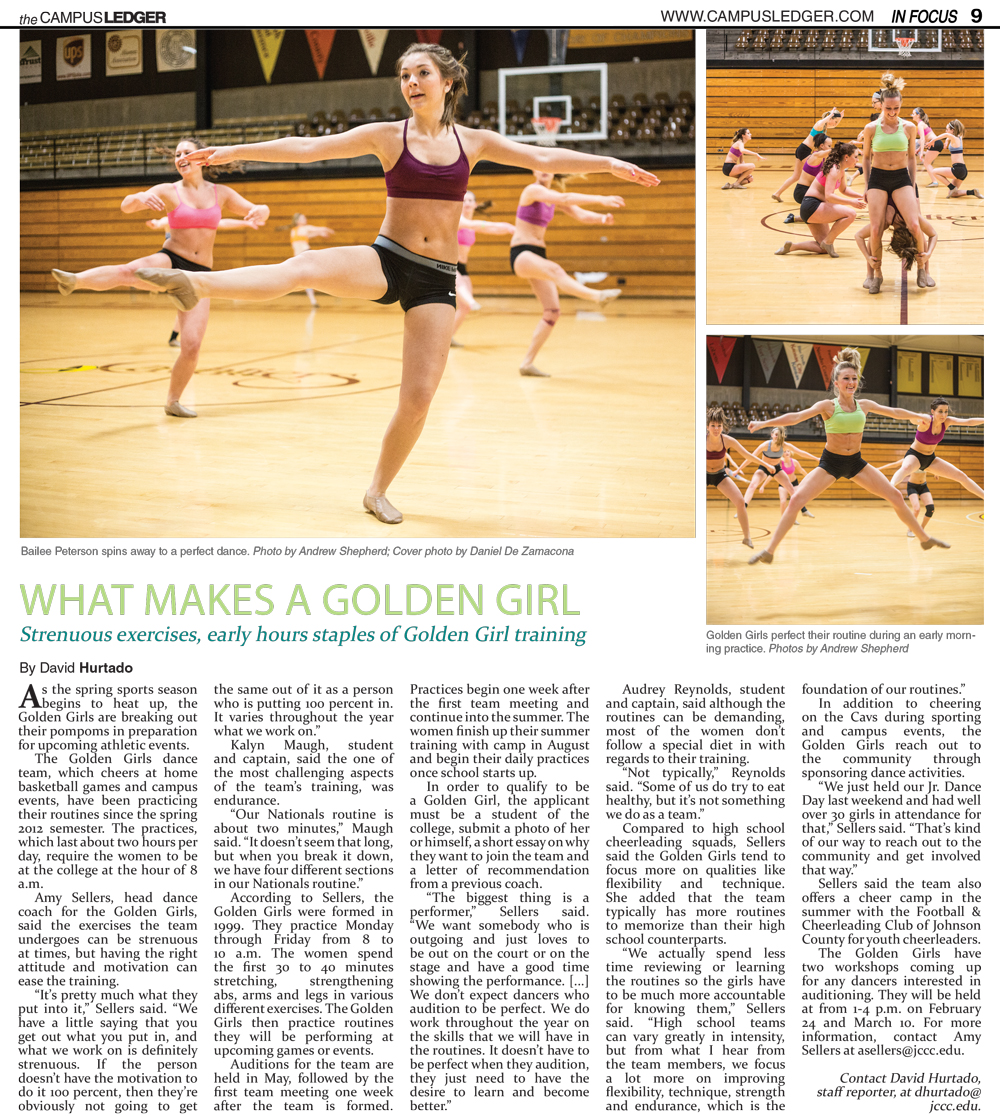
Column: Enough is enough; it’s time to restore the republic

0

By David Hurtado

The year is 476 A.D., and the Western Roman Empire has collapsed beneath the barbarian hordes. Rome, which once stood as the apex of glory in the known world, has been extinguished.

But Rome was not the first great empire to come to an end, nor will it be the last. From the Macedonian Empire to the Han Dynasty, no civilization has withstood the test of time. Each great empire, no matter its power and accomplishments, was ultimately buried under the sands of time.

All throughout history, each empire has been built upon the same foundation; force. And as the saying goes, “those who live by the sword, die by the sword.” The United States on the other hand, is a different kind of empire, if it can be considered an empire at all. We are an empire of ideals.

This country was founded upon the idea that each and every individual is endowed with the right to life, liberty and the pursuit of happiness. Not because of God or words printed on paper, but because we are human beings. Sadly, the beliefs and values which Americans once guarded so closely have become undone.

More than two centuries ago, Alexander Tytler, a Scottish writer and historian, made a profound observation on the nature of Democracies.

“A democracy cannot exist as a permanent form of government. It can only exist until the majority discovers it can vote itself largess out of the public treasury. After that, the majority always votes for the candidate promising the most benefits with the result the democracy collapses because of the loose fiscal policy ensuing, always to be followed by a dictatorship, then a monarchy.”

History has given to America all of these lessons from centuries past, but for some reason we think we know better. Rome fell from glory for the same reasons we stand on the brink of ruin; corruption of the senate, endless warfare and a crumbling economy. But most of all, the Roman people were no longer devoted to their country.

The United States is being dismantled before our very eyes, and no one is doing anything to stop it. As long as there’s money in the bank account, food on the table and a television to watch, people are content to be asleep. While we squander in the darkness, fumbling in ignorance, America as it was intended is receding.

Albert Einstein once said the definition of insanity is doing the same thing over and over again, and expecting different results. According to the Huffington Post, the last time Congress passed a budget was in 2009. So why are they still in office?

My fellow Americans, it is time to admit that most of our elected officials are corrupt blood sucking leeches. Democrat or Republican, none of those rats have the best interests of the nation at heart. Politicians from both parties crave one thing and one thing only; absolute power.

And the fact that we keep voting for them tells them no one gives a damn anymore. When we the people stop holding the federal government accountable, we get Pelosi and Bush. “We won’t know what’s in the bill until we pass it” and “I’ve abandoned free market principles to save the free market system,” are two of the most arrogant sentences I’ve ever heard.

If a politician is going to vote on a bill without even bothering to read it, or abandon the principles our nation was founded on, they don’t belong in office. They belong in a jail cell.

Our government does not care about the average citizen, only those who can benefit them financially or vote for them in elections. Our whole system is a fraud, yet you still have fools arguing and bickering over why their party is better. If you open your eyes, you will see that none of them are good; they are all corrupt.

This is why laws like NDAA and the Patriot Act were passed, while CIPA and PIPA were almost passed. We can’t remove our hands from each other’s necks for even the briefest of moments to stand together against all that threatens the United States. Like the Roman people before us, Americans are no longer devoted to their country.

I say enough is enough, it’s time we reminded the federal government they are servants of the people. We cannot undo the past, but we can create a better future for ourselves and our children; the American Dream. We’ve read this in our school books as children, now is the time to embrace those ideals, and stand up against the weight of tyranny.

I know this will not be easy; the deck is stacked against us. But take heart, for we are not the first to stand against such odds. 238 years ago, farmers and shopkeepers, printers and blacksmiths fought against an almighty empire. They wished to affirm to the world that freedom, tolerance and justice are more than words, they are rights endowed to us at birth that no human has the authority to deny.

As George Washington said long ago before the Battle of Long Island,

“The time is now near at hand, which must probably determine whether Americans are to be free men or slaves; whether they are to have any property they can call their own; whether their houses and farms are to be pillaged and destroyed, and themselves consigned to a state of wretchedness from which no human efforts will deliver them. […] We have, therefore, to resolve to conquer, or die”

It’s time to restore the republic.

Contact David Hurtado, staff reporter, at [email protected].

Sports Column: Does tuition cover community?

0

By Mac Moore 

We just don’t seem to care. It’s not our fault. We are all busy. School and work, work and school; the days are filled so quickly. We have to make very smart decisions about how we spend our free time.

The Lady Cavs’ basketball team is finishing up their second straight season of decimating the East Jayhawk Conference. This team is sensational. So far in the season the team is 22-1 and 9-0 at home. Average attendance of home games: 168. The team is also not the exception; they are more like the rule. This college’s athletics program, as a whole, is one of the most consistent junior college programs in the country.

These teams can’t get the support they need. Let’s rephrase that, the support they deserve. They definitely don’t need our support. In actuality, attendance is not a necessity for this program. The school is lucky to be so properly funded that it in no way requires ticket sales to equip its teams with top notch facilities and resources. Money is not the issue. It just might be nice to demonstrate school spirit and unity.

This goes way past school athletics. We are the most dismissive campus ever. Not that we are out and out rude, but that middle C in the JCCC acronym should not be taken literally. There is no sense of “community” at this college.

Everybody seems to be so wrapped up in their own things. The nursing kids know the other nursing kids and the EMT students know the other EMT students. The lines are drawn by fields of study. Even the undeclared students seem to just keep hanging out with the same kids from high school.

It is to be expected. This is a commuter college. We drive here, complain about the parking spaces that are actually abundant (we just hate walking), go to class and then go back home. The lack of dorms which most colleges offer seems to have created a drive-thru education that has eradicated socialization on campus.

“Hi, I would like an associate degree, one internship and a couple acting classes on the side. Yeah, and can you hold the mustard on that?”

“Yes, that will be $10 grand, please pull to the next window.”

Can we change this? Is there a way to make the student body care? This is a question we at The Ledger have faced. Our cohorts for JCAV and ECAV have faced the same. ECAV DJs broadcast show clips in the Down Under every Wednesday from 11 a.m. to 1 p.m. They ask, “Have you heard of ECAV?” As it turns out, no one has. Occasionally interests are peaked, but usually the discussion is met with the scurried walk as the student attempts to avoid the pitch of listening to the college’s own radio station.

The sad reality is we probably can’t change this. An overwhelming majority of the college will continue to use this school as a 7-11 education, in and out.

But you don’t have to. Yeah, you, the person currently reading this paper, skimming through articles before you leave this issue on a Food Court table (don’t you dare throw it in the trash). Start caring, start talking to people in your classes. Quit making tweets that criticize other classmates because they actually try to be friendly in this atmosphere of dismissiveness.

Contact Mac Moore, sports editor, at [email protected].

Column: Too much technology

0

By Joe Hofbauer 

“Oh God! My eyes!” I screamed as I fell to my knees clutching my face. The sun laughed mercilessly and continued to blind me with its powerful beams of light. Well, that’s what I get for having my face glued to a monitor the whole weekend.

Technology has been on this planet since the beginning of man, from the pointy wooden sticks used as spears by our early ancestors to having nanobots injected into white blood cells to help fight cancer.  We all know there is no stopping the forward progress that our past generations have laid before us, yet with technology on the rise, most humans are beginning to fall.

How much time do we waste on our phones, computers, or just watching TV? Did you know going outside and taking in a deep breath will actually improve your focus and help clear your mind? Did you know the closer you live to nature, the healthier you are likely to be?

In 2009 the Journal of Epidemiology and Community Health published some pretty solid findings. The study took 345,143 Dutch people’s medical records, assessing them for 24 conditions including cardiovascular, respiratory and neurological diseases. Scientists then correlated the records with how much green space was located within 1 km and 3 km of each subject’s postal code. People who lived close to a park or wooded area experienced less anxiety and depression than those who lived further away from green space.

Most of our society’s common practices are now piled indoors either on the computer, watching TV, on our phones or just playing video games. We all must enjoy a little mindless indulgence once in a while. Nothing’s wrong with that.

I can hear some of you thinking quietly, “We’ve got another hippie with an opinion, great.” I have nothing wrong with the advancements of technology. The fact that you can instantly call anyone anywhere in the world with the touch of a button is incredible. I’m just as guilty of slothing as much time on the interwebs as my fellow n00bs, but there must be moderation.

You’ll never know what you may find on your way unless you go, so take a chance and get out there.

Contact Joe Hofbauer, reporting correspondent, at [email protected].

Staff Editorial: The most American thing to do

0

Governments are chiefly responsible for five functions with respect to their citizens. These functions are spelled out in the preamble of our own Constitution: establish justice, insure domestic tranquility, provide for the common defense, promote the general welfare, and secure the blessings of liberty to ourselves and our posterity.

According to the U.S. Census Bureau in 2008, an estimated 300,000 people lived in poverty in Kansas. That number has increased to more than 384,000. It seems some in the government forgot about the general welfare of the people. Someone is not doing their job.

In May of last year, the Kansas government eliminated income taxes for almost 200,000 small businesses while simultaneously eliminating tax breaks for childcare expenses. Governor Brownback supported these actions, creating one of the largest tax cuts in Kansas history. Brownback, a self-proclaimed Catholic, supported budget cuts that took money away from public assistance in order to give businesses a tax break.

We already have a homeless problem in Johnson County. How does this type of governance help those people? How does this type of governance assist the mentally ill who live on the street? Will a tax break for small businesses reduce the homeless population? Does this promote the welfare of all the people or just some? Will these small businesses use their extra profit to make donations? These are the questions we should ask ourselves and of our leaders.

We at The Ledger do not presume to have the answers. Our purpose is to just ask questions and have our readership ask questions. Travel to the area of North 5th Street and Minnesota Ave in Kansas City, Kan. There exists one of several tent cities, a community of homeless huddling together for safety.

Obviously the government and its actions cannot be blamed for the choices of individuals. We are where we are because it is exactly where we chose to be. But a self-proclaimed Catholic should know how to help his fellow man.

Intelligent men and women caught in the wrong place at the wrong time need hope. They need to know that no one finds poverty acceptable in the country that boasts itself the greatest nation in the world. They need to know that no one believes children should have to skip a meal because they can’t afford to eat. The inherent decency of all humankind refuses to let these issues be swept under the rug.

The Ledger urges our readership to do what the government sometimes won’t: help. If you can afford to donate money to any of the numerous local charities, please do so. If you can donate valuable time to volunteer for one of these organizations, please do so.

Not only will volunteering help others, it will help you develop a greater appreciation for just how great the problems of poverty and homelessness really are. The Ledger staff calls upon its readership to act American by helping Americans.

Web-exclusive: Creation of a new faculty senate approved

0

College faculty voted in favor of creating a new faculty senate. Out of a total of 267 faculty voters, 257 voted for the measure while 10 voted against. According to an email sent by the Faculty Association,  their goal is to have a functional faculty senate in operation before the end of the spring semester.

Compiled by Jon Parton, [email protected]

Web-exclusive: Track athletes sign with Division I schools

0

By Stephen Cook

Signing
With their families nearby, Hayes Grissom (left) and Monet Jackson (right), track athletes, sign contracts with Div. I schools Wednesday, Feb. 6. Photo by Stephen Cook

Two members of the college’s track team signed contracts with Division I schools Feb. 6. Hayes Grissom will be attending Troy University and Monet Jackson will be throwing for Colorado State.

Grissom, who throws javelin at the college, said it feels really good to have made a decision and to be done with the difficult and sometimes stressful selection process.

“I was reminding myself that I was blessed to be in such a situation where I am getting recruited,” Grissom.

Track and field Coach Phil Groves introduced the two during the signing, complimenting them for their hard work and dedication.

“Both these young people have really exemplified what it means to be a Cavalier,” Groves said. “They’re fantastic athletes, they’re outstanding students and they’re better people.”

Contact Stephen Cook, copy editor, at [email protected].

Bringing music to the masses

0

Cas Haley, a well-known reggae singer and guitarist, gives a small show in the cafeteria Jan. 16. This finalist from season 2 of “America’s Got Talent” performed his own songs “Will I Find” and “Connection” as well as a cover of Bob Marley’s “No Woman No Cry.” Photos by Daniel De Zamacona

Click for full images.


The return to records

0
“Oracular Spectacular,” MGMT’s first album, spins on a modern record player. Photo by Ashley Lane

By Stephen Cook

“Oracular Spectacular,” MGMT’s first album, spins on a modern record player. Photo by Ashley Lane

Decades ago, if you wanted to listen to music you could either turn on the radio or put on a record. Fast forward to now, when there are more listening options than ever before: iTunes, Pandora, Spotify, Grooveshark, CDs and MP3s just to name a few. In addition to these, there is traditional radio and vinyl records.

Although the general popularity of vinyl records fell during the late ‘90s and ‘00s, an era when new technologies such as CDs and MP3s became widespread, records are once again becoming more prevalent. According to a report by Nielsen SoundScan, 4.6 million LP/Vinyl Records were sold in 2012 – a 17.7 percent increase over the 3.9 million sold in 2011.

Today’s selection isn’t limited to just vintage vinyl, either. Artists such as Taylor Swift and the Black Keys are releasing brand new albums on vinyl. Amazon.com has more than 1 million vinyl records for sale, ranging from Lady Gaga to Jimi Hendrix and everything in between.

Coleen Voeks, who works at the Kansas City record store Vinyl Renaissance, has been listening to records since she was a child. Over the past 10 years, she said she has come to the point where she won’t buy anything but vinyl.

“If I’m going to sit down and actually listen to something I listen to it on vinyl,” Voeks said. “It’s more enjoyable; it’s a full experience.”
Voeks noted that although there are plenty of people who like listening to music, not all take the time to sit and appreciate the music.

“There’s the casual listener of music and then there’s people who genuinely really listen to music,” Voeks said. “I think those are the people that really are into vinyl, because you hear so much more. It’s such a better sound.”

Listening to vinyl records is not just an audible experience, it is also tactile, Voeks explained. You have to care for your records and equipment as well as set them up to play.

Carter Lewis, student, also sees records as being something real you can collect and experience.

“I started collecting them and started listening to them,” Lewis said. “I got really attached to owning them. I started collecting them more. So the past couple years, I would search out and try to find better and better records and I really like it because it’s good to have something that’s physical in your hands.”

Lewis said he has spent about $1,500 to $3,000 on his collection of records. Currently, his collection is made up of about 300 records that he inherited from his parents along with about 75 to 100 records he has purchased himself. According to Lewis, it is worth it to invest in good equipment and good records.

“There’s a warmness to it that you really don’t get out of a CD or a MP3,” Lewis said. “Also it’s a higher audio quality than regular MP3s or CDs due to analog recording.”

Joel Nanos, who runs Element Recording Studios in Kansas City, explained the recording and production process can have an effect on the final sound quality of a song. According to Nanos, analog provides a more natural way of listening to music, whereas with digital recording, the sound must be converted into digital code before being played back.

“In the old days you recorded a record. You were recording with an analog microphone into analog equipment onto tape that was being cut to vinyl,” Nanos said. “It was being pumped through analog speakers into our ears, which are analog devices, and we like that warmth and that distortion — not distortion in a bad way, but in a good way that creates that warmth and fuzz.”

Additionally, Nanos said in order for music to be made into MP3s and CDs, the audio has to be carved down to size, meaning sound quality is lost in the process. This real, natural sound quality is why he believes the interest will continue.

“I don’t think vinyl will go away, I don’t think it’ll take over the digital world,” Nanos said. “I think that will be forever the dominant form of getting music.”

Instead of putting iTunes on random or just listening to one or two songs at a time, a vinyl record makes you more likely to listen to the album all the way through, Voeks explained, as the artist intended it to be heard. It’s not as easy to skip tracks.

Nanos said although many musicians who come through his studio hope to release their music on vinyl, he estimated only about a quarter of them are able to due to budget and public interest.

“Everyone always expresses frustration when they’re in the studio and they realize after all this is done that [people won’t] hear what they created the way it was intended to be heard,” Nanos said. “Hopefully at least that small percentage [of vinyl listeners] will still be out there.”

Contact Stephen Cook, copy editor, at [email protected].

InFocus: A tribute to Fred Krebs

0

Click for full-size image.

Page8O

Backpage comic: Punimals

0

Illustration by Morgan Daigneault

Click for full image

DANG-YO-BACKPAGE9-O

New sushi vendor rolls into the college

0
Click for full image. Photo by Daniel De Zamacona

By Malakki Matters

Click for full image. Photo by Daniel De Zamacona

A storm swells within the cafeteria; the waters rise and Tsunami is gone, leaving in its place Sushi with Gusto. The old sushi establishment was surpassed by its chosen replacement beginning Monday, Jan. 7.

Jay Glatz, manager, Dining Services, explained the future of Sushi with Gusto’s presence. Every year the college evaluates each representative within Dining Services. The previous sushi vendor Tsunami had been located in the cafeteria for six years. This year the decision was made to seek outside bids.

Glatz received four bids for consideration. He said the one that stuck out was the new vendor, Sushi with Gusto, because of the selection they had to offer and support from their corporate office.

“We are up roughly 30 percent in sales,” Glatz added.

Amongst students there has been a positive response regarding the new venue.

“There were days when [Tsunami’s sushi] was looking old and so I wouldn’t get it,” said student Amber Reed, “but [Sushi with Gusto’s sushi] looks more fresh.”
Students also enjoyed new options.

“It looked like a wider selection,” said Lisa Acevedo, student. “This place has better California rolls.”

Yati, a chef at Sushi With Gusto, carefully prepares a roll on Jan. 29.  Photo by Daniel De Zamacona
Yati, a chef at Sushi With Gusto, carefully prepares a roll on Jan. 29. Photo by Daniel De Zamacona

Phillip Allen, a regional sales manager for the restaurant, compared Sushi with Gusto to going to a fine, quality restaurant.

Sushi with Gusto has gone beyond the traditional venue. The restaurant has expanded its borders and market without changing its physical location by moving its product in three additional locations around campus: Encore Espresso, Vibe, and the Convenience Store.

A final expansion for Sushi with Gusto is yet to come. Glatz met with representatives from Sushi with Gusto and Café Tempo on Thursday, Jan. 17. They sampled and discussed possibilities of carrying the product there as well.

In the coming weeks there will be a new line at Café Tempo with a rotating special every day.  The details are sparse as the menu is still under construction, but there will be three or four different products that are new both to Café Tempo as well as Sushi with Gusto.

“It will be a nice addition to Café Tempo,” Glatz said.

According to the company’s website, Sushi with Gusto was formed in 1997 and has grown ever since. Currently Sushi with Gusto can be found in 25 states across the eastern shore and Midwest.

Contact Malakki Matters, reporting correspondent, at [email protected].

The Jack of all trades of baseball

0
Kent Shelley, head coach of baseball, was inducted into the American Baseball Coaches Association (ABCA). Photo by Andrew Shepherd

By Joe Hofbauer

Kent Shelley, head coach of baseball, was inducted into the American Baseball Coaches Association (ABCA). Photo by Andrew Shepherd

Just because you grow up around something doesn’t mean you will be good at it. But for Kent Shelley, head baseball coach, that couldn’t be any further from the truth.
With his recent induction into the American Baseball Coaches Association (ABCA), it’s easy to see Shelley knows exactly what he’s doing.

During his time at Pratt Community College in Pratt, Kan., Shelley, then co-captain of the baseball team, was voted MVP. After his run at Pratt, it was only a matter of time until other colleges wanted to get in on the action.

Shelley received offers to play for KU, Oklahoma State University, Emporia State University and many other Division II colleges, as well as the National Association of Intercollegiate Athletics.

“It had always been a dream of mine to return home and play for the Jayhawks and graduate from the University of Kansas,” Shelley said. “Luckily I was able to fulfill that dream.”

Shelley played for KU for two years and was selected co-captain his senior year. Soon he was hired as graduate assistant coach. After a year of coaching he decided it was time to get a job in the “real world.”

“I let money be a main motivator, and I let the state of Colorado be the second,” he said. “After a short stint in sales I decided to return to my true love, and that’s the profession of coaching baseball.”

After returning to Kansas, Shelley was contacted by Johnson County Community College, Kansas City Kansas Community College and Fort Scott Community College and offered assistant coaching positions at all three.

“Luckily I chose the correct one,” Shelley said.

He became the first paid assistant coach in the college’s history. Shelley had the opportunity to coach under the “legendary” Sunny Maynard. The position of head coach opened and Shelley was offered the position.

Terry Calaway, college president, acknowledged Shelley’s award and commitment to the college at the Jan. 17 Board of Trustees meeting.

“[Shelley’s] just been one of the best of the best,” Calaway said.

Calaway then addressed Shelley directly.

“We are so, so honored to have the opportunity to work with you and to have this chance to celebrate this recognition of your great work both inside the classroom and on the field,” he said.

Shelley is in his 26th year here at the college and still going strong.  He credits his entire success to his family, players and staff.

Contact Joe Hofbauer, reporting correspondent, at [email protected].

Board announces presidential search committee

0

By Mackenzie Clark

searchcmteO

A subcommittee of the Board of Trustees selected representatives from various areas of the college to form an official presidential search committee charged with selecting the next president. Chair Melody Rayl announced the members of this committee at the Jan. 17 Board meeting.

Dennis Day, executive vice president, Student Success and Engagement, was selected as one representative of the administration.

“I have every confidence in everybody that’s in the committee that they will do an excellent job of representing their constituencies,” he said.

Deborah Williams, president of the Faculty Association, originally suggested David Krug, associate professor, Accounting, to serve as the sole faculty representative on the search committee. She said some faculty members raised concerns about having only one representative.

“I had some discussions with Trustee Rayl and others and they were receptive to the idea of having another faculty member serve on the committee,” Williams said.

Williams will serve as the second faculty representative. Bruna Iacuzzi, president of Student Senate, will represent students on the committee.

“Students that I’ve talked to have said they would like a president who is actively involved in the student body,” Iacuzzi said.

For example, she said, students told her they would like to see a president attending club bake sales or athletic events. Another concern students shared with her was promotion of diversity.  She plans to offer an online survey to get additional feedback.

“If students communicate with me I can report what they think,” Iacuzzi said.

One concern Williams said she has heard from faculty members is the time of change at the college, with the retirement of several administrators.

“Knowing the relationships that we’ve had with these existing players – to have a new slate is of concern, or of interest, at least, to faculty,” she said.

Day is not as concerned and said he feels the transition will be fairly smooth and efficient.
“We’ve got some very senior executive management in place,” he said. “We’ve got a president who’s not going anywhere. He’s still around. We’re into a search process while the president is still here. […] We are in a very, very good position in many ways.”

At their December meeting, the trustees voted to approve a proposal from the search firm Gold Hill Associates in an amount not to exceed $40,000. Preston Pulliams, manager of the firm, led the search committee through their first meeting to plan a tentative timeline for the search process on Jan. 16 (see the information box along with this article).

searchtimelineO


Once candidates are narrowed to finalists, the search committee will “absolutely” seek comments from the community at large, Day said. If all goes as planned, the final decision will be made before the spring semester ends.

“Our most important piece is to get to some very good finalist candidates and to assure that the campus community and the community at large have exposure to those finalists,” he said, “because ultimately that’s where the real input comes from.”

Contact Mackenzie Clark, editor-in-chief, at [email protected].

Baseball field renovations nearly complete

0
Construction workers were still working on the college’s baseball field through January. New lights have been installed, in addition to replacing the grass field with turf. Photo by Mackenzie Gripe

By David Hurtado

Construction workers were still working on the college’s baseball field through January. New lights have been installed, in addition to replacing the grass field with turf. Photo by Mackenzie Gripe

Students driving by the College Boulevard entrance to the college may have noticed the gradual demolition of the old baseball field and subsequent rise of the new one.

The field, located on the north side of the GYM, began renovations last September and is expected to be completed by Friday, Feb. 1. The total cost came out to $1,613,596, with $249,735 going toward new lighting and $1,363,861 set aside for the field itself. Brown Midwest was the general contractor hired for the job.

Rex Hays, executive director of campus services, said the college decided to renovate the field due to maintenance needs and to attract more potential recruits for the sports program. Hays said the field had not been updated for at least 20 years and was suffering from drainage issues and a great amount of slope in the outfield.

“For our athletic program, we needed to be able to compete in terms of recruiting with some of the other colleges around,” Hays said. “To give you an example, all the high schools have turf fields. So a lot of the high schools that the recruits play on are coming off better fields at their high school versus what they were here at the college.”

Gabe Brown, owner of Brown Midwest, said the company demolished the entire field, doing away with everything that was there and leaving only the scoreboard intact. The company added a new fence, dugouts, turf, benches, storage racks and lighting. They also regraded, or leveled, portions of the outfield where the land was sloping.

Brown said the biggest advantages turf had over grass were maintenance costs and downtime.

“There’s no maintenance. You never have to mow it again. The lines are already in the turf, so you don’t have to reset the lines every time you play and they don’t wash away,” he said. “You can play on the field within 30 minutes of a heavy rainstorm because the field drains itself. Those are the primary advantages.”

According to Brown, it generally takes about six months to renovate a baseball field. He said the college’s took about five months to complete.

Carl Heinrich, director, Athletics, said the new field will allow for easier time management for student athletes.

“You can get 15 inches of rain and 20 minutes after it stops raining, you can be on [the turf field],” Heinrich said. “With a typical field, you can’t do that. [Student athletes] will be able to practice at a certain time of day that typically in the past, if it’s rained and it’s muddy, they haven’t been able to practice at that time and might have to practice later. It’s going to give to them a consistency in their time management.”

Heinrich added other sports facilities on campus were in need of renovations also, including the GYM floor and the soccer field.

Kent Shelley, head baseball coach, said he believes the renovations will greatly aid the college in terms of recruitment and the quality of the sports program.

“The past year or two, we have lost some top tier prospects to other programs which have improved their facilities to the point where we could not compete,” Shelley said.

He said this gives us the best facility in the Jayhawk Conference and one of the best in the country.

“So now we’re going to be able to go into the homes of those top tier student athletes and be able to look them in the eye and tell them that they’re going to be coming to one of the top ten community colleges in the country and playing in one of the top five baseball facilities in the country,” Shelley said.

Contact David Hurtado, staff reporter, at [email protected].

Staff Editorial: College fails to recognize outstanding employees

0
LackofRecognitionScherbaO
Illustration by Sara Scherba

We at The Campus Ledger consider ourselves lucky because our parents never hesitated to say “I love you” when we were growing up. That little bit of reassurance was amazingly reassuring to us in our formative years.

Perhaps the administration could take a lesson from Mom and Pop.

The college community suffered the sad losses of two very influential members, as well as several more to retirement, in recent weeks. Although colleagues who worked close by spoke highly of them, it is clear just by reading their obituaries that the administration failed to acknowledge how much their achievements mattered before it was too late.

This college is inundated with remarkably talented professors. Administrators should consider themselves lucky they stay.

Over the past few years, the college has conducted multiple salary studies in order to bring faculty pay up to the levels of similar schools. These employees are a cut above the rest and, therefore, should be paid above average. If they are going to be held to this college’s high standards, they ought to be compensated at the same standard. Pay raises here barely keep up with cost of living and inflation increases.

There are adjunct faculty members who have been here more than 10 years. That’s 10 years with no health insurance, nor benefits outside permission to use the lactation room.

If part-time faculty members teach advanced classes that tend to have lower enrollment, sometimes they are forced to choose whether to take a pay cut and teach the class because it’s their passion or cancel the class and wait for next semester.

Sure, occasionally there are special awards for faculty members. Does one award in 20 years of teaching really justify keeping up from day to day?

The original plan for the presidential search committee was to invite a single full-time faculty member to represent the needs of all faculty members at this college. The only word to describe this plan is preposterous.

And what about the hourly employees? They receive no representation on the search committee. Instead they’re required to man the student service desks or empty trash cans in the food court every half hour or so.

As one staff member told us, “I’ve never gone through that ceremony where they hand out 5- and 10-year pins to employees because I don’t want to shake their hands. I treasure my pins. I earned them. But I didn’t want to get a fake smile to go with them, so I pick them up from HR a couple of days later.”

It’s this kind of treatment that will eventually drain the zest from the amazing professors we have, or cause them to leave before their time. This lack of appreciation is toxic and it does a disservice to everyone on campus.
It’s no surprise when some of the college’s best employees take off for greener pastures while they’re still young. While this school and this area seem like ideal choices that any teacher would be lucky to experience, many of them quickly realize it’s not quite as perfect as it may seem. Subsequently, the wise ones take their talents elsewhere.

The time has come for the administration to rethink their methods of acknowledging employees for maintaining the standards that make this college what it is. Tomorrow could be one day too late.

Affordable Care Act to effect employee health insurance

0

By Jon Parton

The college is expected to increase spending in order to provide funding for provisions under the Patient Protection and Affordable Care Act (PPACA).

The law, commonly referred to as Obamacare, introduces penalties for large employers who do not offer health insurance to those workers working 30 hours or more per week.

Although the provision will not go into effect for the school until June 1 of next year, Jerry Zimmerman, benefits manager, Human Resources, said college administrators are currently researching what actions the school will need to take.

“We have anywhere from 250 to 300 what I will refer to as part-time regular employees who are working 30 hours a week,” Zimmerman said. “Having said that, potentially the college has another 250 to 300 people for which we have to determine whether we are going to provide medical coverage effective June 1, 2014.”

Under the new provision, employers who offer insurance are required to provide coverage that pays 60 percent of medical expenses while costing the employee no more than 9.5 percent of household income in premiums.

“Where that becomes a real challenge I think, for our Board of Trustees, is that we have a lot of folks who are students here who are part-time regular employees who aren’t making $30,000 or $40,000 a year,” Zimmerman said. “They become the lowest common denominator and it’s 9.5 percent of that amount. That’s sort of, if you will: the waterline which the premium can’t exceed.”

College officials may choose not to offer part-time regular employees medical coverage and instead pay a penalty.

“Realistically and culturally, I don’t think that’s going to happen at [the college] because I believe that offering the coverage to this group of individuals is going to cost us substantially less,” Zimmerman said. “I think it’s fairly reasonable to assume that we’ll be providing coverage at some level to these folks, I just don’t know what it looks like and it won’t be until June 1 of 2014.”

Don Perkins, associate vice president, Financial Services, said although paying a penalty may be cheaper for the college, he has not seen any research into the matter and thinks it will not be a driver in the decision-making process.

Bob Drummond, vice-chair, Board of Trustees, said college administrators are still researching the issue.

“It’s still early on,” Drummond said. “We’re looking at all the potential possibilities right now and hope to face the challenge.”

Contact Jon Parton, managing editor, at [email protected].

Sports Column: Are you ready for some Footbaugh?

0

By Mac Moore

Originally I picked the Falcons and the Ravens for the Superbowl because I really like birds.

Aside from mascot-based gambling patterns, I also think Ray Lewis, the greatest linebacker of all time versus Tony Gonzalez, the greatest tight end of all time, both playing in what would be their final game, would be one of the best Super Bowl Week stories ever.

Instead we will have to settle for something equally enticing: the Harbaugh Super Baugh to decide the best team in pro footbaugh. The Harbaugh brothers have both been dominating coaches in their time in the NFL.

Jim has won 76 percent of his games in his first two seasons with the 49ers and made it to the NFC Championship games both seasons. In John’s five years with the Ravens, the team has won a league leading 61 games. John, too, lost in the conference championship game last season. Both teams lost in the closing seconds of the game. One year later, both teams went into the victory formation in the final seconds and let the clock burn off to seal their place in the Super Bowl. I can dig it.

I like Jim Harbaugh. He is fiery, he is passionate and he will show it on the field. After winning in the closing seconds against the Lions last year, a boisterous Jim ran across the field in celebration, initiated an overly-aggressive slap-esque handshake with Lions coach Jim Schwartz. This sent Schwartz into a rage. Jim Harbaugh didn’t back down, didn’t apologize and it was great. When asked if he would apologize his response was, “Apologies always seem to me like excuses.”

Fast forward to the NFC championship game this year when Falcons wide-receiver Harry Douglas gets a reception on a ball that seemingly hit the turf. Harbaugh challenges, the refs uphold the ruling and Harbaugh jumps in the air, slinging his headset, his clipboard and any other possession he is holding in multiple directions, all while screaming to high heaven. Win, lose or draw (they literally ended a game with a tie this season), Jim Harbaugh will entertain.

Ray Lewis will try to end his 17-year career by shutting down Jim Harbaugh’s squad. 17 years ago, Ray Lewis registered his first career sack against the Colts. Their quarterback? Jim Harbaugh. The first postseason win for the Ravens this year was against the Colts. Their quarterback? Rookie Andrew Luck. Luck’s college coach at Stanford? Jim Harbaugh. Crazy.

Joe Flacco has won eight postseason games. Colin Kaepernick has only played in nine games total to this point. Flacco throws cannons down the field hoping the coverage breaks down and the Ravens steal big yardage. Kaepernick is running a fairly exotic college offense at the pro level and is still underdeveloped at passing in the pocket. This hasn’t stopped him from gouging teams through the air and on the ground. Did I mention this kid is a freight train?

The Ravens’ defense is a veteran-laden squad that is playing second fiddle to the offense for the first time in a decade. Of course there is still some bite in this old dog. If you don’t believe it, ask Tom Brady. He may have caught rabies from that last game.

The 49ers’ defense is unforgiving. While they have been prone to allowing some big plays like the Falcons showed in the first half of the NFC title game, they also beat teams into submission. Don’t plan to run; defensive tackle Justin Smith will eat you. Don’t plan to catch the ball over the middle of the field; Patrick Willis will hit you in the mouth. Don’t plan to get away from them; they will find you.

The game will come down to two things. One, how long will the Ravens’ defense slow down Kaepernick? And two, how much advantage will the Ravens’ offensive take while this is happening?

The Falcons came out to a blazing 17-0 start against the Niners. Then they neither started running out the clock nor kept a foot on the gas. They just sort of got stagnate while Gore battered the defense and Kaepernick exposed the holes containing the read-option causes. If they can keep putting up points even while this read-option does its damage, then the Ravens win.

I just don’t think they can. The younger QB has won all but three Super Bowls in the last 13 seasons: Peyton Manning over Rex Grossman in 2007 and Kurt Warner over Steve McNair in 2000. Trent Dilfer is about seven months older than Kerry Collins; his Ravens beat the Giants in 2001. Kaepernick is 25. Joe Flacco is 28. I will gimmick gamble whenever I can, so I pick the 49ers to win their record-tying sixth Super Bowl. Niners 30, Ravens 23.

Contact Mac Moore, sports editor, at [email protected].

News briefs – Jan. 31, 2013

0

NB9

Column: Athletic entitlement

0

By Jon Parton

As long as you make someone else a lot of money, you can get away with numerous crimes. Just ask convicted child molester Jerry Sandusky from Penn State. More recently, Lance Armstrong admitted to using illegal performance enhancing drugs for years alongside his teammates.

In the case of Sandusky, part of the coaching staff, as well as certain school administrators knew of the abuses taking place and decided to conceal that information from law enforcement officials.

The public response for these criminals has been either one of apathy or support for those who broke the law. We like our sports and we like it when our teams win. Unfortunately, some of us are willing to forget our ethics in the name of victory.

It is precisely this overlook that encourages athletes to continue this behavior. As long as you win, sports fans don’t care what laws you break. The NFL has become notorious for allowing players to continue playing despite facing legal troubles. The Kansas City Chiefs alone have had 25 players arrested between 2000 and 2010.

We Americans have to give up the idea of winning at any cost. Sports fans continue to make excuses for these players who break the law. In rationalizing the bad behavior of these athletes, we encourage this to continue.

Two football players from Steubenville High School in Ohio were charged in the rape and kidnapping of a teenager back in August 2012. Early in January, the hacktivist group Anonymous published a video of a witness joking about the crime. One player states in the video, “They raped her quicker than Mike Tyson.”

How many rapes are worth a championship? How many violent assaults can be overlooked before we say something? Why are we protecting these people? The answer is money. It always comes down to money.

The NFL alone makes close to a billion dollars between things like ticket sales, merchandising and TV deals. As a society, we’re telling the NFL that it’s OK to have felons on teams as long as they win games.

Jerry Sandusky was convicted of 45 charges related to child molestation. How many years did this go on? How many innocent children are worth a shot at a Bowl game? That depends. How long are you going to support this?

Contact Jon Parton, managing editor, at [email protected].

Column: Simplest solutions usually work best

0

By Mackenzie Clark

I was fortunate enough to grow up in a nice house in an ideal, all-American neighborhood of Lenexa; a little subdivision where the streets fill with children in the summertime and Boy Scouts parade up and down the block to sell trash bags.

The houses on this street don’t seem to change owners often – perhaps every 20 or 25 years or so, once the kids have started their own families and it’s fairly apparent they won’t need to come back. (Of course in the past few years many more of us are staying home, but that’s another story.)

But, sadly, parents of younger children on my street have a particularly good reason to keep a closer eye on playtime and to lock their doors at night: our neighbor is a registered sex offender.

Nothing sets his house apart from the rest of them. To unknowing passers-by, he probably appears to be a perfectly friendly person; not the type to be charged with aggravated indecent liberties with a 12-year-old child at 44 years old himself.

Those of us who have lived here long enough know better. This man’s punishment: three years and five months in jail; not nearly enough. He has been home for several years now, igniting reasonable fear in the parents who live near me.

I called the Lenexa Police Department to verify that sex offenders are not required to post any sort of notice on their property. This is correct. On Halloween they are “encouraged to make their homes unavailable” to trick-or-treaters by leaving the porch lights off, et cetera, but aren’t legally obliged to note their status.

“I think they should be,” the officer told me, “but they aren’t.”

Thanks to modern convenience we have free services at our fingertips, like Family Watchdog (http://www.familywatchdog.us). But how many parents check their addresses on websites like this and actually make note of their surroundings? My guess is less than half.

Public information is readily available, but I’ve learned that most people don’t like to put the time or effort into seeking out this kind of knowledge. I’m not being critical – it’s not something we like to think about. However, parents need to be fully aware of what potential dangers are out there in order to properly educate their kids.

This isn’t just going to happen. I could rant all day about the stress my neighbors’ families face knowing this man is so close to home and preach that parents should put forth the effort to identify the dangers in their neighborhoods, but it would make no difference.

Prevention needs to be taken to the next level. We need to take a step back from “political correctness” and require registered sex offenders to post a sign in their yards, or even just identifiable signs in their front windows or on their apartment doors.

Children in public schools are taught from an early age to identify Safe Place or block mother signs in homes near their schools. They would be safer if they could identify threats just as easily. Lessons in “stranger danger” teach them that there are bad people in the world; they’re not new to the concept, as much as we may wish they could be.

Sex offenders know the moment they committed their crimes they forfeited the right to privacy. The fact that we have this information and aren’t using it to its full potential is practically criminal.

It is time to get serious about preventing crimes against those who can’t protect themselves if we ever want to see a change for the better.

Contact Mackenzie Clark, editor-in-chief, at [email protected].

Column: Gun control laws alone cannot prevent shootings

0

By David Hurtado

On Dec. 14, 2012, in the small town of Sandy Hook, Conn., Adam Lanza murdered 26 human beings. Since then, tens of thousands of Americans across the country have crusaded for stricter gun control laws, blindly ignoring the real problem.

We live in a society that glorifies violence to the point of religious fanaticism and harbors an absolute lack of compassion for human suffering. Combine that with how often our “forward thinking” society turns a blind eye toward people afflicted with mental health disorders and this is what we are left with; a monument to all our sins.

Yes, what happened at that elementary school is heartbreaking, but disarming or making it harder for law-abiding citizens to have a gun for personal protection is not the solution. It was already illegal for Lanza to murder people and bring a firearm on school property. What other law can you think up that would have stopped him? If you fail to recognize the problem, then no solution will work.

In 1927, a man by the name of Andrew Kehoe butchered 38 children, six adults and injured another 58 in an event known as the Bath School Disaster. In retaliation for losing a local election, as well as being under financial and personal stress, Kehoe detonated over 500 pounds of explosives under Bath Community School. The dynamite wasn’t evil; Kehoe was.

To be fair, I agree that we need some measure of gun control in these United States. Humanity has changed very little since man first discovered the killing power of rock and bone, and there is no need for people to be running around with guns if they are mentally ill and fail to pass required background checks.

That being said, no amount of paperwork will prevent each and every mass shooting. Everyone wants to blame this on guns. I get it. Really, I do. But that’s ignorance of the real problem.

Mental health issues are overlooked in our society. There’s a little pill for everything. Feel sad? Take a pill. Feel anxious? Take a pill. Feel hyper? Take a pill.

And if we’re not drowning the mentally ill in bottles of medication, we lock them up in asylums, ignoring their despair. That’s the problem with America. If an individual doesn’t conform to what society deems “normal,” they are ostracized and cast out. Freaks. Losers. Weirdoes. These are all labels that serve to increase the apathy toward the mentally ill.

While Lanza is ultimately responsible for his actions that day, we must take a step back and realize something. Had Lanza been properly treated and had people in his life who befriended him, it’s quite possible this never would have happened. However, I am in no way trying to justify his actions or come to his defense. Lanza caused this hellish bloodbath of his own free will.

But at the heart of Sandy Hook, there is an issue with far deeper roots in our society than gun violence or mental health issues. As I stated above, our culture has an unnatural fetish for violence, which is the result of an entitlement society, without respect for others or the property of others. It is the result of a lack of accountability and refusal to take responsibility for anything.

Our children are taught, from an early age, that it’s alright to fail and then blame someone else for that failure, so long as they feel good about it. They are taught that they are entitled to do what they want when they want to do it, with no regard for the consequences. From the womb of our depraved society, we have bred a generation of sociopaths.

Seneca the Elder, a Roman rhetorician and writer once said, “A sword never kills anybody; it is a tool in the killer’s hand.”

History repeats itself because no one ever listens the first time. According to an article in The Washington Post, Connecticut has among the strictest gun laws in the nation. But in the end, they meant nothing to Adam Lanza.

Contact David Hurtado, staff reporter, at [email protected].

Whiteboards help encourage political activism

0

By Gabrielle Fitzgerald

A recent addition to the Billington Library attempts to spark student interest in politics and the government.

A few four-sided whiteboards are scattered through the library with political questions at the top; dry-erase markers are attached to the side and students are welcome to write their answer on the board.

“We really want people to be able to express how they really feel and to think about what they really believe,” said Judy Korn, manager, Library Access Services, “so every week or so we try to change the question, so they have something else to think about.”

“Not only is it important for a student to take classes for their major,” said Jason Kovac, executive director, Academic Initiatives, “but it’s also important for that student to be exposed to ideas and participate actively and think critically in conversations about what it means to live in a democracy.”

The whiteboards are part of a bigger project called the Democracy Commitment, an initiative specific to two-year schools.

“The goal of the Democracy Commitment is try to get students to understand that you’re not in a bubble,” Korn said. “That whatever happens out there impacts you and whatever you do, impacts those around you. In order to be a productive part of your community, you need to be involved.”

As part of the Democracy Commitment program, the college will be participating in a number of different events.

“We’ve tried to promote things that the college was already doing, kind of in keeping with the spirit of the Democracy Commitment, including the Supreme Court of Kansas visiting the college last semester,” Kovac said. “This year we’re going to have a naturalization ceremony on campus.”

The whiteboards, just a small part of a bigger picture, are designed to prepare students for their future.

“Young people are going to be in charge,” Korn said. “They really need to be able to think critically, to make good decisions, and to look at things from all different sides. It’s something they’re supposed to be learning in college.”

Contact Gabrielle Fitzgerald, features editor, at [email protected].

Web-exclusive: Computer server down at the college, network outage across all systems

0

The college’s MyJCCC login, ANGEL and Banner have  been inaccessible since last night. Students and faculty attempting to log in have been met with error messages.

In an email statement last night, Sandra Warner, director, Administrative Computer Services, said the server supporting the MyJCCC site  was experiencing “serious technical difficulty.” In a later email statement, Warner said a replacement part was ordered for the server and as of this morning, the server had been rebuilt and the restore process was initiated.

The MyJCCC site allows students to enroll or drop classes, check financial aid status, and other functions. It also serves as an informational portal for employees of the school.

The Campus Ledger will include updates as the situation warrants.


Update: All systems have been restored as of 2:46 p.m. According to an email statement by Warner, follow-up maintenance will be required and will be communicated in advance.

Compiled by Jon Parton, [email protected]